
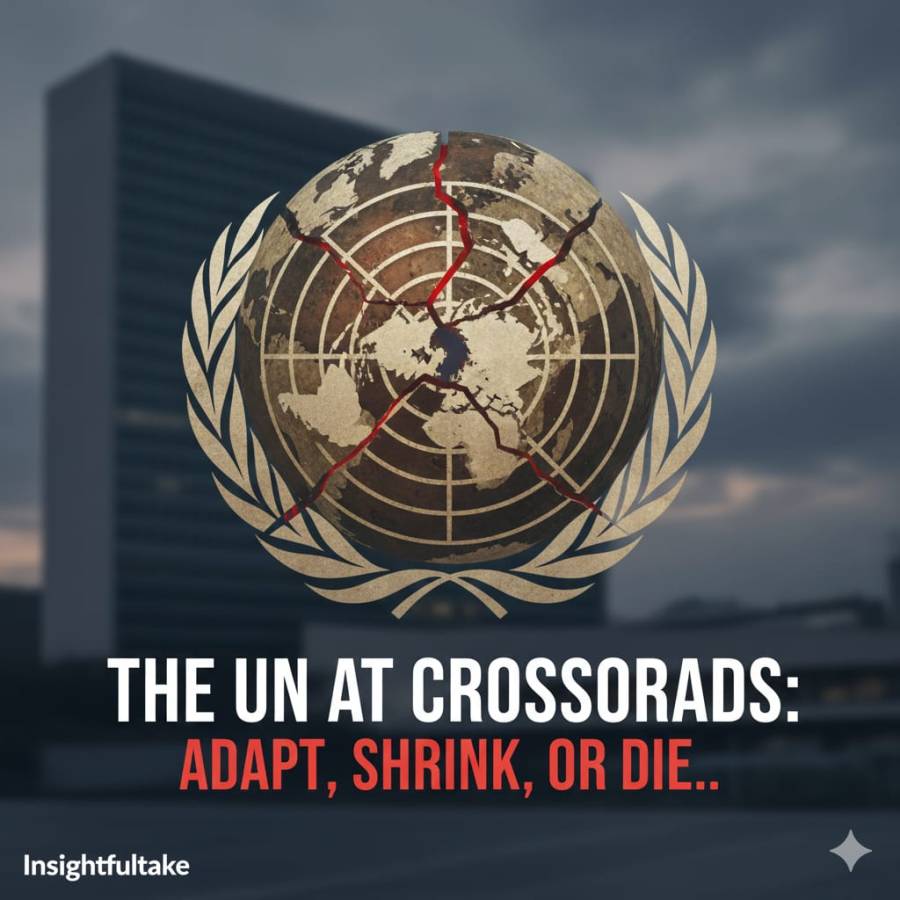
Since 1945, the United Nations has stood as the primary pillar of international cooperation, acting as a safety net for the world’s most vulnerable. However, a sharp policy shift in Washington is currently threatening the very foundations of this global institution. A recent $2 billion pledge from the United States, accompanied by a chilling warning for UN agencies to “adapt, shrink, or die,” has sent shockwaves through the halls of diplomacy in Geneva and New York.
While $2 billion sounds like a staggering sum, in the context of global humanitarian aid, it represents a radical downsizing. To understand the gravity of this moment, we must look beyond the numbers and examine the changing philosophy of international politics.
The New Reality of “Conditioned Charity”
Historically, the United States has been the UN’s largest benefactor, with contributions sometimes reaching as high as $17 billion annually. The current administration’s decision to pivot toward a $2 billion “umbrella fund” marks a departure from traditional, broad-based funding.
The strategy is clear, and Washington is no longer interested in writing a blank check. Instead, it is moving toward a “spigot” model, where funds are tightly controlled and distributed based on specific U.S. demands and performance metrics. This “humanitarian reset,” as described by U.S. Ambassador Michael Waltz, aims to align aid with national foreign policy goals rather than global consensus.
For the UN, this is an existential challenge. If the “spigot” only opens for programs that serve the interests of a single superpower, the UN risks losing its status as a neutral, universal arbiter of human rights and relief.
The “Adapt, Shrink, or Die” Dilemma
The ultimatum given to UN agencies “to adapt, shrink, or die” is a reflection of a growing “America First” sentiment that views international organizations with skepticism. Critics of the UN have long argued that the body is bloated, bureaucratic, and occasionally inefficient. From this perspective, the funding cuts are a “tough love” approach designed to force long-overdue reforms.
However, the “shrink” part of the mandate has immediate, real-world consequences. UN agencies like those handling refugees (UNHCR), food security (WFP), and migration (IOM) operate on thin margins. When billions are slashed from budgets, it isn’t just “bureaucracy” that disappears; it is food shipments to famine-stricken regions, medical supplies for war zones, and shelter for those fleeing persecution.
Will the UN Die?
It is unlikely the United Nations will “die” in the literal sense. It remains the only forum where every nation has a seat at the table. However, it faces the very real risk of becoming a “zombie organization”—a body that exists on paper but lacks the financial muscle to enact meaningful change.
If the UN cannot find a way to diversify its funding, it will become increasingly beholden to the whims of a few wealthy donors. We are seeing a shift from multilateralism (where nations work together toward common goals) to transnationalism (where aid is traded for political loyalty).
A Fresh Perspective: The Rise of a Multi-Polar Humanitarian World
While the U.S. pullback creates a massive vacuum, it also presents an opportunity for a “fresh perspective” in international politics. For too long, the world has relied almost exclusively on Western taxpayers to fund global stability.
- The Rise of New Donors: To survive, the UN must look toward emerging economies like China, India, and the Gulf States. If these nations step up to fill the funding gap, the power balance within the UN will shift, potentially making the organization more representative of the modern world, rather than the post-WWII era.
- Efficiency over Ideology: The UN does need to adapt. By embracing technology, reducing overhead, and proving “results-driven assistance,” the body can make a stronger case for its relevance to skeptical taxpayers worldwide.
- Regional Solutions: We may see a move away from a centralized UN toward regional bodies (like the African Union or ASEAN) taking more responsibility for their own humanitarian crises, funded by local wealth.
Final Take
The US warning to “adapt, shrink, or die” is a turning point in history. While the immediate outlook for humanitarian workers is grim, marked by job losses and program cuts, the long-term survival of the UN depends on its ability to evolve.
The UN will not die, but the version of the UN we have known for 80 years is fading away. What emerges next will either be a leaner, more efficient engine for global good, or a fragmented system where aid is used as a political weapon. The “financial reality” has arrived; now, the world must decide if it can afford a world without a functional United Nations.








Leave a Comment