
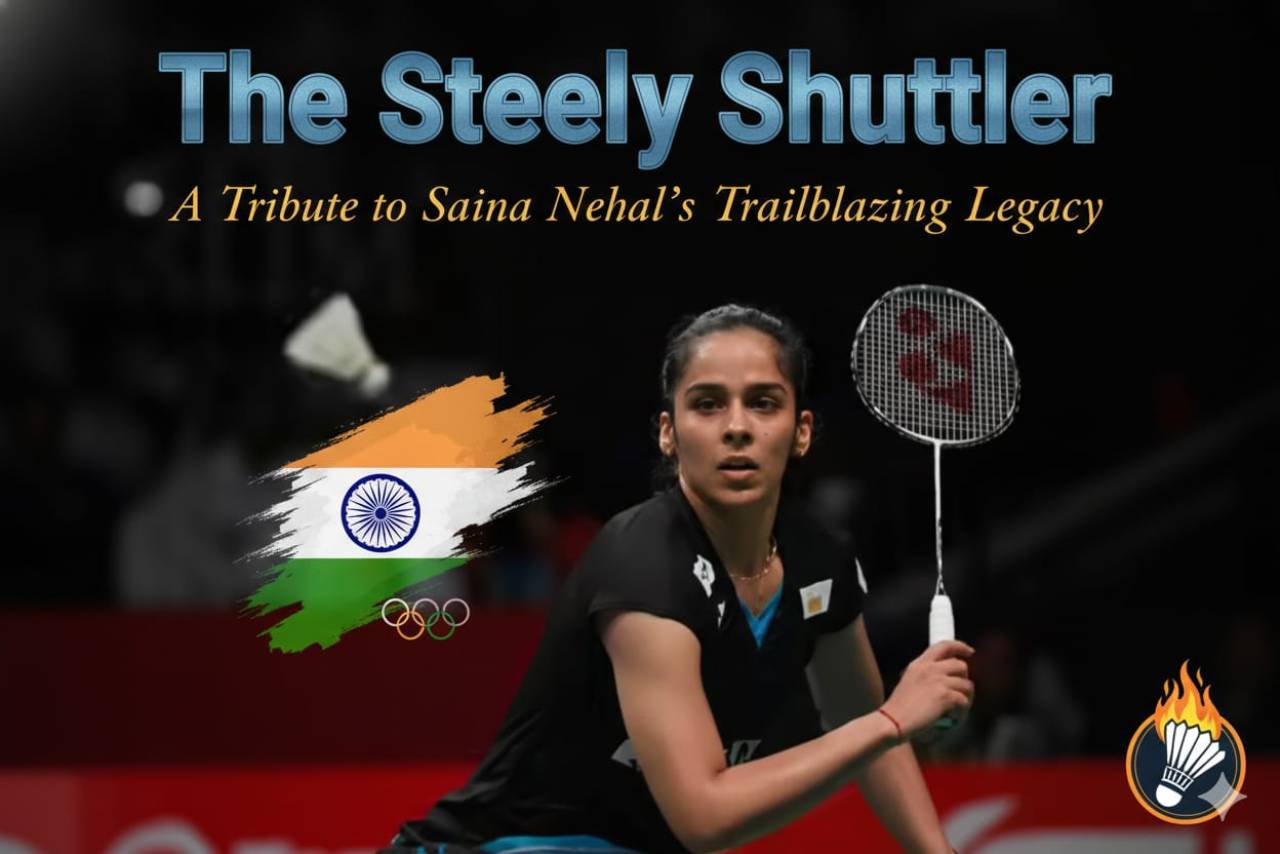
Before Saina Nehwal, India hoped. After her, India expected to win.
For nearly two decades, the sound of a shuttlecock meeting a racquet at high velocity was synonymous with one name in India: Saina Nehwal. On January 19, 2026, the woman who single-handedly altered the DNA of Indian badminton finally hung up her racquets. In a poignant revelation, she admitted that her body—specifically a "degenerating" knee and the onset of arthritis—could no longer sustain the nine-hour daily grind required to be the best in the world.
While the news marks the end of an era, Saina’s departure isn't a retreat; it is a final, quiet bow from a warrior who had already conquered her Everest.
The Girl Who Broke the Glass Ceiling
Before Saina, badminton in India was a sport of "what ifs." There were flashes of brilliance from the legendary Prakash Padukone and Pullela Gopichand, but for the most part, the world stage was dominated by the "Great Wall" of China and Southeast Asian giants.
Saina, born in Hisar and raised in Hyderabad, didn't just compete with them; she dismantled the aura of invincibility surrounding them. Her breakthrough at the 2008 Beijing Olympics, where she became the first Indian woman to reach a quarterfinal, was the first tremor. By 2009, when she clinched the Indonesia Open, she became the first Indian to win a BWF Super Series title. Suddenly, an entire nation realized that an Indian girl from Haryana could not only play with the world’s best but could stand atop the podium.
London 2012: The Moment of Immortality
If 2008 was the promise, 2012 was the fulfillment. At the London Olympics, Saina Nehwal did what no Indian shuttler had ever done: she won an Olympic medal. That Bronze was more than just metal; it was a cultural shift. It proved that Olympic glory wasn't a fluke reserved for a few.
Watching Saina navigate the grueling rounds in London—with her signature grit, the steely "come on!" after every winning point, and her relentless court coverage—inspired a generation. It is no exaggeration to say that the "Badminton Revolution" in India, which later produced stars like PV Sindhu and Lakshya Sen, was built on the foundation Saina laid.
A Career of "Firsts"
Saina’s resume reads like a history book of Indian sports. She wasn't just a player; she was a pioneer of "firsts":
- First Indian woman to become World No. 1 (2015).
- First Indian to win the World Junior Championships (2008).
- First Indian to win two Commonwealth Games Singles Gold medals (2010, 2018).
- First Indian to reach the final of the BWF World Championships (2015).
The Quiet Exit of a Giant
The last two years were a test of a different kind. A chronic knee injury sustained during the Rio 2016 Olympics never truly left her. In her retirement confirmation, Saina spoke with a raw honesty that reflected her playing style: "Your cartilage has totally degenerated... I just felt my time was up because I couldn’t push much."
She chose to leave without a grand farewell ceremony, believing that her absence from the court for two years had already told the story. It was an exit on her own terms—unfussy, realistic, and dignified.
"I actually felt that I entered the sport on my own terms and left on my own terms, so there was no need to announce it." — Saina Nehwal
The Legacy Beyond the Court
Saina Nehwal’s impact cannot be measured solely by her 24+ international titles or her Padma Bhushan. Her true legacy lies in the badminton academies overflowing with young girls across India, the increased television ratings for the sport, and the shift in the Indian sporting psyche from being "happy to participate" to "hungry to win."
She taught India that grit is a talent in itself. She wasn't always the most naturally gifted athlete on the court, but she was almost always the hardest worker. Her rivalry with the Chinese "trio" of Wang Yihan, Wang Shixian, and Li Xuerui is the stuff of legend.
Final Take
As Saina transitions into this new chapter, Indian sports fans will remember her not for the injury that ended her career, but for the fire she ignited. She was the pioneer who proved that an Indian woman could be the best in the world.
The courts may be quieter without her fierce "come on!", but the echoes of her triumphs will resonate in every smash hit by an Indian shuttler for decades to come. Thank you, Saina, for teaching us how to win.











Leave a Comment