
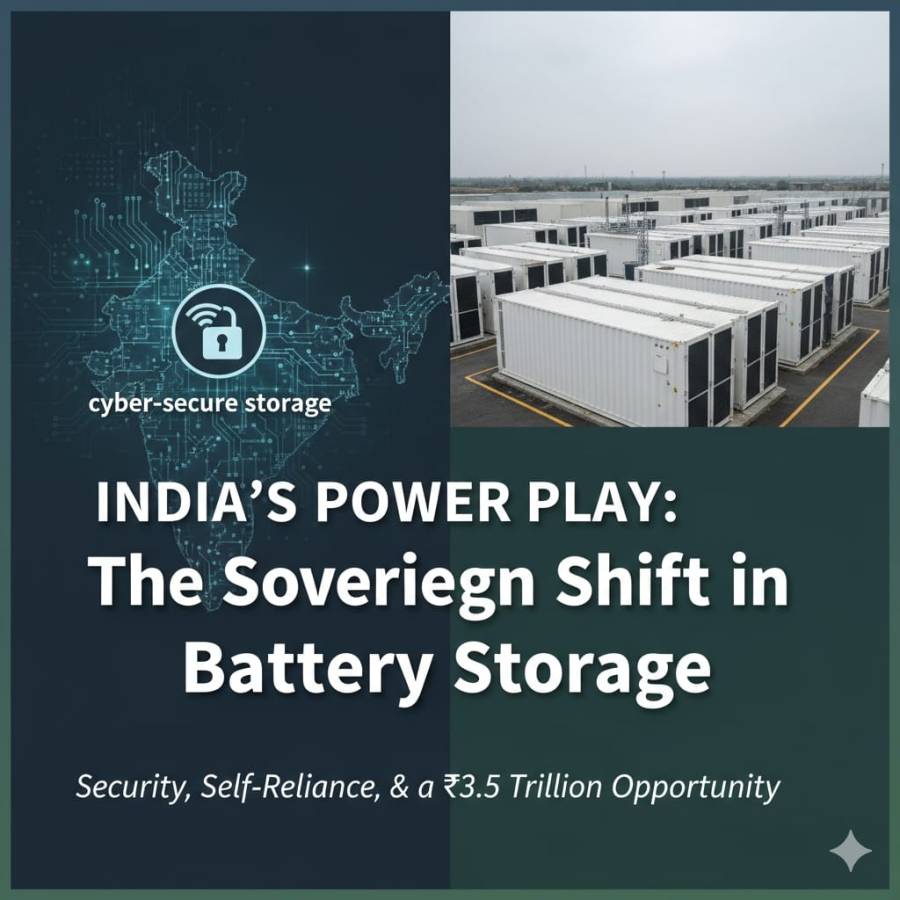
A fundamental shift is underway in India’s power sector—one that is less visible than new solar parks or gigafactories, yet far more strategic in the long run. For years, India’s energy transition discourse revolved around scale: cheaper solar modules, larger manufacturing capacities, and the elusive goal of domestic lithium-ion cell production. Today, the focus is quietly but decisively moving elsewhere—from the imported chemistry of battery cells to the trustworthiness and control of the systems that manage them.
Recent government proposals to mandate up to 50% local content in Battery Energy Storage Systems (BESS) mark this inflection point. This is not merely an extension of the “Make in India” framework. It reflects a deeper recognition that in a digitised power grid, energy security is inseparable from cyber security and system integrity. India’s pivot is not away from batteries, but toward owning the intelligence that governs them.
Why the Grid’s ‘Brain’ Matters More Than Its Chemistry
Battery cells remain the most visible and capital-intensive part of any storage system. Yet they are also the most globally concentrated, dependent on raw materials and supply chains that India does not currently control. Acknowledging this reality, policymakers have chosen a more pragmatic and arguably more strategic route.
The proposed localisation mandate deliberately excludes battery cells for now. Instead, it targets the Energy Management System (EMS), power electronics, inverters, control software, and structural containers—the components that determine how energy is stored, dispatched, protected, and secured.
This focus is driven by a stark operational truth: a modern power grid is only as resilient as its weakest digital link. With reports suggesting that India’s national grid faces dozens of cyber intrusion attempts every day, the Ministry of Power is increasingly treating unverified foreign hardware and software as a systemic risk. In this context, localisation is no longer an industrial incentive; it is a security imperative.
For developers and EPC players, the signal is unambiguous. The era of plug-and-play imports in critical energy infrastructure is drawing to a close. Trust, traceability, and domestic accountability are becoming as important as cost efficiency.
The ₹3.5 Lakh Crore Opportunity Hidden in Plain Sight
India’s ambition to deploy 47GW of battery energy storage by 2032 will require investments estimated at ₹3.5 lakh crore. While much of the public conversation still fixates on cell manufacturing, the policy shift opens a substantial opportunity in areas that collectively account for 35–40% of total BESS costs.
|
Component |
Local Focus & Opportunity |
|
Software (EMS) |
Indigenous platforms; grid-balancing, forecasting, and dispatch software by Indian firms. |
|
Power Electronics |
Inverters and converters; domestic PCB assembly and semiconductor integration. |
|
System Integration |
Containers and thermal systems; growth for industrial enclosures and HVAC firms. |
This approach closely mirrors the solar sector’s Approved List of Models and Manufacturers (ALMM) framework. By creating a trusted vendor ecosystem, the government is effectively ensuring that a significant share of future capital expenditure remains within India—while simultaneously reducing exposure to opaque supply chains.
Short-Term Friction, Long-Term Control
The transition, however, will not be frictionless. Developers are understandably concerned about costs. Localisation often brings a short-term premium, especially when domestic manufacturers lack the scale efficiencies of global incumbents. Project tariffs may face upward pressure before supply chains mature.
Yet focusing solely on near-term costs risks missing the larger shift in value creation. As renewable penetration increases, the grid’s needs are evolving—from mere capacity addition to real-time balancing, resilience, and intelligent dispatch. In this environment, value is migrating toward system integration, software, and services, not just hardware.
For Indian businesses, waiting for a perfect, fully indigenous battery cell ecosystem may be a strategic misstep. The more immediate and defensible opportunity lies in dominating the integration and intelligence layers of storage.
As India’s grid becomes more decentralised, the ability to deliver cyber-secure, domestically verified storage systems will emerge as a key competitive differentiator for Indian EPC and system integrators.
A Quiet but Consequential Reset
India’s march toward 47GW of storage capacity is not simply a race to deploy hardware. It is a race to build trust—in software, in systems, and in the resilience of the national grid. The silent pivot away from dependence on imported cells toward trusted, indigenous systems reflects a mature understanding of what energy sovereignty truly demands.
For companies willing to invest in control systems, cybersecurity, and intelligent integration, this shift may prove far more rewarding than the chase for scale alone. In India’s evolving power sector, the future belongs not just to those who store energy—but to those who control it securely and intelligently.

























Leave a Comment