
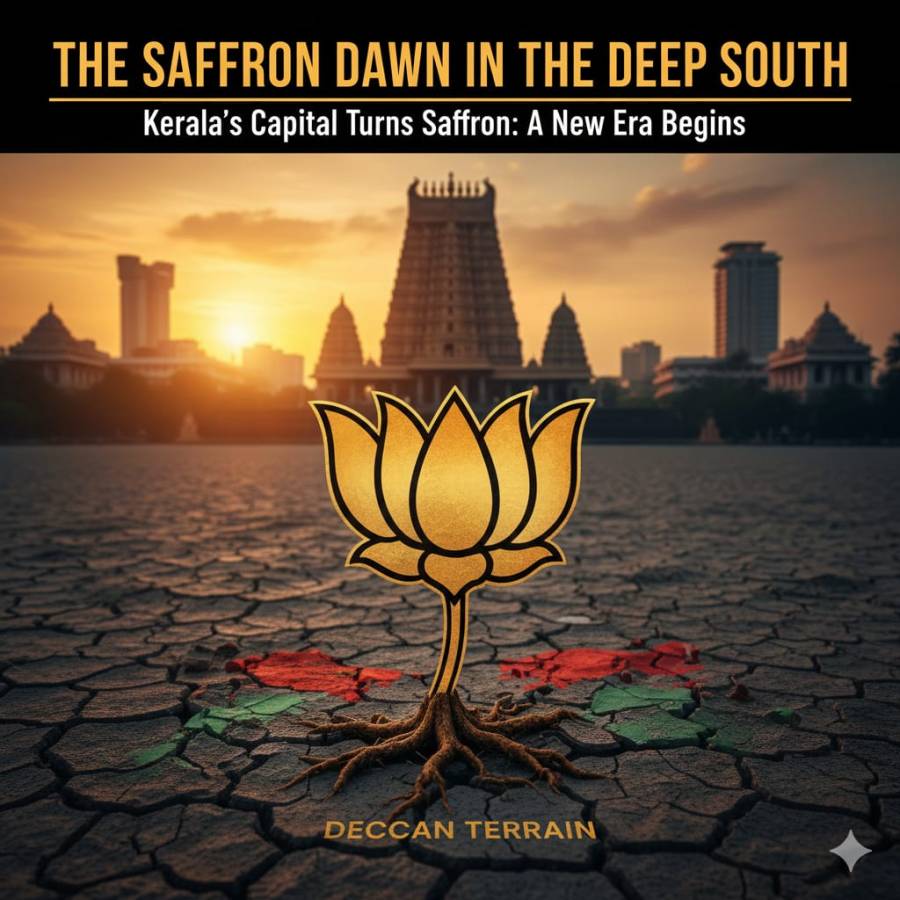
For decades, the political landscape of Kerala was a fortress of bipolarity, a seesaw between the red of the Left and the tricolor of the Congress. To many, the state’s socio-political fabric—woven with high literacy, strong secular traditions, and a significant minority population—seemed like a "Deccan shield" that would forever repel the Hindutva tide.
That narrative was shattered on December 26, 2025. With the swearing-in of V.V. Rajesh as the first-ever BJP Mayor of the Thiruvananthapuram Corporation, the "saffronization" of the deep south is no longer a distant prophecy—it is a governing reality.
Breaking the 45-Year Red Wall
The victory in the capital is a seismic event. By winning 50 of the 101 seats and securing the Mayor’s post with the help of a strategic independent vote, the BJP has dismantled a four-decade-long hegemony held by the Left Democratic Front (LDF).
This isn't just about winning a city; it’s about capturing the nerve center of the state. Thiruvananthapuram is where policy is made, where the bureaucracy lives, and where the intellectual discourse of Kerala is anchored. By planting the lotus here, the BJP has moved from being a "party of protest" to a "party of governance" in the eyes of the Malayali voter.
The Blueprint: How the Terrain was Tamed
The BJP’s expansion into this traditionally resistant terrain was not an accident of fate, but the result of a deliberate, multi-pronged strategy:
The Micro-Management of Faith: Moving beyond grand national slogans, the party localized its "defender of faith" identity. During the Sabarimala crisis, the party acted as a lightning rod for Hindu grievances, but more recently, it has transitioned into a more sophisticated "cultural preservation" narrative that resonates with the traditional middle class of the south.
The "Development Plus" Narrative: Under the leadership of figures like Rajeev Chandrasekhar, the party pivoted toward urban efficiency. By highlighting the decay in infrastructure and waste management under previous regimes, they convinced the Thiruvananthapuram electorate that "Delhi’s speed" could be brought to the Deccan coast.
Tactical Social Engineering: In a masterstroke of southern politics, the BJP began blurring the lines between its core base and other communities. The outreach to the Ezhava community and the surprising "silent support" from sections of the Christian community—driven by shared concerns over demographic shifts—provided the necessary arithmetic to cross the finish line.
From the Coast to the Hinterlands
The "spread of wings" is now visible beyond the capital. The 2025 local body results show the BJP emerging as the principal opposition in several municipalities across the southern districts of Kollam and Pathanamthitta.
Unlike the northern "Malabar" region, where religious polarities are more rigid, the "Deccan terrain" of southern Kerala offers a unique opportunity: a high density of Hindu voters who are increasingly disillusioned with the traditional duopoly. The BJP is betting that the Thiruvananthapuram model—combining hyper-local governance with a strong ideological backbone—can be replicated in every municipality from Kanyakumari to Kochi.
The Road to 2026
Prime Minister Narendra Modi’s description of this win as a "watershed moment" serves as a warning to the LDF and UDF. The party is no longer content with being the "third player" that merely spoils the vote share.
With V.V. Rajesh at the helm of the capital’s corporation, the BJP now has a year-long "live demonstration" period. If they can transform Thiruvananthapuram into a showcase of the "Double Engine" model, the 2026 Assembly elections could witness the lotus blooming not just in the capital, but across the entire southern corridor of the state.
"The political change in Thiruvananthapuram will change the entire political situation in Kerala," Mayor V.V. Rajesh declared shortly after taking his oath. For the first time in history, the Deccan terrain is listening.





















Leave a Comment