

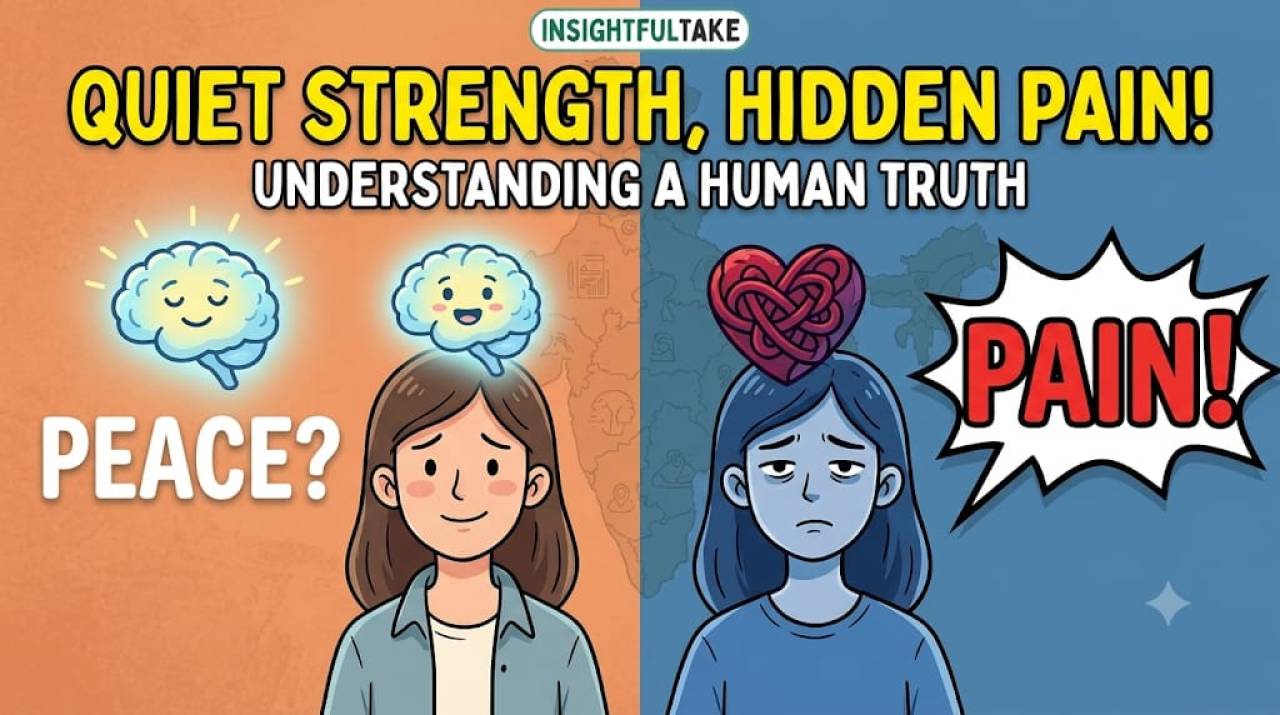
Loneliness doesn’t just leave you alone—it quietly changes how your mind speaks to you, and who you believe yourself to be.
Loneliness is often described as a missing presence — an empty chair, a silent phone, the absence of a familiar voice. We tend to treat it as a temporary emotional discomfort, something that will pass once life becomes busy again. But loneliness has a deeper effect than we usually admit. When it lingers, it does not merely hurt the heart; it reshapes the way we think, feel, and relate to ourselves.
Prolonged loneliness quietly places the mind in a state of alert. Without realizing it, our thoughts become sharper, more suspicious, and less forgiving. Small worries feel heavier. Self-doubt grows louder. The inner voice that once felt neutral or kind can turn harsh. It is not because we are weak, but because the human mind was never designed to exist without reflection from others.
Science now confirms what many have felt privately for years. Chronic loneliness activates the brain’s threat systems, making us constantly scan for rejection or danger. At the same time, the parts of the brain that respond to warmth, reward, and connection begin to dull. Over time, even positive interactions may feel less satisfying. This creates a painful loop: we crave connection, yet feel exhausted or disconnected when it appears.
What is rarely spoken about, however, is how loneliness changes our relationship with ourselves. When external reassurance fades, we are left alone with our thoughts — unfiltered, unsoftened by conversation. In that silence, old insecurities echo more clearly. Questions we once ignored rise to the surface. Am I enough? Do I matter when no one is watching?
Interestingly, this is not a new human experience. Long before modern psychology gave it names, spiritual traditions understood loneliness as a threshold. Monks, mystics, and seekers across cultures deliberately stepped away from society, not because solitude was comfortable, but because it was revealing. They believed that when distractions fall away, the self stands exposed — fragile, restless, but honest.
Modern research quietly supports this ancient idea. Sitting with discomfort, without immediately escaping it, strengthens emotional regulation and self-awareness. Loneliness, when faced rather than avoided, can begin to loosen the grip of our thoughts. We start to notice that not every fear is a truth, and not every inner criticism deserves belief.
Literature has always mirrored this journey. Characters cast into isolation — whether on deserted islands or emotional exile — often discover that their greatest struggle is not survival, but identity. Without society to reflect them back, they are forced to ask who they are beneath roles, labels, and expectations. Some break under this weight. Others emerge changed, quieter, but clearer.
The wisdom here is not to romanticize loneliness. It can be deeply painful, and prolonged isolation should never be dismissed. But there is a difference between running from loneliness and listening to it. The discomfort it brings is not always a verdict on our worth; often, it is a signal that the mind is under strain and longing for balance.
Small acts matter more than grand solutions. A brief conversation, a shared smile, or a moment of presence can gently remind the brain that connection still exists. At the same time, choosing moments of intentional solitude — a walk without distraction, a few lines written honestly, a pause without judgment — can turn loneliness into self-acquaintance rather than self-attack.
Loneliness makes us uncomfortable because it strips away the noise. It introduces us to parts of ourselves we rarely meet — uncertain, unpolished, and deeply human. Yet that unfamiliar presence within is not an enemy. It is the beginning of understanding.
Sometimes, the path back to the world quietly begins with learning how to sit kindly with oneself.




















Leave a Comment