
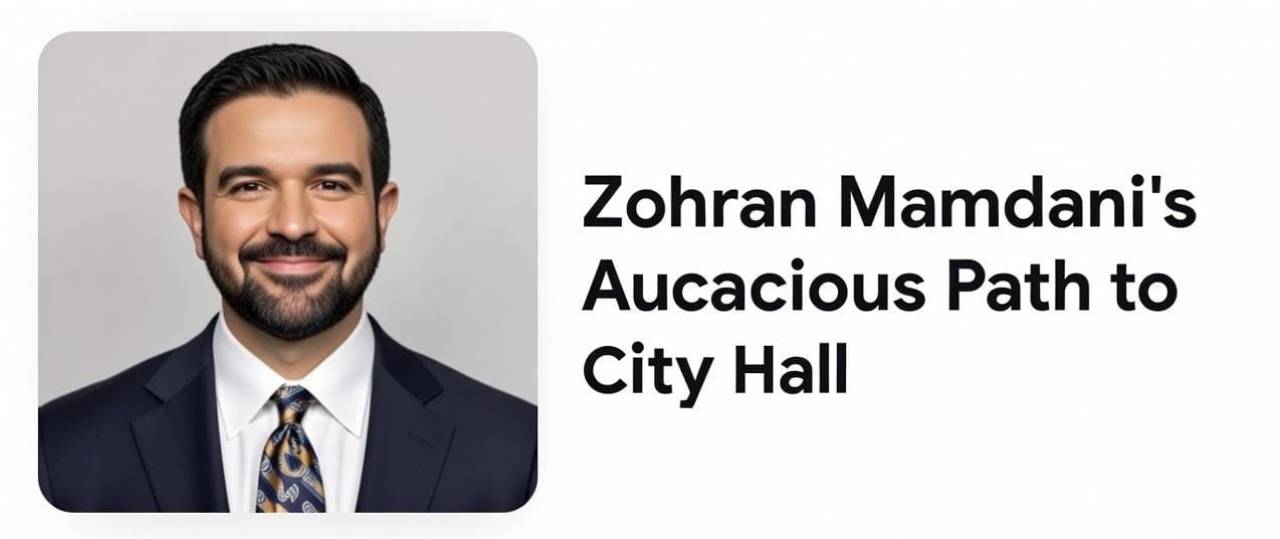
On the stroke of midnight, in the echo of a decommissioned Beaux-Arts subway station, a new era for New York City began. Zohran Mamdani, a 34-year-old Democratic Socialist and former foreclosure prevention counselor, took the oath of office as the 112th Mayor of New York City. Sworn in with his hand on a Quran, Mamdani has made history as the city’s first Muslim mayor, its first South Asian mayor, and the youngest person to lead the metropolis in over a century.
His victory is not merely a change in personnel but a decisive reordering of the political landscape in the world’s financial capital.
A Radical Departure: Governing "Expansively and Audaciously"
The imagery of Mamdani’s inauguration—holding the ceremony in a subway station rather than a grand ballroom—was a deliberate signal of his "working-class first" agenda. Backed by progressive icons like Senator Bernie Sanders and Representative Alexandria Ocasio-Cortez, Mamdani’s platform is built on a "politics of consistency" that challenges the very foundations of New York’s capitalist identity.
His primary focus is an aggressive attack on the city's affordability crisis. Key pillars of his administration include:
- The Four-Year Rent Freeze: Targeting nearly one million rent-stabilized apartments to provide immediate relief to the city's bedrock working class.
- Fare-Free Transit: A plan to eliminate fares on every city bus, coupled with the rapid construction of priority bus lanes to combat "spatial stratification."
- Public Housing Revolution: A commitment to build 200,000 new units of union-built, permanently affordable social housing, inspired by the Vienna model.
- Economic Redistribution: Funding these ambitious projects through progressive taxation on the city's wealthiest residents and large corporations.
Why It Matters: The Indian and Diaspora Perspective
For the Indian diaspora and observers in India, Mamdani’s rise offers a complex and multi-layered narrative. He is the son of celebrated filmmaker Mira Nair and postcolonial academic Mahmood Mamdani—roots that resonate deeply with the global South Asian community.
1. A New Model for Political Mobilization
Mamdani’s campaign was a masterclass in grassroots organizing. By releasing videos in Urdu and Bengali and focusing on neighborhoods like Jackson Heights (Little India) and Kensington (Little Bangladesh), he tapped into a "silent majority" of South Asian voters who have often felt ignored by the political establishment. For the diaspora, this represents a shift from being a "donor class" to becoming a decisive "voter class."
2. Challenging the Monolith
His victory highlights that Indian-American political identity is not monolithic. While some celebrate his success as a win for representation, others—particularly within Hindu nationalist circles—have expressed concern over his vocal criticism of the BJP government and his pro-Palestinian stance. For the diaspora, Mamdani represents a generational break, where identity is tied less to the politics of the "motherland" and more to local economic justice and global progressive solidarity.
3. Lessons for Indian Domestic Politics
In India, where opposition parties often struggle to counter emotive nationalism with a cohesive economic message, Mamdani’s success offers a case study. His campaign proved that a clear, passionate focus on "bread and butter" issues—rent, transportation, and wages—can mobilize youth and overcome even the most entrenched political dynasties.
The Daunting Task Ahead
Despite the celebratory mood, Mamdani faces a "daunting task." He enters office with a Republican President, Donald Trump, who previously threatened to withhold federal funding. Although their recent Oval Office meeting was described as "cordial," the ideological gap remains a chasm.
Furthermore, the New York business community remains skeptical. Real estate leaders warn that aggressive rent freezes and tax hikes could lead to an exodus of capital. Mamdani’s ability to balance his "audacious" socialist goals with the pragmatic realities of running a global financial hub will be the ultimate test of his mayoralty.
Mamdani is trying to redefine what a city owes its people. As he told the crowds at City Hall, "No longer will City Hall hesitate to use its power to improve New Yorkers' lives." For a city that never sleeps, the next four years will be anything but quiet.
By Gautam Jha
Managing Editor
















Leave a Comment