
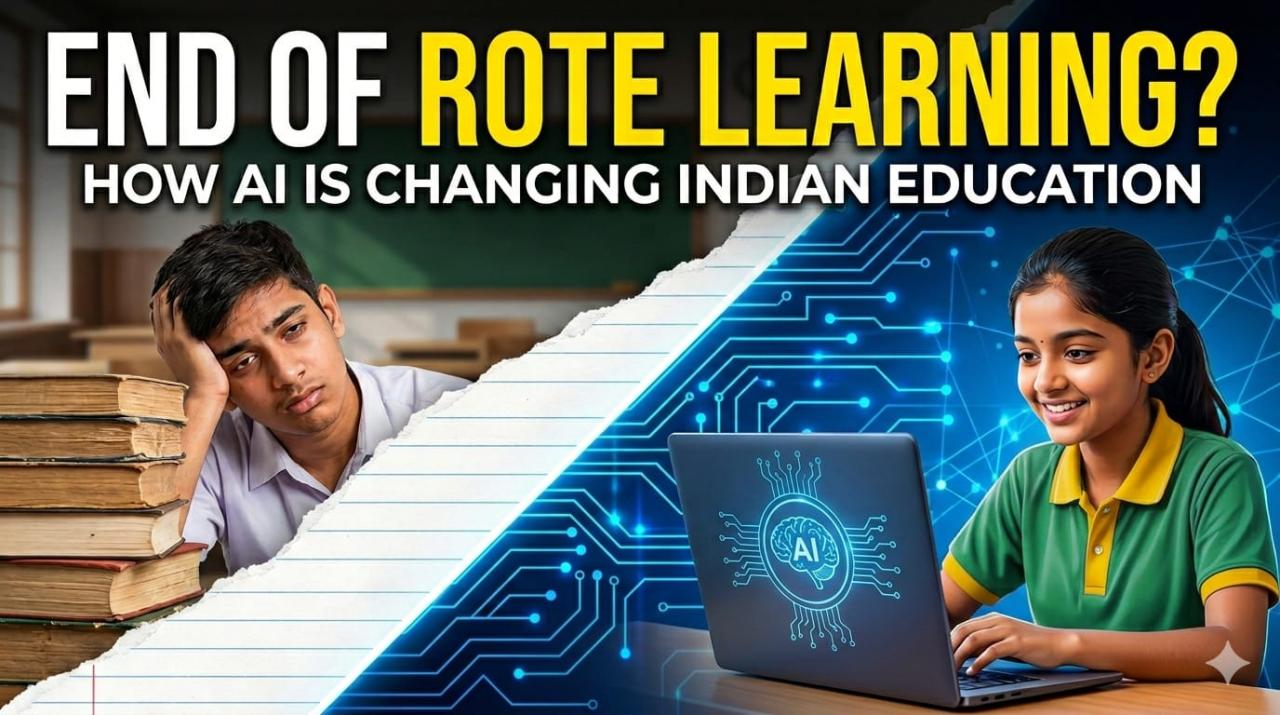
Marks may have once belonged to memory—but the future belongs to minds that question, analyse, and truly understand.
For generations of Indian students, education has followed a familiar pattern. Textbooks were memorised line by line, answers were practised repeatedly, and success depended on how well one could reproduce content in exams. This method helped many score high marks, but it often failed to build real understanding. As Artificial Intelligence (AI) enters classrooms, this long-standing culture of rote learning is beginning to face a serious challenge.
Rote learning is based on repetition rather than reasoning. Students remember formulas, definitions, and dates without always understanding their meaning or use. Once exams are over, much of this information fades away. More importantly, when students face unfamiliar problems, they struggle to apply what they have learnt. This gap between learning and thinking has limited creativity and problem-solving skills for years.
AI offers a different way forward. Unlike traditional classroom methods that treat all students alike, AI allows learning to become personalised. AI-based systems can track how a student learns, where they make mistakes, and how quickly they grasp ideas. Based on this, lessons can be adjusted to suit individual needs. A student who finds a topic difficult can receive simpler explanations and extra practice, while a faster learner can move ahead without waiting for the rest of the class.
This change shifts learning from memorisation to understanding. In science, students can use simulations to see how laws and concepts work instead of just reading about them. In mathematics, AI tools can break down problems step by step, helping students understand the logic behind solutions. In subjects like history or geography, learning becomes about connections and causes, not just dates and facts. Such experiences encourage curiosity and questioning, which rote learning often discourages.
India’s education system is slowly adapting to this change. Recent reforms emphasise conceptual learning, skill development, and critical thinking. The focus is moving away from marks alone and towards real understanding. AI and digital tools are being introduced as support systems to help achieve these goals. This shift is important because today’s world values skills like problem-solving, communication, and adaptability more than simple memory.
Teachers also stand to benefit from AI. Many routine tasks such as checking objective answers, tracking progress, or identifying learning gaps can be handled by technology. This frees teachers to spend more time explaining concepts, guiding discussions, and supporting students emotionally and academically. The teacher’s role becomes less about finishing the syllabus and more about shaping young minds.
At the same time, it is important to be cautious. AI cannot replace human interaction in classrooms. Education is not only about information but also about values, discipline, teamwork, and empathy. These qualities develop through conversation, debate, and shared experiences. AI should assist teachers, not replace them. When used carefully, it can strengthen learning rather than weaken it.
There are also practical challenges. Not all students have equal access to digital devices or reliable internet. Many rural and underprivileged areas still face basic infrastructure problems. Concerns about data privacy, excessive screen time, and over-dependence on technology must also be addressed. For AI to truly improve education, these gaps must be reduced through thoughtful policies and public investment.
Despite these challenges, the direction of change is clear. The future of education cannot depend only on memorisation. Information is easily available today. What matters more is how students understand, analyse, and use that information. AI supports this shift by encouraging active learning rather than passive repetition.
As AI becomes more common in Indian classrooms, rote learning is likely to lose its central role. Exams will also need to change, focusing more on application and reasoning. This transition may be slow, but it is necessary. An education system that values thinking over memorising will better prepare students for life beyond exams.
In the end, AI offers India a chance to correct a long-standing weakness in its education system. By moving away from rote learning and towards meaningful understanding, education can become more relevant and empowering. When students are trained to think, not just remember, learning becomes a foundation for growth — not just a test of memory.
For generations of Indian students, education has followed a familiar pattern. Textbooks were memorised line by line, answers were practised repeatedly, and success depended on how well one could reproduce content in exams. This method helped many score high marks, but it often failed to build real understanding. As Artificial Intelligence (AI) enters classrooms, this long-standing culture of rote learning is beginning to face a serious challenge.
Rote learning is based on repetition rather than reasoning. Students remember formulas, definitions, and dates without always understanding their meaning or use. Once exams are over, much of this information fades away. More importantly, when students face unfamiliar problems, they struggle to apply what they have learnt. This gap between learning and thinking has limited creativity and problem-solving skills for years.
AI offers a different way forward. Unlike traditional classroom methods that treat all students alike, AI allows learning to become personalised. AI-based systems can track how a student learns, where they make mistakes, and how quickly they grasp ideas. Based on this, lessons can be adjusted to suit individual needs. A student who finds a topic difficult can receive simpler explanations and extra practice, while a faster learner can move ahead without waiting for the rest of the class.
This change shifts learning from memorisation to understanding. In science, students can use simulations to see how laws and concepts work instead of just reading about them. In mathematics, AI tools can break down problems step by step, helping students understand the logic behind solutions. In subjects like history or geography, learning becomes about connections and causes, not just dates and facts. Such experiences encourage curiosity and questioning, which rote learning often discourages.
India’s education system is slowly adapting to this change. Recent reforms emphasise conceptual learning, skill development, and critical thinking. The focus is moving away from marks alone and towards real understanding. AI and digital tools are being introduced as support systems to help achieve these goals. This shift is important because today’s world values skills like problem-solving, communication, and adaptability more than simple memory.
Teachers also stand to benefit from AI. Many routine tasks such as checking objective answers, tracking progress, or identifying learning gaps can be handled by technology. This frees teachers to spend more time explaining concepts, guiding discussions, and supporting students emotionally and academically. The teacher’s role becomes less about finishing the syllabus and more about shaping young minds.
At the same time, it is important to be cautious. AI cannot replace human interaction in classrooms. Education is not only about information but also about values, discipline, teamwork, and empathy. These qualities develop through conversation, debate, and shared experiences. AI should assist teachers, not replace them. When used carefully, it can strengthen learning rather than weaken it.
There are also practical challenges. Not all students have equal access to digital devices or reliable internet. Many rural and underprivileged areas still face basic infrastructure problems. Concerns about data privacy, excessive screen time, and over-dependence on technology must also be addressed. For AI to truly improve education, these gaps must be reduced through thoughtful policies and public investment.
Despite these challenges, the direction of change is clear. The future of education cannot depend only on memorisation. Information is easily available today. What matters more is how students understand, analyse, and use that information. AI supports this shift by encouraging active learning rather than passive repetition.
As AI becomes more common in Indian classrooms, rote learning is likely to lose its central role. Exams will also need to change, focusing more on application and reasoning. This transition may be slow, but it is necessary. An education system that values thinking over memorising will better prepare students for life beyond exams.
In the end, AI offers India a chance to correct a long-standing weakness in its education system. By moving away from rote learning and towards meaningful understanding, education can become more relevant and empowering. When students are trained to think, not just remember, learning becomes a foundation for growth — not just a test of memory.




















Leave a Comment