
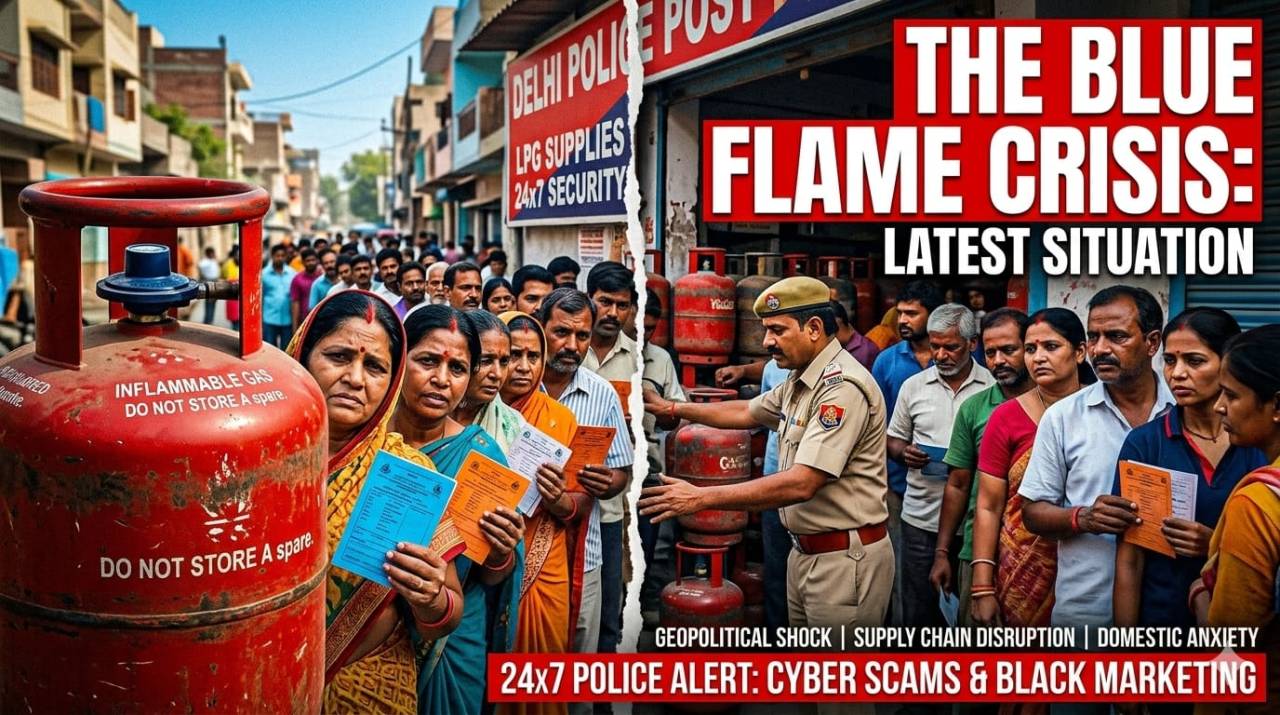
When the blue flame in India’s kitchens begins to flicker, it is no longer just a household inconvenience—it is a warning signal of how global conflicts can reach the very heart of everyday life.
The rhythmic clinking of iron cylinders, once a mundane soundtrack to Indian mornings, has taken on a frantic, metallic urgency. In the heart of New Delhi, the air is thick not just with the usual smog but with a palpable sense of anxiety. From the narrow alleys of Chandni Chowk to the sprawling high-rises of Gurugram, the “Blue Flame”—the humble LPG cylinder—has suddenly become the most sought-after commodity in the country.
As of mid-March 2026, India finds itself navigating a perfect storm: a geopolitical firestorm in West Asia that has choked supply lines, a domestic surge in panic buying, and a predatory wave of cyber scammers looking to profit from empty kitchens.
The Frontline: Police at the Godowns
The crisis reached a tipping point this week when the Delhi Police took the extraordinary step of cancelling all routine leaves for its personnel. In an order that feels more suited to a national security threat than a fuel shortage, the Ministry of Home Affairs directed round-the-clock deployment outside LPG godowns, refilling stations, and warehouses.
“We aren’t just managing traffic; we are managing desperation,” says a beat officer stationed near a distribution centre in East Delhi. “People are arriving at 4:00 AM. There is a fear that if they don’t get a refill today, they might not get one for a month.”
While the government maintains there is no complete dry-out at distributorships, the scenes on the ground tell a story of frayed tempers. In Old Delhi, long queues of residents clutching blue booklets have become permanent fixtures. Many claim that online booking servers are lagging and calls to local agencies go unanswered, forcing them to stand for hours in the heat.
The Global Trigger: The West Asia Domino Effect
The root of the crisis lies thousands of miles away. The ongoing conflict in West Asia has severely disrupted maritime lifelines through the Strait of Hormuz—a vital artery for India’s energy imports.
The Supply Gap by the Numbers
- Import Dependency: India imports roughly 42–44% of its LPG requirements.
- The Hormuz Hurdle: Nearly 60% of these imports pass through the Strait of Hormuz, primarily from Qatar and the United Arab Emirates.
- Panic Surge: Daily LPG bookings have surged from 55.7 lakh to over 88.8 lakh per day, as households rush to secure backup cylinders.
Union Minister for Petroleum and Natural Gas, Hardeep Singh Puri, recently assured Parliament that domestic production has been ramped up by 28% to compensate.
However, energy experts note that this domestic boost covers only 10–12% of the total consumption gap, leaving a large portion of India’s supply chain under high-alert “force majeure” conditions.
The Shadow Crisis: Black Markets and Cyber Bots
Where scarcity appears, opportunists follow.
The Delhi Police Crime Branch and the Delhi Police Special Cell have been tasked with monitoring social media platforms for scams tied to the LPG shortage.
Cybercriminals are exploiting the panic by sending fraudulent WhatsApp messages and SMS alerts promising:
- “Priority Delivery”
- “Emergency LPG Refill”
- “Fast-track Booking”
These messages often request a small “processing fee” through suspicious links. Once clicked, they do not deliver gas—only financial loss.
Meanwhile, reports indicate the emergence of refilling mafias illegally siphoning gas from domestic cylinders into smaller canisters. These are then sold to street vendors and eateries at three times the normal price, fueling a thriving underground market.
The Government’s Shield
To prevent a deeper crisis, the Centre has invoked the Essential Commodities Act, 1955 to regulate supply and prevent hoarding.
Key emergency measures include:
Priority Allocation
- 100% of Piped Natural Gas (PNG) is being diverted to households.
- Industrial supply to sectors like glass, ceramics, and textiles in hubs such as Gujarat has been partially curtailed.
Price Protection
- Despite global price volatility, the government has shielded beneficiaries of the Pradhan Mantri Ujjwala Yojana, keeping LPG prices around ₹613 in Delhi to protect low-income households.
A Test of Resilience
The LPG crisis of 2026 is a stark reminder of India’s vulnerability to global energy shocks. A small ray of relief arrived this week when two Indian-flagged carriers—INS Shivalik and Nanda Devi—reached Mundra Port carrying much-needed LPG supplies.
Yet the road to normalcy remains uncertain.
For ordinary citizens, the advice from authorities remains clear: avoid panic buying. Every extra cylinder stored in a balcony is one less available for a neighbour’s kitchen.
As the Delhi Police maintains its 24-hour vigil across distribution centres, the nation waits for geopolitical tensions to ease—hoping that the next time a stove knob turns, the flame will remain steady, and blue.















Leave a Comment