
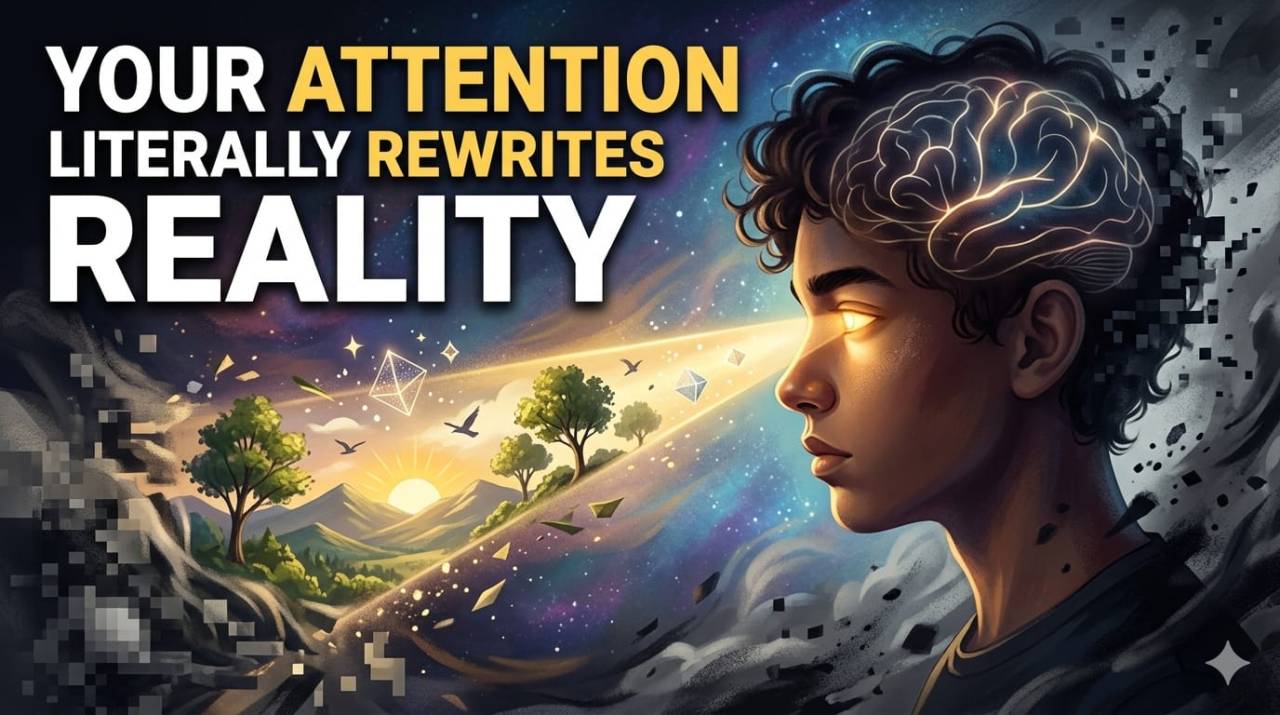
Your brain doesn’t show you reality—it filters it. What you choose to focus on ultimately shapes the world you experience.
We often move through the world under the comfortable illusion that we are objective observers. We believe our eyes are cameras and our ears are microphones, recording a "truth" that exists outside of us. However, modern neuroscience is dismantling this premise with startling clarity: Reality is not something you encounter; it is something you curate.
In the Guiding Lights of our lives, the most powerful beacon isn’t external—it is the lens of our own attention. If your brain is an editor, it’s time to step into the director’s chair.
The Biological Editor: Survival vs. Significance
Every single second, our sensory organs are bombarded with approximately 11 million bits of information. From the hum of a refrigerator to the subtle shift of light on a wall, the world is a chaotic symphony of data. Yet, the conscious mind can only process about 40 to 50 bits per second.
To bridge this massive gap, the brain utilizes a complex filtering system, largely governed by the Reticular Activating System (RAS). This bundle of nerves at the brainstem acts as a gatekeeper. Its job is simple but profound: it filters out the "noise" and highlights the "signal."
Historically, this served a primal purpose. If you were a hunter-gatherer, your RAS would filter out the rustle of wind but amplify the snap of a twig—a potential predator. In the modern world, however, this filter is often hijacked by the loudest, most stressful stimuli. When we don't choose our focus, our biology chooses it for us, and it almost always chooses fear, lack, and urgency.
The Feedback Loop: How Focus Becomes Fact
The truly "mind-bending" aspect of this biological editing is that it creates a self-fulfilling prophecy. This isn't just "positive thinking"; it is a phenomenon known as Selective Perception.
When you focus intensely on a specific theme—let’s say, professional inadequacy—your brain actively seeks out data points to support that narrative. It "sees" the one slightly critical email and ignores the five messages of praise. It remembers the one stumble in a meeting and deletes the thirty minutes of brilliant contribution.
"Your focus doesn’t just guide what you notice—it actually shapes what you experience as real."
Over time, this repeated focus triggers Neuroplasticity. The neural pathways associated with your primary focus become thicker and more efficient. In essence, by focusing on stress, you are literally building a "stress-optimized" brain. You aren't just feeling heavier; you are physically restructuring your mind to find weight in every situation.
Rewriting the Script: Tools for Intentional Reality
If reality is an edited film, then mindfulness and intention are the editing software. To shift your reality, you must change your "search terms." Here is how we can begin to rewire the filter:
1. The Power of the "Prime"
Before you start your day, "prime" your RAS. By setting a specific intention—such as "I am looking for opportunities to be helpful"—you are giving your brain a new set of instructions. Suddenly, your brain begins to highlight moments of connection that it previously would have discarded as irrelevant.
2. Gratitude as a Cognitive Tool
Gratitude is often dismissed as a "soft" practice, but in neurological terms, it is a high-level recalibration tool. When you practice gratitude, you are forcing your brain to scan the environment for "progress" and "safety" rather than "threats." This shifts the chemical cocktail in your brain from cortisol (stress) to dopamine and serotonin (reward and stability).
3. Intellectual Curiosity
Learning a new skill or exploring a new topic expands the boundaries of what your brain is allowed to notice. If you learn about architecture, you suddenly "see" buildings that you walked past for years. Your reality literally expands because you have added new categories to your mental filter.
The Ethics of Attention
In an era of the "attention economy," where apps and algorithms are designed to capture our focus for profit, reclaiming your attention is a revolutionary act. We are currently living in a world where our filters are being tuned by external forces to prioritize outrage, comparison, and consumption.
When we allow our attention to be fragmented, our reality becomes fragmented. We feel scattered and anxious because our "editor" is being given conflicting and chaotic footage to work with. Guiding your light inward means recognizing that your attention is your most valuable currency. Where you spend it is where you live.
The Question for the Director
As you read this, your brain is discarding the temperature of the room, the weight of your clothes, and the background noise of your environment to prioritize these words. It is editing your world right now to create this experience.
The evolution of your life depends on a single, recurring choice: What will you give permission to exist in your field of vision?
If you want a different reality, don’t try to change the world first. Change the filter. Focus on the growth, the gratitude, and the potential, and watch as your brain builds a world that matches.














Leave a Comment