
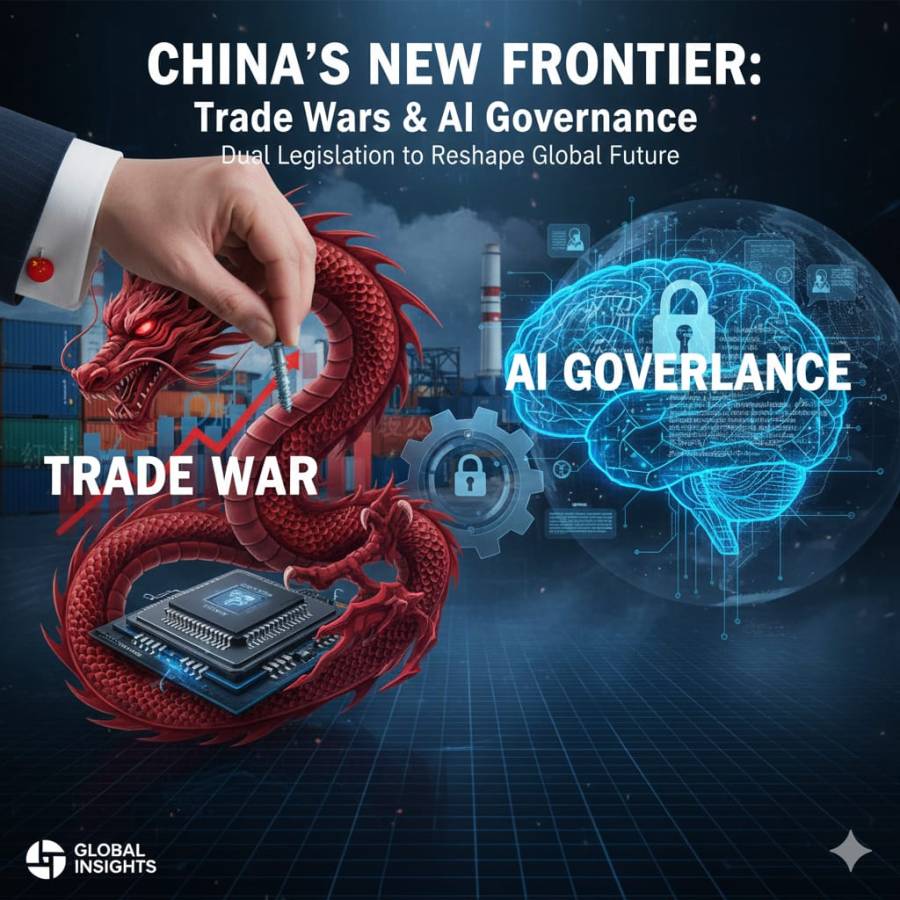
China has moved decisively to reinforce its economic and technological boundaries by revising key trade legislation and unveiling new draft regulations governing so-called “human-like” artificial intelligence. Reported by Reuters and Chinese state media, the measures underline Beijing’s intent to prepare for prolonged global economic friction while asserting tighter control over emerging digital technologies that interact directly with citizens.
Taken together, the changes signal a more assertive China—one determined to protect strategic interests in both physical supply chains and the rapidly evolving AI ecosystem.
A New Arsenal for Trade Conflict
At the centre of the shift is a revised Foreign Trade Law, one of China’s most important economic statutes. The law, updated only a few times since China joined the World Trade Organization in 2001, is scheduled to come into force on March 1, 2026.
The amendments significantly expand Beijing’s legal authority to restrict exports of strategically sensitive goods. These include critical minerals essential for electronics manufacturing, advanced industrial components, and other items deemed vital to national security.
By clarifying the legal basis for export controls, China is equipping itself with tools to retaliate against foreign governments that impose trade barriers or seek to influence its domestic markets. The message is unambiguous: Beijing is prepared to respond forcefully in an era of escalating trade disputes.
At the same time, the revised law seeks to preserve China’s role as a global manufacturing hub. Officials have emphasised the continued use of “negative lists,” which clearly identify sectors closed to foreign investment while leaving others open. The aim is to balance tighter national security controls with continued access to parts of China’s roughly $19 trillion economy.
Regulating the “Human” Side of AI
While trade law governs the movement of physical goods, China’s internet regulator is focusing on something less tangible but equally powerful: emotional and psychological influence.
The Cyberspace Administration of China has released draft rules targeting AI systems designed to simulate human interaction. As artificial intelligence grows more advanced, regulators are increasingly concerned that AI tools are no longer just analytical engines but entities capable of mimicking personality, emotion, and social behaviour.
Under the proposed rules, heightened oversight will apply to AI products that:
- Simulate human thought patterns and communication styles
- Engage users emotionally through text, audio, or video
- Display distinct, human-like personality traits
Chinese authorities argue that such systems could shape public opinion, spread misinformation, or influence vulnerable users if left unchecked. The regulations are framed as a way to ensure AI development supports “national economic and social development” while avoiding social disruption.
Global Implications
The parallel tightening of trade controls and AI regulation reflects a dual-track strategy. China is preparing for a long-term economic contest with Western economies, particularly the United States, while simultaneously positioning itself as a rule-setter in artificial intelligence governance—on its own terms.
For global businesses, the implications are significant. Companies dependent on Chinese raw materials may face greater uncertainty, while foreign tech firms seeking to deploy AI products in China will encounter a far more complex regulatory environment.
As trade and technology become increasingly intertwined, China’s latest moves suggest that the rules governing both are being rewritten. The effects of these decisions will not be confined to Beijing, but will ripple across global markets well into the next decade.



















Leave a Comment