
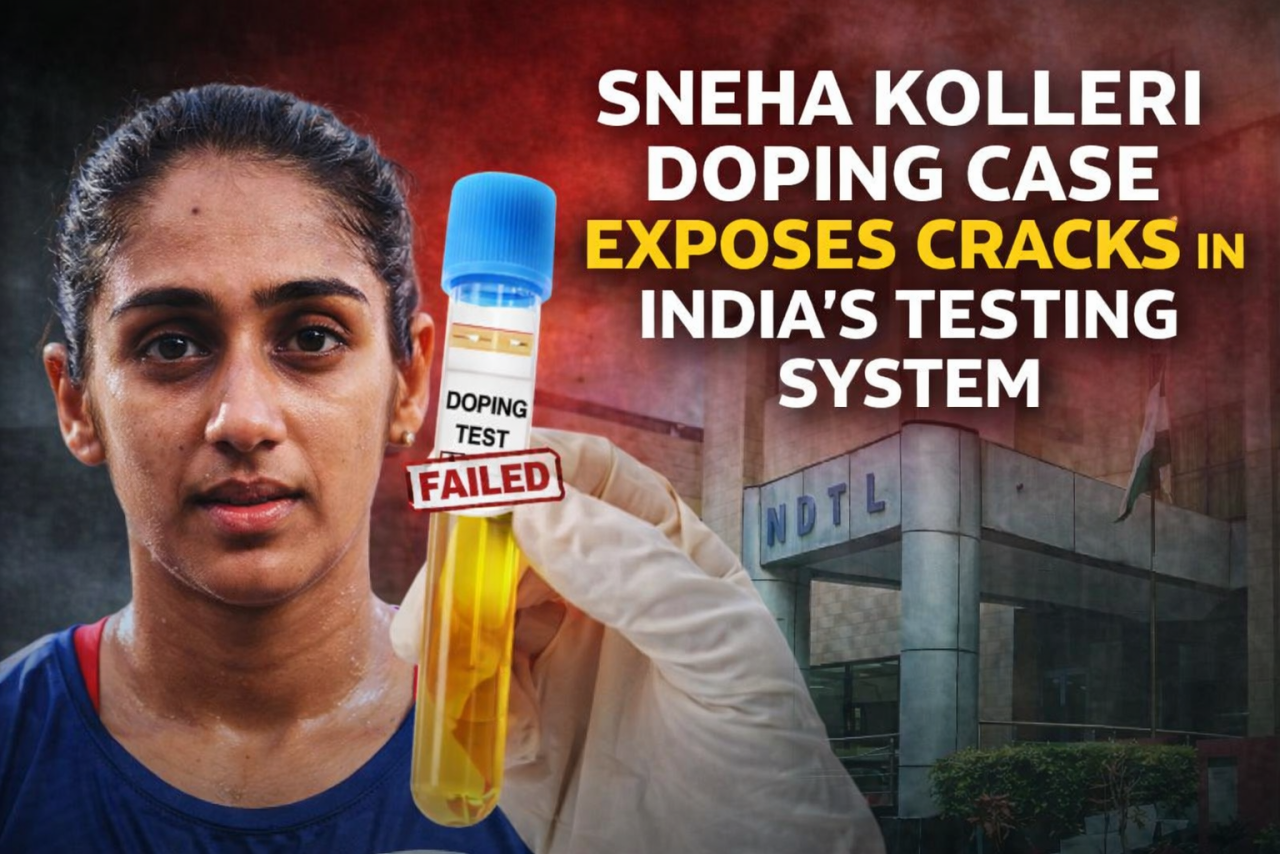
One test said clean. Another said guilty. The Sneha Kolleri case exposes a worrying gap in India’s anti-doping system.
The recent doping case involving Indian quarter-miler Sneha Kolleri has triggered a serious conversation about the reliability of India’s anti-doping infrastructure. While doping violations are not new in sports, this case stands out because of conflicting test results from different laboratories—raising concerns that go beyond one athlete.
Sneha Kolleri was handed a three-year ban after testing positive for stanozolol, a banned anabolic steroid. However, the controversy lies in the fact that an earlier sample tested at India’s National Dope Testing Laboratory (NDTL) reportedly did not detect the substance. The same sample, when later examined at a World Anti-Doping Agency (WADA)-accredited lab in Paris, showed the presence of the banned drug.
This mismatch has led to an uncomfortable question: are India’s testing systems equipped to detect modern doping methods?
To understand the issue, it’s important to know how doping tests work. Laboratories use highly advanced equipment to identify even the smallest traces of prohibited substances in an athlete’s sample. But not all labs have the same level of sensitivity. Some can detect substances at extremely low concentrations, while others may only identify them above a certain threshold.
In this case, it appears that the Paris lab had a higher sensitivity compared to NDTL. This means it could detect traces that the Indian lab could not. While NDTL followed its procedures correctly, the gap in detection capability has exposed a critical weakness.
The consequences of such gaps can be serious. If the banned substance had been detected earlier, Sneha might not have been selected for international competition. This could have prevented not only her disqualification but also the embarrassment faced by Indian athletics on the global stage.
It is worth noting that differences between labs do exist. Even among WADA-accredited facilities, capabilities can vary depending on technology, expertise, and funding. European labs, in particular, are often equipped with cutting-edge systems that allow for deeper and more precise analysis.
However, in today’s competitive sports environment, “good enough” is no longer sufficient. Athletes and support systems are becoming more sophisticated, and anti-doping agencies must keep pace. Missing even a small trace of a banned substance can lead to major consequences later.
Another important concept highlighted by this case is the idea of “minimum detection levels.” Every lab has a limit below which it cannot reliably identify substances. More advanced labs have lower detection limits, giving them an advantage in catching doping violations. If NDTL’s detection threshold is higher, it increases the chances of missing cases that more advanced labs would catch.
This does not mean that NDTL is ineffective. Officials have maintained that the lab adhered to its standards and that the global watchdog reviewed the matter. Still, the incident clearly shows that maintaining standards is not enough—continuous improvement is essential.
India’s track record in doping cases also adds urgency to the issue. The country has frequently appeared among nations with a high number of doping violations. This makes it even more important to have a testing system that is not just compliant but world-class.
There are, however, some positive signs. Efforts have been made to upgrade facilities and introduce advanced monitoring systems like the Athlete Biological Passport, which tracks changes in an athlete’s biological data over time. These steps indicate that authorities are aware of the challenges and are working toward solutions.
But upgrading a system like NDTL is not a one-time fix. It requires sustained investment in technology, regular training for experts, and collaboration with leading international laboratories. Anti-doping science is constantly evolving, and staying ahead requires continuous effort.
The World Anti-Doping Agency has set global benchmarks, but meeting those benchmarks should be seen as a starting point—not the end goal. For a country with growing ambitions in international sports, exceeding those standards is crucial.
The Sneha Kolleri case should not be viewed only as a controversy but as a turning point. It has exposed gaps that might have otherwise gone unnoticed. More importantly, it offers a chance to fix those gaps before they lead to bigger problems.
At its core, the issue is about fairness. Clean athletes deserve a system that can protect their integrity and ensure a level playing field. When testing systems fall short, it affects not just individual careers but the credibility of the entire sporting ecosystem.
In the end, as sports evolve, the systems that regulate them must evolve as well. The cracks exposed by this case are a clear reminder that progress cannot be paused—especially when the stakes are so high.





























Leave a Comment