
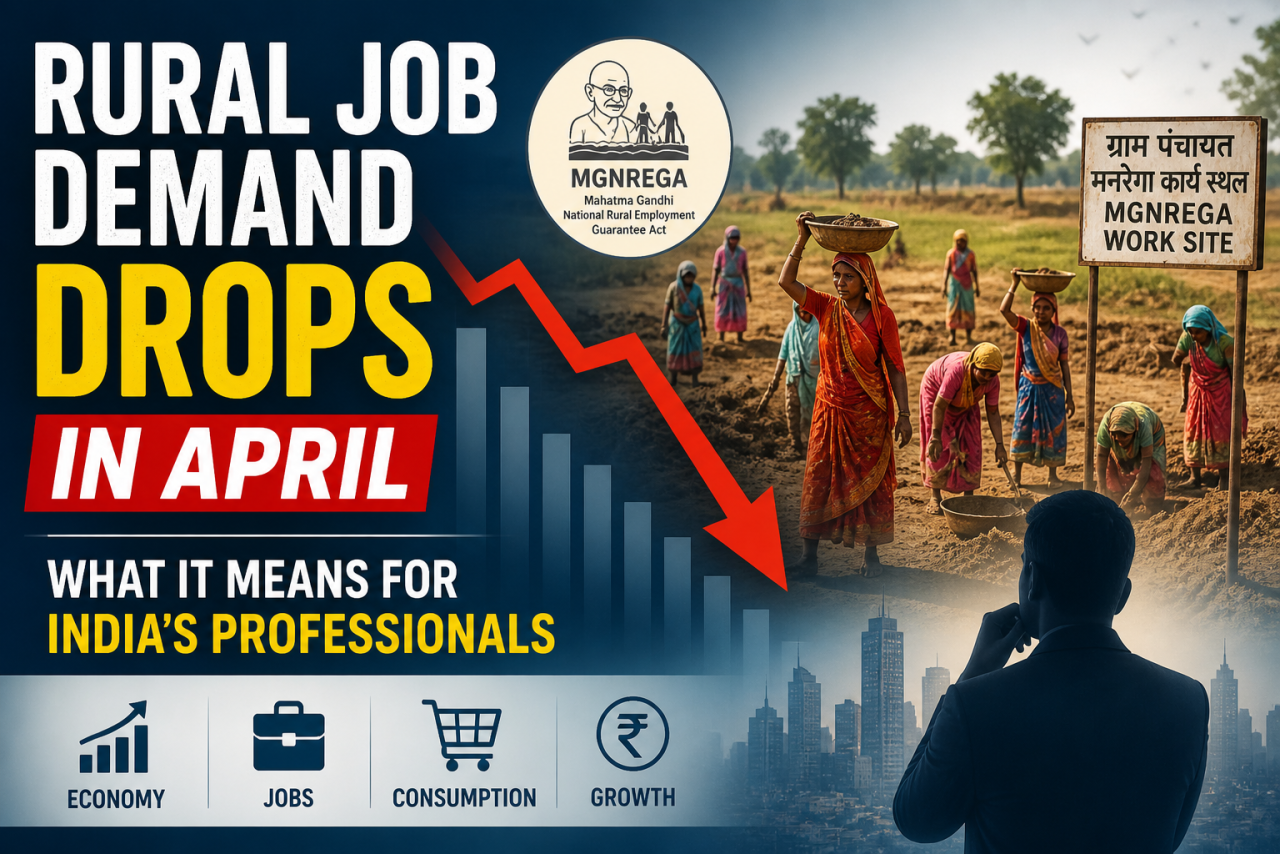
India’s rural job demand just dropped sharply—this silent shift could reshape urban jobs, consumption, and your career trajectory.
India’s rural economy is often seen as a distant reality for urban professionals, but its shifts quietly shape the broader economic landscape that affects everyone—from job stability to consumption trends. The recent decline in demand for rural employment under the government’s flagship job scheme in April is one such signal that deserves closer attention.
According to recent data, only about 17.5 million people sought work under the rural job guarantee programme in April, marking a drop of nearly one-third compared to the same period last year. This sharp fall may appear like a positive sign at first glance—suggesting reduced distress—but the underlying story is more layered and relevant for India’s working class.
A Cyclical Dip or Structural Shift?
Rural employment demand is not static. It tends to follow seasonal patterns, and April often coincides with increased agricultural activity due to the Rabi harvest season. As farm work rises, reliance on government-backed employment schemes naturally declines. This trend has been observed in previous years as well.
However, what stands out this time is the continuation of a broader softening trend seen over recent months. Participation had already declined in March, and similar patterns were visible in parts of the previous year. This indicates that the drop may not be purely seasonal—it could also reflect deeper transitions in rural livelihoods and economic activity.
The Urban Connection: Why It Matters
For working professionals in cities, rural employment data might seem disconnected from day-to-day life. But in reality, it plays a critical role in shaping demand across sectors.
When rural incomes stabilize or grow, consumption increases. This fuels demand for goods ranging from FMCG products to housing materials, automobiles, and digital services. A decline in rural job demand could mean either improved income opportunities elsewhere—or reduced economic activity. Both scenarios have very different implications.
If the decline is due to better farm output and rising industrial absorption, it can be a positive sign for overall economic growth. It suggests that workers are finding more sustainable or higher-paying opportunities outside the scheme. This could strengthen supply chains, boost productivity, and create indirect opportunities in urban sectors.
On the other hand, if the drop reflects implementation challenges or limited availability of work under the scheme, it could signal stress in the rural economy. Reduced income at the grassroots level can eventually slow down consumption, affecting businesses and, ultimately, urban employment.
Industrial Growth and Labour Shift
Recent industrial output data shows moderate growth, driven largely by manufacturing and mining. If this momentum continues, it could absorb a portion of the rural workforce, reducing dependency on government schemes.
This transition—from welfare-driven employment to market-driven opportunities—is crucial for long-term economic development. However, it also requires a robust ecosystem that supports skill development, mobility, and job creation.
For professionals, this is a key signal. Sectors linked to infrastructure, manufacturing, logistics, and rural consumption could see evolving demand patterns. Companies operating in these spaces may adjust hiring strategies, investment priorities, and expansion plans accordingly.
Regional Imbalance Still Persists
Another important insight is the uneven distribution of rural job demand across states. States like Andhra Pradesh and Telangana continue to report high participation, while others show moderate or declining trends.
This regional imbalance highlights that India’s economic recovery is not uniform. For professionals, especially those working in policy, consulting, or business strategy, this presents both challenges and opportunities. Understanding these variations can help in making more informed decisions—whether it’s market entry, resource allocation, or career moves.
The Bigger Picture
The rural job guarantee scheme has always acted as a safety net—an automatic stabilizer during times of economic stress. A decline in demand, therefore, should not be viewed in isolation. It must be interpreted alongside other indicators like agricultural output, industrial growth, inflation, and consumption patterns.
For India’s working professionals, the takeaway is clear: macroeconomic signals are increasingly interconnected. Rural trends are not just about villages—they influence corporate performance, job markets, and economic stability in cities as well.
Final Take
The drop in rural job demand in April is neither entirely reassuring nor entirely concerning. It sits at the intersection of seasonal cycles, economic transitions, and policy execution.
For professionals navigating India’s evolving economy, staying informed about such trends is not optional—it’s strategic. Because in a country as interconnected as India, the story of rural labour is also, in many ways, the story of urban opportunity.
India’s rural economy is often seen as a distant reality for urban professionals, but its shifts quietly shape the broader economic landscape that affects everyone—from job stability to consumption trends. The recent decline in demand for rural employment under the government’s flagship job scheme in April is one such signal that deserves closer attention.
According to recent data, only about 17.5 million people sought work under the rural job guarantee programme in April, marking a drop of nearly one-third compared to the same period last year. This sharp fall may appear like a positive sign at first glance—suggesting reduced distress—but the underlying story is more layered and relevant for India’s working class.
A Cyclical Dip or Structural Shift?
Rural employment demand is not static. It tends to follow seasonal patterns, and April often coincides with increased agricultural activity due to the Rabi harvest season. As farm work rises, reliance on government-backed employment schemes naturally declines. This trend has been observed in previous years as well.
However, what stands out this time is the continuation of a broader softening trend seen over recent months. Participation had already declined in March, and similar patterns were visible in parts of the previous year. This indicates that the drop may not be purely seasonal—it could also reflect deeper transitions in rural livelihoods and economic activity.
The Urban Connection: Why It Matters
For working professionals in cities, rural employment data might seem disconnected from day-to-day life. But in reality, it plays a critical role in shaping demand across sectors.
When rural incomes stabilize or grow, consumption increases. This fuels demand for goods ranging from FMCG products to housing materials, automobiles, and digital services. A decline in rural job demand could mean either improved income opportunities elsewhere—or reduced economic activity. Both scenarios have very different implications.
If the decline is due to better farm output and rising industrial absorption, it can be a positive sign for overall economic growth. It suggests that workers are finding more sustainable or higher-paying opportunities outside the scheme. This could strengthen supply chains, boost productivity, and create indirect opportunities in urban sectors.
On the other hand, if the drop reflects implementation challenges or limited availability of work under the scheme, it could signal stress in the rural economy. Reduced income at the grassroots level can eventually slow down consumption, affecting businesses and, ultimately, urban employment.
Industrial Growth and Labour Shift
Recent industrial output data shows moderate growth, driven largely by manufacturing and mining. If this momentum continues, it could absorb a portion of the rural workforce, reducing dependency on government schemes.
This transition—from welfare-driven employment to market-driven opportunities—is crucial for long-term economic development. However, it also requires a robust ecosystem that supports skill development, mobility, and job creation.
For professionals, this is a key signal. Sectors linked to infrastructure, manufacturing, logistics, and rural consumption could see evolving demand patterns. Companies operating in these spaces may adjust hiring strategies, investment priorities, and expansion plans accordingly.
Regional Imbalance Still Persists
Another important insight is the uneven distribution of rural job demand across states. States like Andhra Pradesh and Telangana continue to report high participation, while others show moderate or declining trends.
This regional imbalance highlights that India’s economic recovery is not uniform. For professionals, especially those working in policy, consulting, or business strategy, this presents both challenges and opportunities. Understanding these variations can help in making more informed decisions—whether it’s market entry, resource allocation, or career moves.
The Bigger Picture
The rural job guarantee scheme has always acted as a safety net—an automatic stabilizer during times of economic stress. A decline in demand, therefore, should not be viewed in isolation. It must be interpreted alongside other indicators like agricultural output, industrial growth, inflation, and consumption patterns.
For India’s working professionals, the takeaway is clear: macroeconomic signals are increasingly interconnected. Rural trends are not just about villages—they influence corporate performance, job markets, and economic stability in cities as well.
Final Take
The drop in rural job demand in April is neither entirely reassuring nor entirely concerning. It sits at the intersection of seasonal cycles, economic transitions, and policy execution.
For professionals navigating India’s evolving economy, staying informed about such trends is not optional—it’s strategic. Because in a country as interconnected as India, the story of rural labour is also, in many ways, the story of urban opportunity.

























Leave a Comment