
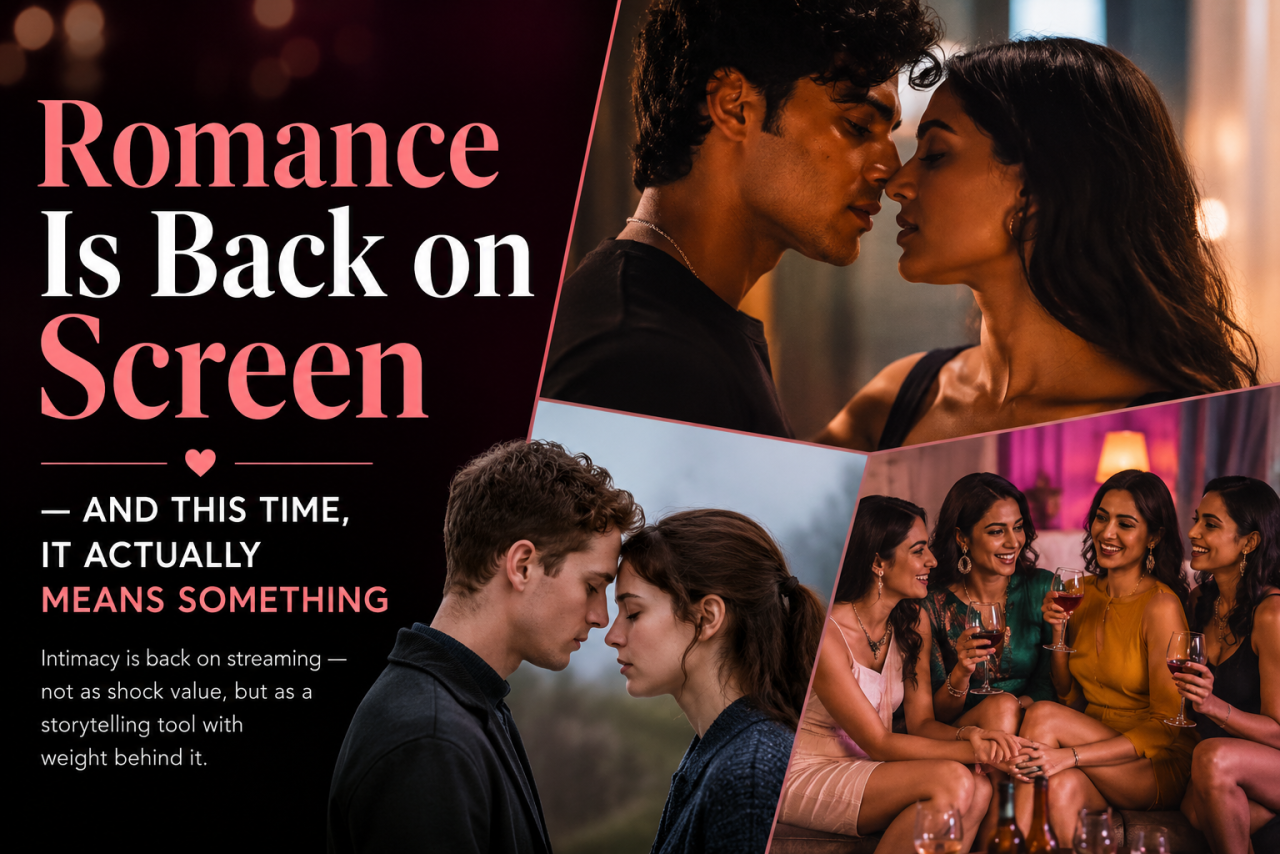
Romance never disappeared—it was waiting for storytellers who understood that desire without emotional depth is just spectacle. The new era of streaming is finally putting love back at the heart of the story.
For a few years, romance appeared to be disappearing from the screen. Dating apps were losing their appeal, Gen Z was often described as hesitant about dating, and a UCLA study found that 60% of American teenagers preferred less intimacy in films and television. Commentators even coined the phrase "romance recession" to describe the changing mood.
That mood is beginning to change.
Series such as Off Campus, Heated Rivalry, and Four More Shots Please! suggest that romance is finding its way back into mainstream storytelling. Physical intimacy is no longer inserted merely to surprise audiences or satisfy commercial expectations. It is increasingly being used to deepen characters and move the narrative forward.
How We Got Here
The evolution of romance on screen over the past fifteen years has been anything but consistent. During the Twilight years between 2008 and 2012, longing was conveyed through hesitant touches, lingering glances, and restrained emotion. By 2020, Normal People presented extended intimate scenes with remarkable honesty, treating physical relationships as an ordinary part of human life rather than something sensational.
The years that followed saw a different trend. Shows like Euphoria pushed visual intensity much further, while Game of Thrones was frequently criticised for turning intimacy into spectacle, often sidelining its female characters in the process. Romance increasingly became either a narrative obligation or a device to provoke conversation.
Audiences, particularly younger viewers, gradually began looking for something different. They were less interested in explicit content than in believable emotional relationships. Many found that authenticity in Korean dramas, where slow-building affection, unresolved tension, and emotional restraint often create stronger chemistry than immediate physical attraction.
The Female Gaze Changes Everything
Another important change has taken place behind the camera.
More women are shaping these stories as writers, directors, and producers, and that influence is visible in the way romance is portrayed. Off Campus has women at the centre of its creative team. Four More Shots Please! explores friendship, desire, vulnerability, and personal consequences from women's perspectives. In Netflix's The Royals, Ishaan Khatter is deliberately framed as the visual focus, reversing a convention long associated with Indian cinema. Even the song Cherry Pie celebrates female desire with unusual confidence.
As a result, intimacy is becoming more emotionally layered. It is no longer limited to attraction alone. It now reflects insecurity, loneliness, power, affection, and the difficult choices people make within relationships. Indian streaming platforms, which once treated romance as a brief interruption, are increasingly willing to explore what emotional intimacy means before and after a romantic encounter.
The Craft Behind It
This transformation has also been supported by changes in filmmaking itself.
Intimacy coordinators have become an important part of many productions, helping actors perform emotionally and physically demanding scenes in a safe, carefully planned environment. Aastha Khanna, who worked on The Royals, has described the process as ensuring that every intimate moment serves a clear purpose within the story. Like an action sequence or a dance performance, these scenes are rehearsed, choreographed, and discussed in advance.
The result is a more disciplined approach to romance. Intimate moments are expected to contribute to character development or the progression of the plot rather than existing simply for visual impact.
What It Says About Right Now
The renewed interest in romance also reflects broader cultural changes. A generation that spent the pandemic questioning relationships, dating culture, and emotional connection is now responding to stories that acknowledge those uncertainties. The appeal lies less in fairy-tale endings than in emotional honesty. Viewers recognise conversations, misunderstandings, vulnerability, and the quiet moments when two people slowly realise what they mean to one another.
Popular culture has always mirrored the values and anxieties of its time. The return of emotionally richer romance suggests that audiences have become more interested in perspective, empathy, and genuine connection than in spectacle alone.
Romance has returned to the screen with renewed confidence. More importantly, it has regained its emotional purpose, reminding audiences that intimacy is most powerful when it reveals character rather than simply attracting attention.
For a few years, romance appeared to be disappearing from the screen. Dating apps were losing their appeal, Gen Z was often described as hesitant about dating, and a UCLA study found that 60% of American teenagers preferred less intimacy in films and television. Commentators even coined the phrase "romance recession" to describe the changing mood.
That mood is beginning to change.
Series such as Off Campus, Heated Rivalry, and Four More Shots Please! suggest that romance is finding its way back into mainstream storytelling. Physical intimacy is no longer inserted merely to surprise audiences or satisfy commercial expectations. It is increasingly being used to deepen characters and move the narrative forward.
How We Got Here
The evolution of romance on screen over the past fifteen years has been anything but consistent. During the Twilight years between 2008 and 2012, longing was conveyed through hesitant touches, lingering glances, and restrained emotion. By 2020, Normal People presented extended intimate scenes with remarkable honesty, treating physical relationships as an ordinary part of human life rather than something sensational.
The years that followed saw a different trend. Shows like Euphoria pushed visual intensity much further, while Game of Thrones was frequently criticised for turning intimacy into spectacle, often sidelining its female characters in the process. Romance increasingly became either a narrative obligation or a device to provoke conversation.
Audiences, particularly younger viewers, gradually began looking for something different. They were less interested in explicit content than in believable emotional relationships. Many found that authenticity in Korean dramas, where slow-building affection, unresolved tension, and emotional restraint often create stronger chemistry than immediate physical attraction.
The Female Gaze Changes Everything
Another important change has taken place behind the camera.
More women are shaping these stories as writers, directors, and producers, and that influence is visible in the way romance is portrayed. Off Campus has women at the centre of its creative team. Four More Shots Please! explores friendship, desire, vulnerability, and personal consequences from women's perspectives. In Netflix's The Royals, Ishaan Khatter is deliberately framed as the visual focus, reversing a convention long associated with Indian cinema. Even the song Cherry Pie celebrates female desire with unusual confidence.
As a result, intimacy is becoming more emotionally layered. It is no longer limited to attraction alone. It now reflects insecurity, loneliness, power, affection, and the difficult choices people make within relationships. Indian streaming platforms, which once treated romance as a brief interruption, are increasingly willing to explore what emotional intimacy means before and after a romantic encounter.
The Craft Behind It
This transformation has also been supported by changes in filmmaking itself.
Intimacy coordinators have become an important part of many productions, helping actors perform emotionally and physically demanding scenes in a safe, carefully planned environment. Aastha Khanna, who worked on The Royals, has described the process as ensuring that every intimate moment serves a clear purpose within the story. Like an action sequence or a dance performance, these scenes are rehearsed, choreographed, and discussed in advance.
The result is a more disciplined approach to romance. Intimate moments are expected to contribute to character development or the progression of the plot rather than existing simply for visual impact.
What It Says About Right Now
The renewed interest in romance also reflects broader cultural changes. A generation that spent the pandemic questioning relationships, dating culture, and emotional connection is now responding to stories that acknowledge those uncertainties. The appeal lies less in fairy-tale endings than in emotional honesty. Viewers recognise conversations, misunderstandings, vulnerability, and the quiet moments when two people slowly realise what they mean to one another.
Popular culture has always mirrored the values and anxieties of its time. The return of emotionally richer romance suggests that audiences have become more interested in perspective, empathy, and genuine connection than in spectacle alone.
Romance has returned to the screen with renewed confidence. More importantly, it has regained its emotional purpose, reminding audiences that intimacy is most powerful when it reveals character rather than simply attracting attention.






















Leave a Comment