
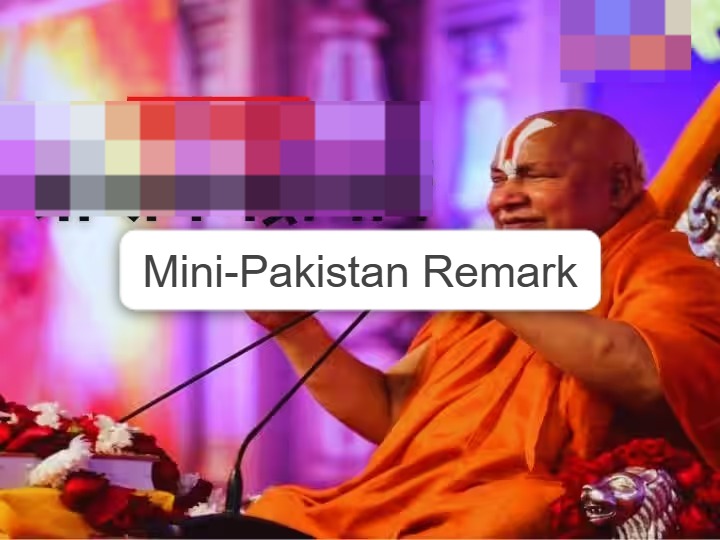
When Jagadguru Rambhadracharya, a prominent Hindu spiritual leader, recently declared that “Western Uttar Pradesh feels like a mini-Pakistan,” it was more than an offhand comment. It was a reminder of how religious figures, cloaked in spiritual authority, often wield divisive language to maintain prominence in India’s turbulent public sphere. His remark, delivered with the ease of someone accustomed to unchallenged influence, reflects a troubling pattern to weaken the bonds of society rather than reinforce them.
India’s Secular Promise
The Constitution of India envisioned a nation where diversity would be celebrated, not demonised. Its Preamble proclaims India a secular republic, and the Supreme Court has ruled that secularism is part of the basic structure of the Constitution, immune to political tampering. Citizens are guaranteed equality before the law and the freedom to practice their faith without fear. This framework was born from the painful memories of Partition, when millions suffered from communal violence. The founders, determined to prevent such horrors from repeating, created a republic that belonged equally to Hindus, Muslims, Christians, Sikhs, Buddhists, Jains, and every other community.
Against this backdrop, Rambhadracharya’s description of an Indian region as “mini-Pakistan” is not simply careless language. It chips away at the constitutional promise by casting suspicion on citizens based solely on their religion.
Why Religious Leaders Turn to Bigotry
Religious gurus in India command mass followings. For many, their relevance today depends less on spiritual wisdom and more on their ability to dominate headlines. In this competition for visibility, inflammatory language becomes a convenient weapon. By invoking Pakistan, Rambhadracharya tapped into not only historical wounds but also the anxieties stoked by recent developments: Operation Sindoor against cross-border terror, the Pahalgam attack that shook Kashmir, and the symbolic refusal of an India-Pakistan handshake during the Asia Cup cricket match. Together, these events have heightened national sensitivities, making divisive rhetoric all the more combustible.
Such language ensures that the guru remains in public discourse, quoted across television and social media. The cost, however, is borne by society, where mistrust and resentment take root.
Political Utility of Sectarian Speech
India’s political class often finds utility in these outbursts. Aligning with religious leaders allows politicians to court their followers, while religious figures enjoy the protection and visibility that political connections bring. In an electoral landscape where communal polarization can tip the balance, phrases like “mini-Pakistan” become coded political signals. They create fear of demographic dominance, justify calls for stronger policing, and rally voters along religious lines.
Rambhadracharya’s remark fits neatly into this cycle. It was less an expression of personal observation than a deliberate act of political positioning.
The Social Fallout
The consequences of such rhetoric are far-reaching. For minority communities, it creates an atmosphere of alienation. Citizens who are equal under the law suddenly find their loyalty questioned. Everyday life becomes shadowed by suspicion, whether in schools, workplaces, or neighbourhoods.
For the majority, the remark fosters mistrust. Coexistence is no longer seen as a natural feature of Indian life but as a compromise that needs constant vigilance. In such an environment, harmony becomes fragile, and conflict can flare with little provocation.
The economy, too, suffers when communal tensions scare away investment, disrupt tourism, and destabilise local markets.
A Global Concern
India’s global identity is tied to its pluralism. As the world’s largest democracy, it aspires to be seen as a model of coexistence. Yet, international media frequently highlight incidents of religious intolerance. When figures like Rambhadracharya describe Indian regions as “mini-Pakistan,” it confirms the fears of critics who argue that India is abandoning its inclusive traditions. For a country seeking leadership in global forums, such perceptions are damaging.
Accountability and Resistance
Hate speech laws exist in India, but enforcement remains selective. Religious leaders with large followings often avoid consequences because of their political clout. It creates a dangerous impunity. Media houses amplify their words for viewership, while political actors exploit them for votes.
The responsibility to resist this lies with multiple actors. Journalists must provide context rather than amplify hate without question. Civil society must promote constitutional literacy, reminding citizens of their shared rights. Interfaith dialogues and grassroots initiatives must counteract suspicion with solidarity. Above all, citizens must ask whether leaders like Rambhadracharya are serving spiritual unity or simply exploiting division for personal prominence.
Reclaiming India’s Spirit
India’s history is one of coexistence. Its cities are dotted with temples, mosques, churches, and gurdwaras that have stood side by side for centuries. The Constitution is a reflection of this lived reality. Rambhadracharya’s remark represents a betrayal of that inheritance. To preserve India’s unity, society must reject such sectarian theatrics.
By calling Western Uttar Pradesh a “mini Pakistan,” Rambhadracharya exposed a strategy increasingly common among religious leaders: using communal bigotry to remain in the spotlight. But India cannot afford to indulge such rhetoric. Its survival as a diverse democracy depends on upholding the secular framework that protects all communities. The challenge is not only to condemn these remarks but to ensure that India’s public discourse is reclaimed by voices of reason, inclusivity, and constitutional fidelity.








Leave a Comment