
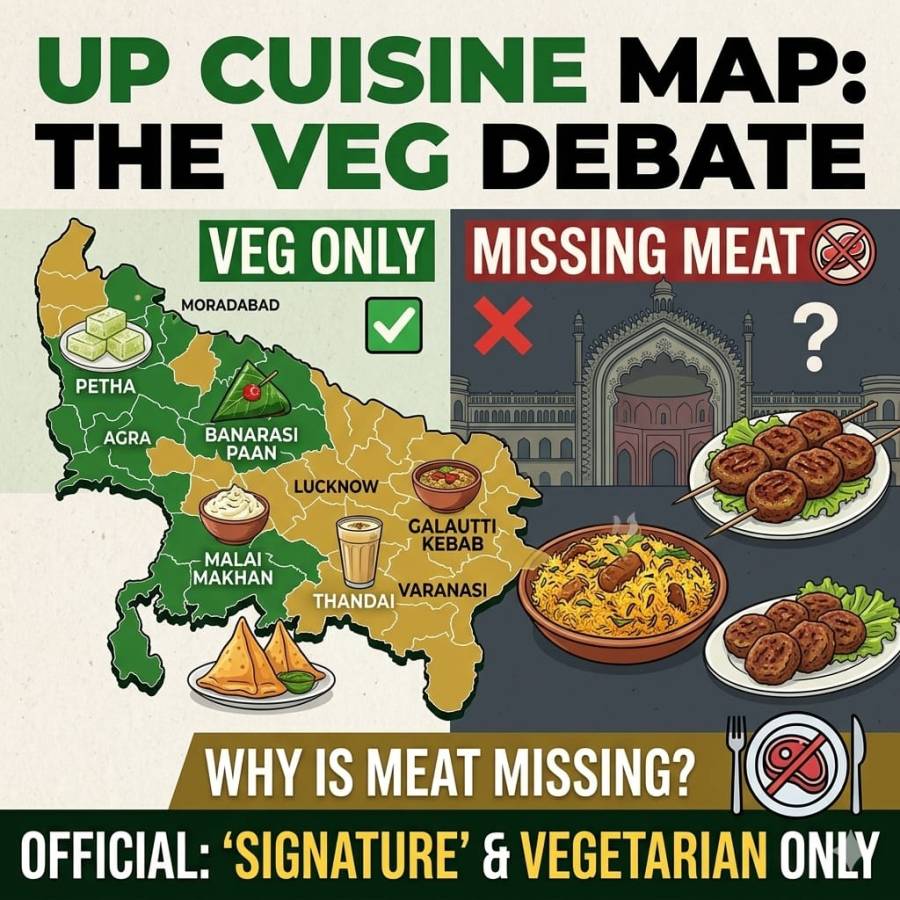
Uttar Pradesh’s new culinary map celebrates vegetarian delicacies but excludes iconic dishes like Galouti kebabs and Awadhi biryani, sparking debate over food, culture, and identity.
In a move to place Uttar Pradesh on the global gastronomic map, the State government has officially notified an exhaustive “culinary map” under its “One District-One Cuisine” (ODOC) scheme. Modeled after the successful “One District-One Product” (ODOP) initiative, the scheme assigns a signature delicacy to each of the state’s 75 districts. However, the list has quickly become a flashpoint for debate, as it features an exclusively vegetarian spread, omitting the iconic meat-based dishes that have defined the region’s culinary identity for centuries.
A Vision for Branding and Export
The ODOC scheme, formally launched by Amit Shah on January 24 following an earlier announcement by Chief Minister Yogi Adityanath, aims to revolutionize the local food industry. By focusing on 208 identified delicacies, the government intends to improve shelf-life, standardize quality, and provide a dedicated logo for each item.
To support local entrepreneurs and artisans, the government has earmarked ₹150 crore for the scheme’s implementation. Eligible businesses can avail subsidies of up to 25%, capped at ₹20 lakh. According to Shashi Bhushan Lal Susheel, Principal Secretary of the UP MSME and Export Promotion Department, the objective is to “increase the presence of UP’s cuisines on India’s and the world’s food platter through better branding and marketing.”
The Sweet and Savoury Map
The list celebrates a diverse array of regional specialties, highlighting the state’s long-standing tradition of sweets, bakery products, and street food.
Notable Inclusions
- Lucknow: Rewari, mango-based products, chaat, and malai makhan
- Varanasi: Thandai, lassi, and the world-famous Banarasi paan
- Agra & Mathura: The legendary petha and peda, alongside “chhapan bhog”
- Gautam Buddh Nagar: Cakes and bakery products
- Azamgarh: White carrot halwa
- Mahoba: Date jaggery
While these selections showcase the diversity of regional vegetarian cuisine, the absence of celebrated non-vegetarian dishes has drawn sharp criticism from food historians and culinary enthusiasts alike.
The Missing Pieces: A “Half-Baked” Platter?
The exclusion of Galouti kebab, Kakori kebab, Awadhi biryani, and Nihari—dishes that attract food lovers from across the globe—has left a significant void in the culinary map.
Similarly, the celebrated Moradabadi biryani and Mutton korma are conspicuously absent.
Pushpesh Pant, noted food historian and President of the Cuisine Society of India, was scathing in his assessment. He described the exercise as “laughable” and called the all-vegetarian list a “half-baked measure” that ignores the fundamental definition of a region’s cuisine.
Pant argued that selectively omitting dishes that have historically shaped the state’s culinary identity amounts to a form of “selective discrimination,” raising broader questions about how cultural heritage is represented through state-backed branding initiatives.
Government’s Defense: Inclusivity and Flexibility
Responding to the criticism, government officials have maintained that the list is not static. Cabinet Minister Rakesh Sachan clarified that the omission was “not intentional” and emphasized the scheme’s focus on products that can benefit a larger population through mass production and packaging.
“The list is flexible and can be upgraded based on local recommendations and public demand,” Sachan stated, adding that future additions would not require fresh Cabinet approval and could be updated with the Chief Minister’s consent.
A Culinary Identity Still Under Debate
As the government moves ahead with food festivals, exhibitions, and collaborations with online aggregators to promote these “signature” dishes, the debate surrounding the ODOC scheme continues to intensify.
Can a culinary map truly represent the soul of Uttar Pradesh while leaving out some of its most globally recognized flavors? For many critics, the answer remains uncertain.
For now, the “Signature UP Dishes” initiative tells a story rich in sweetness and tradition—but one that many believe remains incomplete without the smoky aroma of kebabs, biryanis, and slow-cooked Awadhi classics that have long defined the state’s culinary legacy.
In a move to place Uttar Pradesh on the global gastronomic map, the State government has officially notified an exhaustive “culinary map” under its “One District-One Cuisine” (ODOC) scheme. Modeled after the successful “One District-One Product” (ODOP) initiative, the scheme assigns a signature delicacy to each of the state’s 75 districts. However, the list has quickly become a flashpoint for debate, as it features an exclusively vegetarian spread, omitting the iconic meat-based dishes that have defined the region’s culinary identity for centuries.
A Vision for Branding and Export
The ODOC scheme, formally launched by Amit Shah on January 24 following an earlier announcement by Chief Minister Yogi Adityanath, aims to revolutionize the local food industry. By focusing on 208 identified delicacies, the government intends to improve shelf-life, standardize quality, and provide a dedicated logo for each item.
To support local entrepreneurs and artisans, the government has earmarked ₹150 crore for the scheme’s implementation. Eligible businesses can avail subsidies of up to 25%, capped at ₹20 lakh. According to Shashi Bhushan Lal Susheel, Principal Secretary of the UP MSME and Export Promotion Department, the objective is to “increase the presence of UP’s cuisines on India’s and the world’s food platter through better branding and marketing.”
The Sweet and Savoury Map
The list celebrates a diverse array of regional specialties, highlighting the state’s long-standing tradition of sweets, bakery products, and street food.
Notable Inclusions
- Lucknow: Rewari, mango-based products, chaat, and malai makhan
- Varanasi: Thandai, lassi, and the world-famous Banarasi paan
- Agra & Mathura: The legendary petha and peda, alongside “chhapan bhog”
- Gautam Buddh Nagar: Cakes and bakery products
- Azamgarh: White carrot halwa
- Mahoba: Date jaggery
While these selections showcase the diversity of regional vegetarian cuisine, the absence of celebrated non-vegetarian dishes has drawn sharp criticism from food historians and culinary enthusiasts alike.
The Missing Pieces: A “Half-Baked” Platter?
The exclusion of Galouti kebab, Kakori kebab, Awadhi biryani, and Nihari—dishes that attract food lovers from across the globe—has left a significant void in the culinary map.
Similarly, the celebrated Moradabadi biryani and Mutton korma are conspicuously absent.
Pushpesh Pant, noted food historian and President of the Cuisine Society of India, was scathing in his assessment. He described the exercise as “laughable” and called the all-vegetarian list a “half-baked measure” that ignores the fundamental definition of a region’s cuisine.
Pant argued that selectively omitting dishes that have historically shaped the state’s culinary identity amounts to a form of “selective discrimination,” raising broader questions about how cultural heritage is represented through state-backed branding initiatives.
Government’s Defense: Inclusivity and Flexibility
Responding to the criticism, government officials have maintained that the list is not static. Cabinet Minister Rakesh Sachan clarified that the omission was “not intentional” and emphasized the scheme’s focus on products that can benefit a larger population through mass production and packaging.
“The list is flexible and can be upgraded based on local recommendations and public demand,” Sachan stated, adding that future additions would not require fresh Cabinet approval and could be updated with the Chief Minister’s consent.
A Culinary Identity Still Under Debate
As the government moves ahead with food festivals, exhibitions, and collaborations with online aggregators to promote these “signature” dishes, the debate surrounding the ODOC scheme continues to intensify.
Can a culinary map truly represent the soul of Uttar Pradesh while leaving out some of its most globally recognized flavors? For many critics, the answer remains uncertain.
For now, the “Signature UP Dishes” initiative tells a story rich in sweetness and tradition—but one that many believe remains incomplete without the smoky aroma of kebabs, biryanis, and slow-cooked Awadhi classics that have long defined the state’s culinary legacy.






















Leave a Comment