
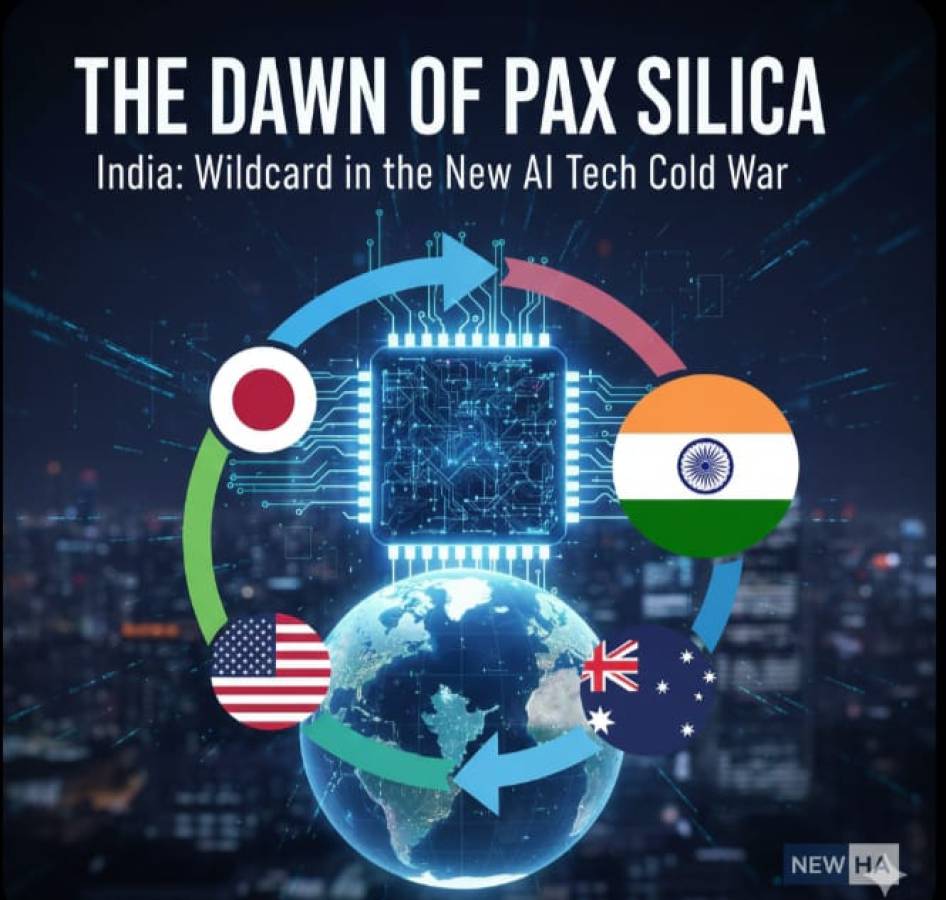
As artificial intelligence reshapes global power, a new geopolitical idea is gaining attention in policy circles: Pax Silica. Much like Pax Americana once defined an era of US dominance, Pax Silica refers to a US-led effort to secure control over the silicon chips, minerals, and supply chains that will define the AI age. At the center of this emerging tech cold war lies a crucial question: where does India fit in?
The term, recently highlighted in geopolitical circles, refers to a US-led coalition of nations aiming to dismantle "coercive dependencies" in technology and manufacturing. At its heart lies the silicon chip—the fundamental unit of Artificial Intelligence (AI)—and the determination of the West to ensure that the next industrial revolution isn’t dictated by Beijing.
The Silicon Standoff
Pax Silica is more than a catchy phrase; it is a defensive wall. It serves as a direct counter-narrative to "Pax Sinica," the idea of a global order led by China. The impetus for this coalition is clear vulnerability. Earlier this year, China demonstrated its leverage by restricting the export of critical minerals, effectively using its near-monopoly on rare earth elements to stare down the US in a high-stakes tariff battle.
The US and its allies have taken the hint. Pax Silica’s primary focus is on building "trustworthy systems" for AI supply chains, critical minerals, and high-end manufacturing. The message is unmistakable: the West does not want to be "arm-twisted" again. By collaborating on everything from frontier foundation models to semiconductor research and energy security, these partners are attempting to create a self-sustaining tech ecosystem that keeps China in the crosshairs, even if official diplomatic channels claim the pact isn’t about "isolating others".
The Indian Paradox
In this grand strategic play, there is a glaring omission: India.
On the surface, it seems odd that India is not yet a formal member of the grouping. All of India’s partners in the Quad—the US, Japan, and Australia—are already party to Pax Silica. Given that the US Treasury Secretary recently spoke of a "fulsome response" to Chinese export freezes that would necessarily involve coordination with India, the door remains wide open.
The US clearly views India as a "critical partner-nation" in the quest to build supply chains that bypass China. Yet, India’s absence from the official signatory list suggests a delicate balancing act. New Delhi has historically preferred "strategic autonomy" over formal bloc-style alliances, especially those that might prematurely escalate tensions with its largest neighbor.
The MNC Vote of Confidence
While the diplomats deliberate, the market has already made its move. Multinational corporations (MNCs) are not waiting for a formal treaty to bet on India’s AI future. Recent, massive investment commitments from tech giants like Microsoft and Amazon offer concrete evidence of India’s growing gravity in the AI space.
These corporations see a "value-proposition" in India that is hard to ignore. With a massive pool of engineering talent, an exploding digital infrastructure, and a government eager to integrate into global supply chains, India offers a hedge against the geopolitical risks of "Pax Sinica". For these MNCs, integrating India into their supply chains is a way to ensure that "geopolitics does not play spoilsport" with their long-term growth.
Final Take
AI is set to trigger a fundamental reset of the global economy. It is no longer just about who has the best software; it’s about who controls the minerals, the chips, and the infrastructure that allow that software to run.
As Pax Silica matures, the pressure on India to join will likely increase. Whether New Delhi officially joins the grouping or continues to act as an "informal" cornerstone of the coalition, one thing is certain: the future of AI will not be decided in Silicon Valley or Beijing alone. It will be decided by how effectively nations like India can leverage their unique position to usher in an era of technology that is secure, sovereign, and truly global.






















Leave a Comment