
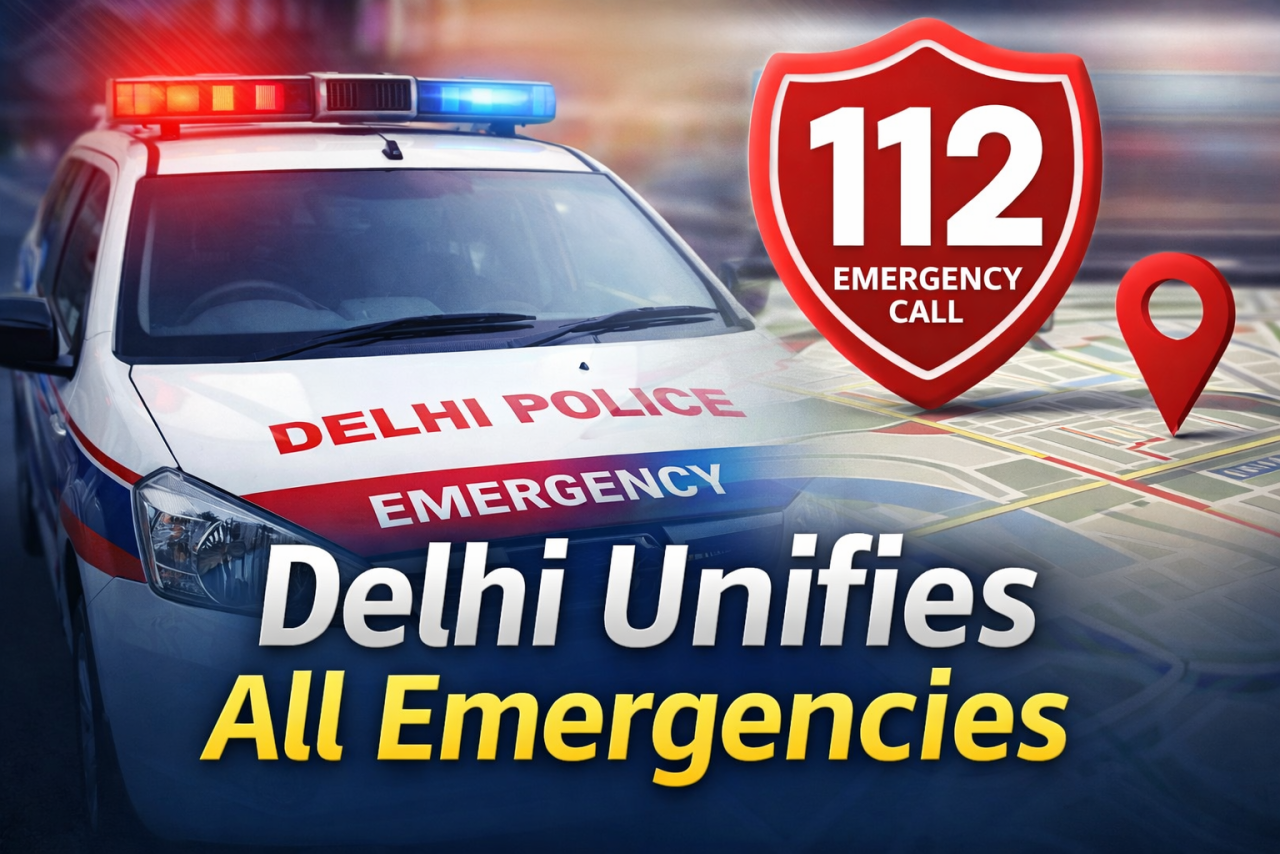
When panic strikes, remembering the right number can cost lives. Delhi’s move to a single emergency helpline, 112, aims to ensure help reaches you faster, without confusion.
In moments of crisis, clarity can mean the difference between safety and tragedy. A fire breaking out in an apartment, a road accident on a busy flyover, a medical emergency at home—these situations rarely allow time to think clearly. Yet for years, Delhi’s residents have had to remember different phone numbers depending on the emergency: 100 for police, 101 for fire, 108 for ambulances, and several others for disaster relief. In a city already struggling with congestion, population pressure, and infrastructure gaps, this fragmentation has often added confusion at the worst possible moments.
That may soon change.
The Delhi government has announced the rollout of a single, unified emergency helpline “112” designed to connect citizens to police, fire, ambulance, and disaster response services through one call. The initiative is part of the Emergency Response Support System (ERSS) 2.0, a national framework that aims to modernize and streamline how emergencies are handled across India.
At first glance, the idea sounds simple. One number instead of many. But behind this simplicity lies a significant shift in how emergency services are coordinated, dispatched, and monitored.
Why Multiple Numbers Were a Problem
For decades, India’s emergency response system evolved in silos. Different departments developed their own helplines, control rooms, and response protocols. While this worked on paper, real-life emergencies rarely fit neatly into one category. A road accident may require police for traffic control, an ambulance for medical care, and firefighters to extract victims from wreckage. Calling three separate numbers in such a scenario wastes precious time.
Delhi Chief Minister Rekha Gupta, while explaining the rationale behind the move, pointed out that multiple helplines often lead to delays and confusion during critical situations. Citizens, especially visitors, senior citizens, or those under extreme stress, may not remember the correct number or may call the wrong service first. By the time help is redirected, the damage may already be done.
The 112 system aims to remove this mental burden entirely. Citizens will only need to remember one number, regardless of the nature of the emergency.
How the 112 System Works
Under ERSS 2.0, all emergency calls will be routed to a centralized Public Safety Answering Point (PSAP). Trained call-takers will assess the nature of the emergency and alert the relevant agencies simultaneously. Whether the situation requires police, fire services, medical assistance, or disaster management teams, the system ensures that the right responders are dispatched without delay.
One of the most important features of the system is automatic location detection. As soon as a call is received, the system identifies the caller’s location, eliminating the need for victims to explain where they are—an especially critical advantage if the caller is injured, panicking, or unable to speak clearly.
The nearest available emergency vehicle—be it a police patrol car, ambulance, or fire tender—is then dispatched automatically. This proximity-based deployment is expected to significantly reduce response times, particularly during the “golden hour,” the first 60 minutes after a serious accident or medical emergency when timely intervention can save lives.
Beyond Phone Calls: Multiple Ways to Seek Help
Recognizing that emergencies do not always allow for a voice call, the 112 system supports multiple access points. Citizens can seek help through a mobile app, SMS, web alerts, or even panic buttons installed in public or private spaces. In cases where speaking is not possible—such as domestic violence situations or medical distress—silent alerts can still trigger a response.
Officials have emphasized that this multi-channel approach makes the system more inclusive and adaptable to different scenarios, especially for women, children, and people with disabilities.
Real-Time Monitoring and Accountability
Another key improvement under ERSS 2.0 is the introduction of real-time dashboards at control rooms. These dashboards allow authorities to track where an incident has occurred, which vehicle has been dispatched, and how long it is taking to reach the site. Delays can be flagged instantly, and alternative vehicles can be deployed if necessary.
This level of monitoring introduces an element of accountability that was often missing in earlier systems. It also allows senior officials to identify bottlenecks, understaffed areas, or recurring problem zones within the city.
Phased Integration and Public Awareness
The Delhi government has clarified that the transition to 112 will happen in phases. Existing emergency numbers will be gradually merged into the unified system, alongside technical upgrades and extensive training of call handlers. Public awareness campaigns are also planned, with displays in offices, public spaces, Metro stations, and buses to ensure that residents know how and when to use 112.
Mock drills and inter-departmental coordination exercises will be conducted to test preparedness and iron out operational gaps before full-scale implementation.
A Safer City Depends on More Than Technology
While the introduction of a single emergency helpline is a major step forward, experts caution that technology alone cannot guarantee safety. Response quality will still depend on staffing levels, vehicle availability, road conditions, and coordination between agencies. However, by reducing confusion at the very first step—seeking help—Delhi’s 112 initiative lays a stronger foundation for faster and more effective emergency response.
In a city where every minute can make a difference, having one number to call when things go wrong is not just a convenience. It is a necessity. If implemented well, 112 could become one of the most quietly transformative public safety reforms Delhi has seen in years.














Leave a Comment