

Not all grief announces itself. Some people cry in public, their pain visible and understood. Others carry the same weight quietly, processing loss in thoughts that never spill over into tears.
We often think of crying as a simple thing: something hurts, and tears fall. But the quote, “Some cry with tears; others with thoughts,” points to a deeper truth about human beings. Grief, sadness, and pain do not have a single outlet. Our emotional plumbing is different. Some of us express sorrow outwardly, with visible tears. Others process it inwardly, in the silent theatre of the mind. Neither way is better or more authentic; they are simply different languages for the same difficult conversation with pain.
Tears are the most recognised form of crying, and science tells us they are far from simple. Emotional tears are different from the tears we shed while chopping onions. They contain stress hormones and other chemicals, leading some researchers to suggest that crying is the body’s way of physically releasing distress. It acts like a release valve. For many people, a good cry brings real relief—a temporary clearing of emotional fog. Tears also send a signal outward. They are a non-verbal call for comfort that says, I am hurting, I need support. In social terms, tears function as a universal language, building empathy without the need for words.
But what about those who cry with thoughts?
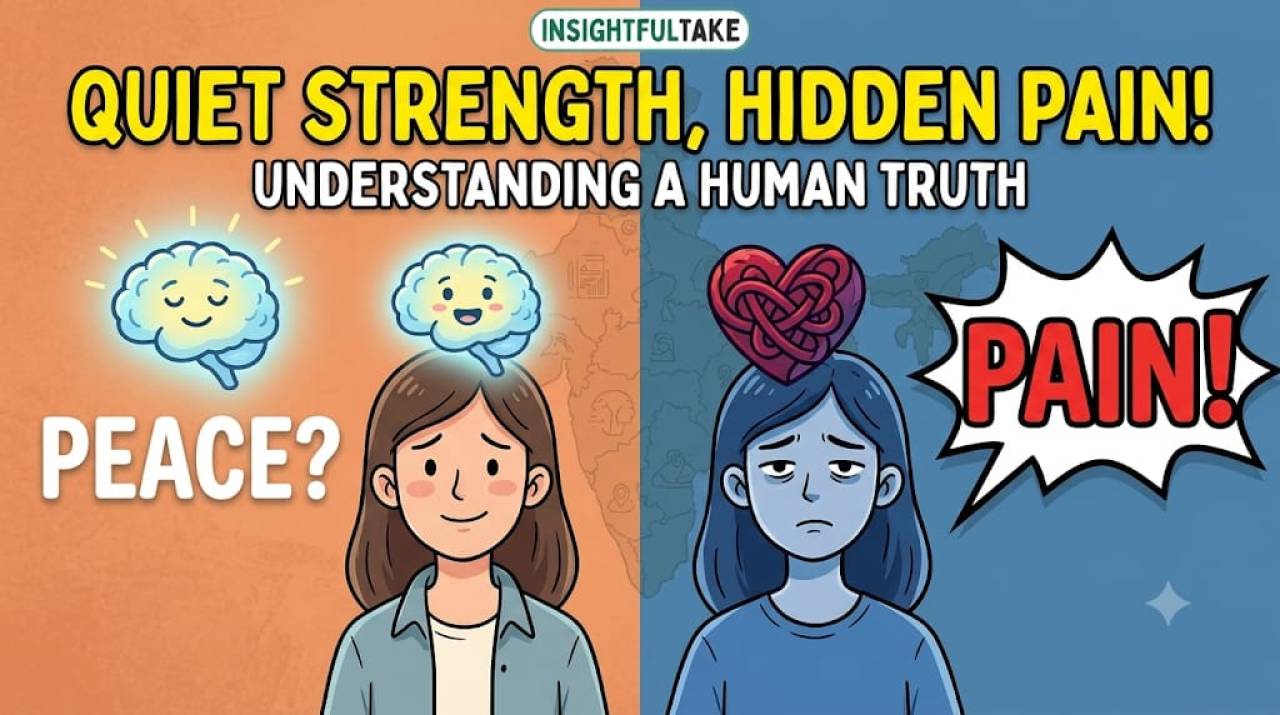
This is the internal landscape of sorrow. For these individuals, pain turns inward. It becomes a loop of replayed memories, quiet self-interrogation, unanswered what ifs, and a heavy ache that never quite reaches the eyes. This is not a lack of feeling. It is often feeling too much, too densely, to be released through tears. Their grief shows up in quiet moments—lying awake at night, staring out of a window, or smiling through conversations while their mind is elsewhere, occupied with its private weight.
This inward way of mourning is frequently misunderstood. A person who does not cry at a funeral may be seen as cold or detached. In reality, the opposite is often true. Their mind may be so crowded with thoughts—about the person lost, the fragility of life, the memories that now carry pain—that the body’s more automatic response is overridden. They are grieving in a different currency. Their tears are made of memory and reflection, not saltwater.
Why we lean toward one language or the other is shaped by many factors. Biology plays a role; some nervous systems are simply more physically reactive. Culture and upbringing matter deeply as well. Many societies, and even families, carry unspoken rules about who is allowed to cry and when. Boys, in particular, are often taught—directly or indirectly—that showing tears is a weakness. Over time, sadness gets redirected into silence, anger, or inward withdrawal. Personal history counts too. Someone who was shamed or punished for crying as a child may learn to keep sorrow locked inside, where it feels safer.
The real problem arises when these two languages are mistaken for character flaws. Those who cry with thoughts may see tearful mourners as dramatic or performative. Those who cry easily may view silent grievers as emotionally closed off. This misunderstanding creates distance at precisely the moment when connection is most needed. In shared moments of loss—such as the death of a friend—some people gather in visible grief, while others stand quietly apart, isolated in their own way of experiencing the same pain.
The healthier response is not to choose one language over the other, but to recognise both—and learn how to listen. If you cry with thoughts, remember that tears are not shallow; they are simply immediate. Allowing someone space to cry is a form of care. If you cry with tears, remember that silence is not emptiness. It may hold a deep, restless ocean of feeling. For some people, a gentle question—“What’s on your mind right now?”—offers more comfort than an embrace.
In the end, whether sorrow flows down our cheeks or moves quietly through the corridors of the mind, it speaks to the same human capacity to care. Pain and loss are universal. There is no single correct way to carry them. A tear is a thought made visible. And a heavy thought is a tear turned inward. Both are real. Both are human. Recognising this makes room for a world where no one has to grieve in a language that goes unheard.



.jpeg)





















Leave a Comment