
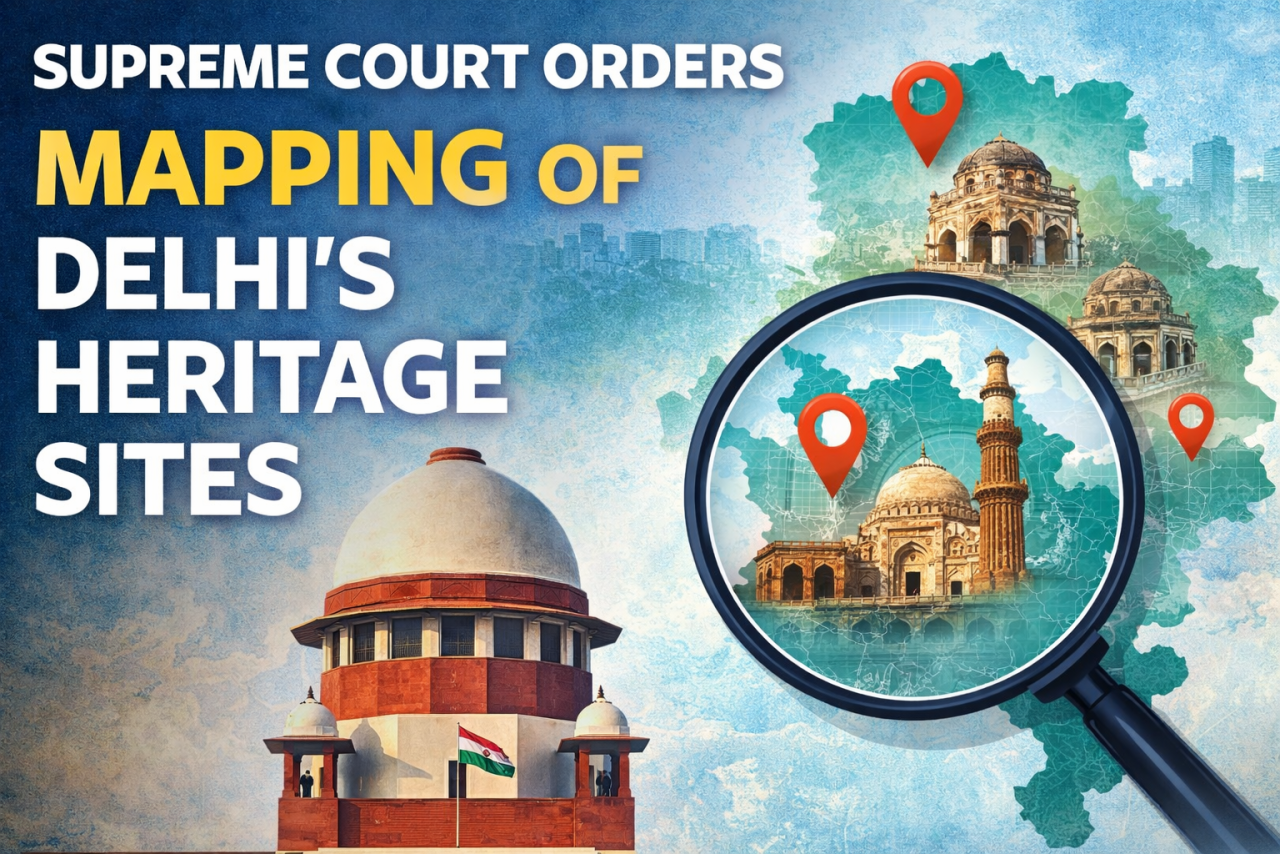
Delhi’s importance does not come only from its political status, but from the many historical layers that continue to exist within its urban landscape. From ancient settlements and Sultanate-era mosques to Mughal tombs and colonial buildings, the city carries the marks of several civilisations. These structures are not only stones and walls. They shape Delhi’s culture, everyday life, and sense of identity. In this context, the Supreme Court’s recent decision to order a detailed mapping of Delhi’s heritage sites is both timely and necessary.
The court has asked multiple civic and government bodies to jointly map and report on the condition of Delhi’s notified heritage structures. This includes agencies such as the Archaeological Survey of India (ASI), the Delhi government’s archaeology department, the Municipal Corporation of Delhi (MCD), the New Delhi Municipal Council (NDMC), and others. The aim is simple and important to understand what heritage exists, who is responsible for it, and how it can be protected in a planned manner.
Delhi’s heritage problem is not a lack of history, but a lack of coordination. According to existing records, around 1,650 heritage structures are officially notified in the city. Of these, only 174 are protected by the ASI. The rest fall under different authorities, including the Delhi government, NDMC, and MCD. This division has created confusion and neglect. Many monuments fall between departments, with no single authority taking full responsibility. As a result, several sites are damaged, encroached upon, or simply forgotten.
The case that led to the Supreme Court’s order began with a petition related to the Gumti of Shaikh Ali, a 700-year-old Lodi-era monument located in Defence Colony. The structure had suffered years of neglect and unauthorised occupation. Only after court intervention was the site cleared, restored, and formally notified as a protected monument. This single example highlights a larger issue that many heritage structures are saved only when citizens approach the courts.
Petitioners and experts have pointed out that conservation efforts in Delhi often follow an “ad hoc” approach. Some monuments receive attention because they are famous or located in high-visibility areas, while others slowly decay in crowded neighbourhoods. Without a proper survey and mapping exercise, authorities do not even have updated information on the condition of many sites. Some heritage lists are over a decade old and do not reflect current realities on the ground.
Mapping heritage sites is not merely about making lists. It is about understanding how history exists within a fast-growing city. Delhi’s population pressure and real estate demand pose serious threats to old structures. Many monuments are surrounded by illegal construction or used for storage, parking, or even garbage dumping. Simply notifying a monument does not guarantee its safety. Protection requires scientific conservation methods, regular monitoring, and community awareness.
Heritage also has a strong connection with lifestyle and culture. Old stepwells, mosques, tombs, and havelis tell stories of how people lived, worshipped, and organised their cities. Losing these sites means losing links to traditions, crafts, and local histories. For residents living around these monuments, they are part of daily life, not distant tourist attractions. When preserved properly, heritage sites can improve neighbourhoods, create cultural spaces, and even support local livelihoods through responsible tourism.
The Supreme Court has emphasised the need for a uniform and systematic plan for conservation. This includes time-bound surveys, clear division of responsibility among agencies, and the use of modern conservation techniques. Importantly, the court has also allowed ongoing restoration work to continue while seeking detailed responses from authorities. This balanced approach recognises both urgency and practicality.
Delhi’s Master Plan already acknowledges the importance of heritage, based on studies conducted by organisations such as INTACH. However, planning documents alone are not enough unless they are followed by action on the ground. Mapping heritage sites is the first step towards accountability. Once authorities know exactly what exists and who is responsible, neglect becomes harder to justify.
In a city that is constantly rebuilding itself, heritage mapping acts as a reminder that development should not erase history. Delhi’s past does not stand in opposition to its future. Instead, it enriches it. By taking heritage seriously, the city can grow in a way that respects its roots while meeting modern needs.
The Supreme Court’s order is therefore not just a legal directive. It is an opportunity to rethink how Delhi treats its history. If implemented sincerely, heritage mapping can protect monuments, strengthen cultural identity, and ensure that future generations inherit a city that remembers where it came from.
By Gautam Jha
Managing Editor




























Leave a Comment