
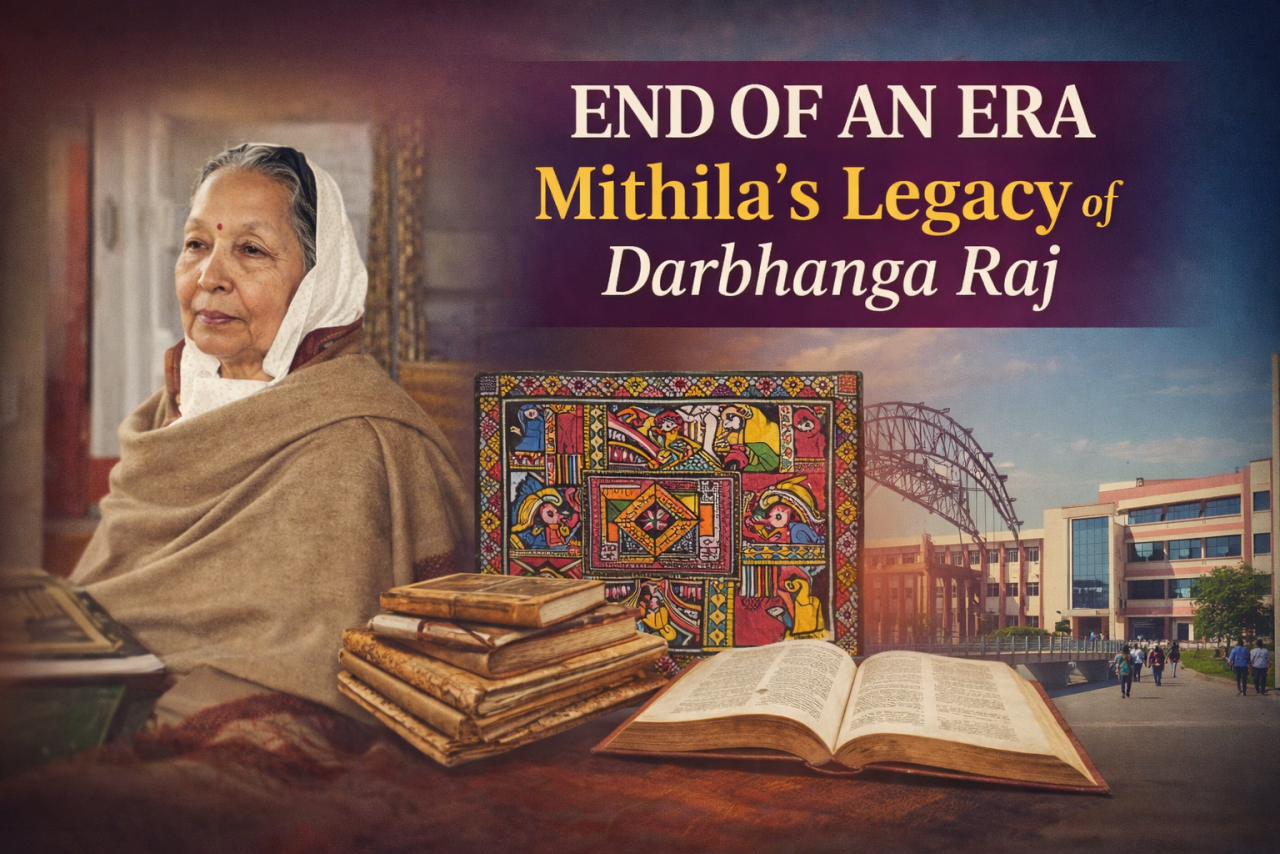
The death of Maharani Kamsundari Devi at the age of 93 marks the end of a significant chapter in the history of the Darbhanga Raj. As the last surviving Maharani of one of India’s most influential zamindari estates, her life spanned a period of profound transition, from royal authority under colonial rule to democratic governance in independent India. Even after the abolition of the zamindari system, she remained a respected and recognisable figure in Mithila’s social and cultural life.
Maharani Kamsundari Devi, also known as Maharani Kalyani Devi, was the third wife of Maharajadhiraja Sir Kameshwar Singh, the last ruling Maharaja of Darbhanga. She married into a family that once commanded extraordinary wealth and influence, but her public life was defined by restraint rather than display. She lived quietly at Kalyani Niwas in Darbhanga, which over time came to symbolise continuity and cultural stewardship rather than political power.
Following Independence, when the Darbhanga Raj lost its formal status, the Maharani continued to be regarded as a moral and cultural reference point. The people of Mithila looked to her as a custodian of tradition at a time when rapid political and social change was reshaping regional identities.
The prominence of the Darbhanga Raj in Indian history provides important context to her role. The Maharajas of Darbhanga were known for their philanthropy and their support for education and nation-building institutions. The family contributed to the establishment and growth of institutions such as Banaras Hindu University, the University of Calcutta, and the University of Allahabad. These values of public service and intellectual patronage continued to influence the royal household long after formal rule ended.
Maharani Kamsundari Devi upheld this legacy, particularly through her support for Maithili language, literature, and scholarship. She ensured the preservation of royal libraries and manuscripts, helping maintain access to important historical and philosophical texts. Her association with the Kameshwar Singh Darbhanga Sanskrit University reflected her commitment to sustaining traditional learning within a modern academic framework.
She also played an important role in supporting local artisans, especially those associated with Mithila painting. Her encouragement helped bring wider recognition to this art form and contributed to its transformation into a viable source of livelihood, particularly for rural women. In doing so, she helped preserve a key element of Mithila’s cultural identity while enabling economic support for local communities.
Her charitable work, carried out through various trusts, focused on education, healthcare, and basic welfare in Darbhanga and surrounding areas. These efforts followed the philanthropic traditions of the Darbhanga royal family and were widely acknowledged, even though the Maharani herself maintained a low public profile.
Despite the shift to democratic governance, Maharani Kamsundari Devi continued to serve as a unifying presence during religious and cultural events. Her participation in ceremonies at places such as the Madhweshwar Temple and her support for initiatives like the promotion of the Mithila Paag reinforced cultural pride among Maithili-speaking communities.
Her passing was met with widespread mourning across Bihar. Senior government officials and political leaders paid tribute, recognising that the Darbhanga royal family’s contributions extended beyond the region and had national significance. Public statements recalled the family’s history of opening its resources in times of need.
With her death, Mithila has lost a figure who represented continuity between past and present. While royal authority has long since disappeared, the values Maharani Kamsundari Devi embodied, education, cultural preservation, and public responsibility, remain relevant. Her legacy lies not in titles or ceremony, but in the lasting influence she had on the social and cultural life of Mithila.
By Gunja Jha
Vice President, Mithilakshar Saksharta Abhiyan
Email: gunjatathagat@gmail.com




















Leave a Comment