
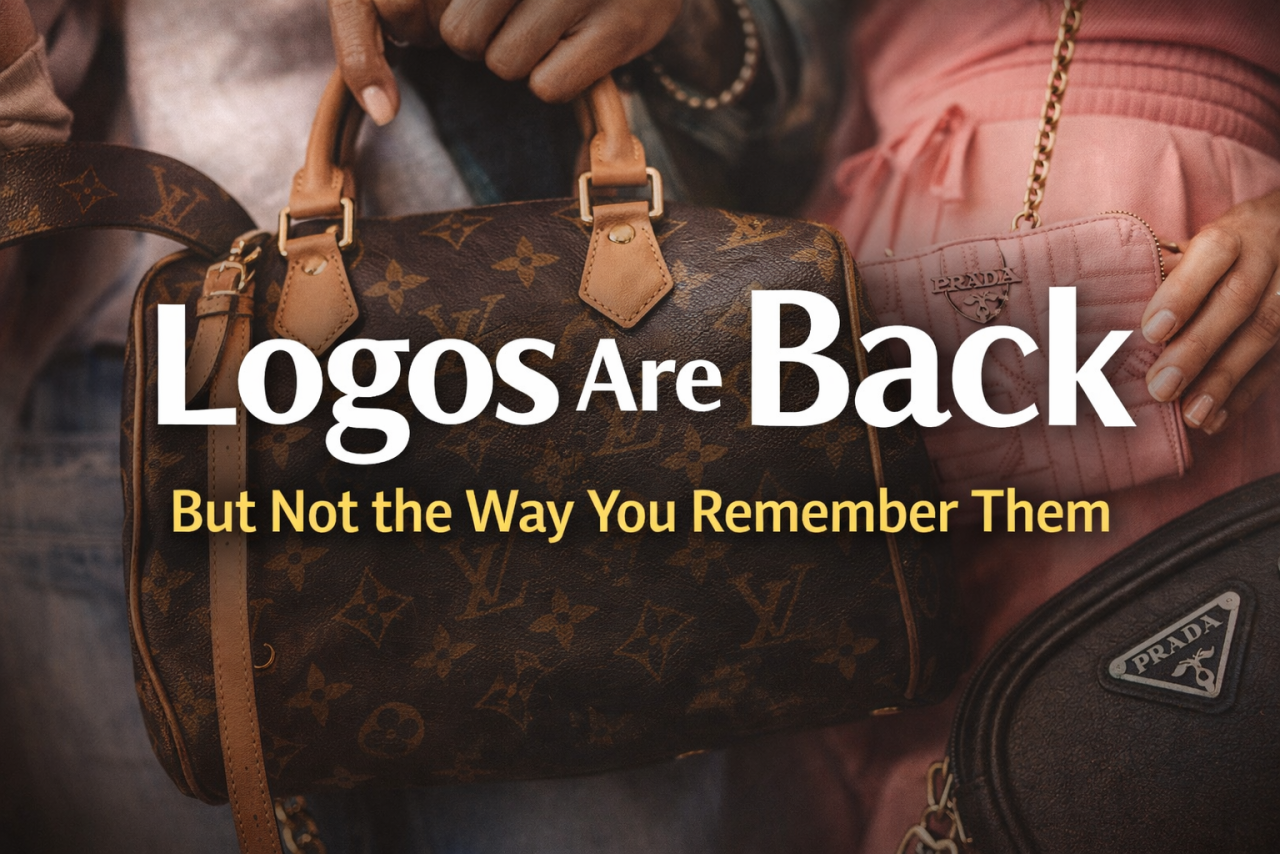
Logos once screamed for attention—now they’re playing a far more intriguing game. They haven’t disappeared; they’ve just learned the art of being seen only by those who know where to look.
There was a time when logos didn’t just exist on clothes—they dominated them. They stretched boldly across T-shirts, wrapped themselves around handbags, and turned everyday fashion into a billboard of aspiration. Wearing a logo meant more than style; it was a declaration of identity, status, and belonging.
Then came the quiet.
Over the past decade, fashion took a deliberate turn away from loud branding. Labels shrank, sometimes disappearing altogether. Luxury stopped announcing itself and instead leaned into understatement—fine tailoring, rich fabrics, and details only a discerning eye could catch. The idea was simple: true style didn’t need validation.
But fashion rarely stays in one place for long.
Today, logos are making a comeback—but not in the way we remember them. They haven’t returned to shout; they’ve returned to whisper. Instead of dominating the outfit, they now live in the margins: a subtle imprint on a strap, a barely visible insignia on a clasp, a quiet signature tucked into a corner. You might miss them if you’re not looking closely—and that’s exactly the point.
This new approach reflects a deeper shift in how we see ourselves. In a world shaped by constant visibility—where social media encourages endless display—there’s a growing desire for control and restraint. People want to express identity without oversharing it. The modern logo fits perfectly into this mindset. It signals taste and affiliation, but only to those who understand its language.
At the same time, branding hasn’t entirely stepped out of the spotlight. In streetwear and youth culture, logos still appear boldly—but often with a twist. They’re stretched, distorted, layered, or reinterpreted. What was once a straightforward symbol of status has become a tool for commentary, irony, or even rebellion. It’s no longer just about wearing a brand; it’s about engaging with it.
Luxury fashion, too, is rewriting its relationship with logos. Designers are no longer treating them as fixed emblems but as flexible elements of design. Monograms are being broken apart, rearranged, or hidden within patterns. Sometimes they’re obvious, sometimes they’re nearly invisible. Either way, they invite the wearer to participate—to notice, to interpret, to decide how much to reveal.
What’s fascinating is how this evolution changes who the logo speaks to. In its earlier form, it was inclusive in a loud, almost aggressive way—anyone could recognise it from across the room. Now, it’s selective. A logo placed on a bag strap or stitched into a lining might go unnoticed by most, but for those who recognise it, it carries a quiet significance. It’s less about mass attention and more about meaningful recognition.
There’s also a sense of nostalgia woven into this comeback. For those who grew up in the era of bold branding, the return of logos feels familiar. But it’s no longer the same story. Years of minimalism have reshaped our tastes, making us more appreciative of subtlety. The result is a new kind of balance—where memory meets modernity.
Fashion today isn’t choosing between loud and quiet; it’s learning to blend both. A single piece can carry a hidden logo and a bold statement at the same time. It can reveal itself differently depending on who’s looking and how closely they’re paying attention.
So, where did the logo go?
It never really disappeared. It simply adapted—stepping back, softening its presence, and waiting for the right moment to return.
And now that it has, it doesn’t need to shout to be heard.



















Leave a Comment