
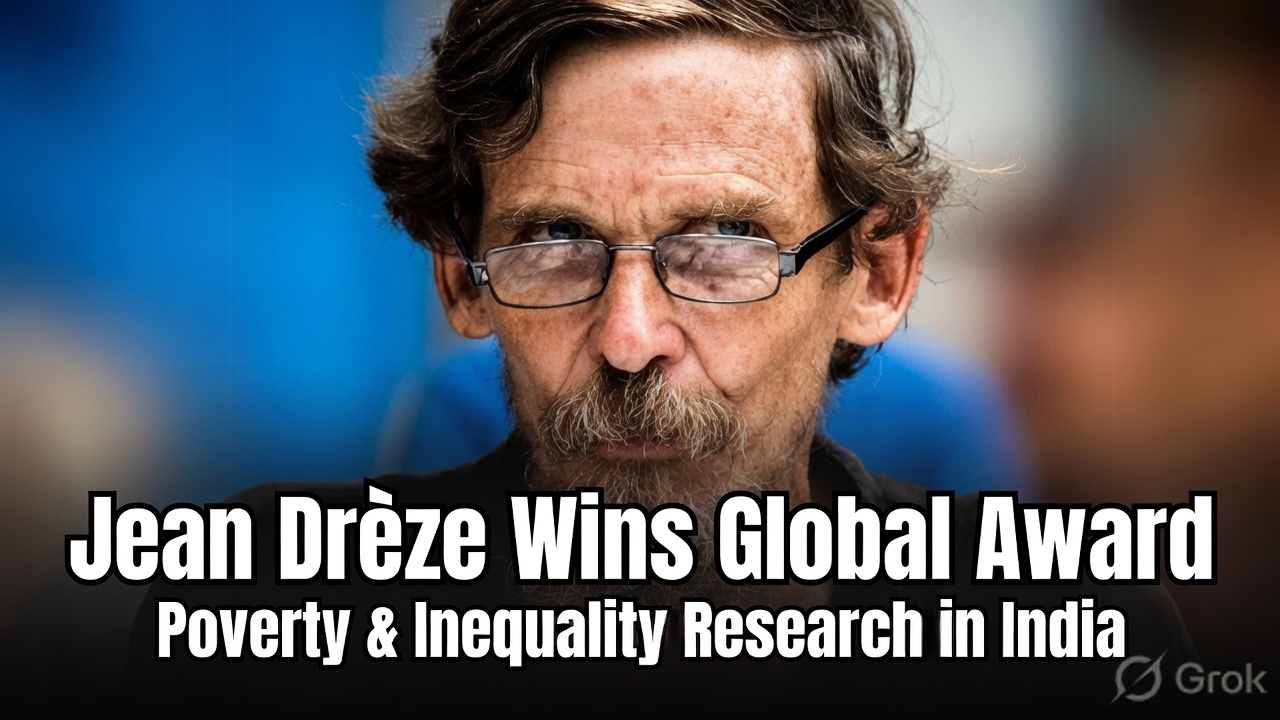
Can research change lives? Jean Drèze’s globally recognized work on poverty and inequality has helped shape policies that impact millions across India.
The global debate on economic and social inequality received renewed attention at the World Inequality Conference hosted by the Paris School of Economics, where renowned welfare economist Jean Drèze was awarded the prestigious 2026 Global Inequality Research Award (GiRA). Presented biennially by the World Inequality Lab and Sciences Po, the award recognizes scholars whose work has significantly advanced the understanding of inequality and its impact on societies.
Drèze was honoured for his pioneering contributions to poverty and inequality research in India, as well as his decades-long advocacy for rights-based social welfare policies. Accepting the award, he emphasized the collective nature of his work, stating that the recognition belonged not only to him but also to the many individuals and grassroots organizations striving for social change.
Invoking the words of Dr. B. R. Ambedkar, Drèze described India as a “museum of inequality,” a society where immense wealth disparities coexist with deeply entrenched caste divisions, educational inequalities, and gender discrimination. His remarks underscored a central theme of his life’s work: inequality cannot be understood solely through economic indicators but must be examined through the broader social structures that shape opportunity and deprivation.
Research That Connects Data with Human Lives
At the heart of Drèze’s international recognition lies a body of work that has consistently bridged rigorous academic research with practical policy solutions. Throughout his career, he has challenged conventional approaches to measuring poverty, arguing that income alone fails to capture the realities faced by millions of people.
His influential works, including Hunger and Public Action and An Uncertain Glory: India and Its Contradictions, co-authored with Nobel laureate Amartya Sen, helped popularize a multidimensional understanding of poverty. This approach considers factors such as education, healthcare, nutrition, and social inclusion alongside income levels.
Drèze’s research has highlighted several structural challenges that continue to shape inequality in India. He has drawn attention to the limitations of household survey data used in poverty estimation, warning that incomplete or flawed datasets can obscure the true extent of deprivation. His studies have also documented the prolonged stagnation of real agricultural wages, revealing that periods of economic growth do not necessarily translate into improved living standards for rural workers.
Perhaps most significantly, his work demonstrates how economic disadvantage is often reinforced by caste hierarchies, gender bias, and geographic exclusion. These overlapping barriers create what he describes as a cycle of inherited inequality that is difficult for vulnerable communities to escape.
Turning Research into Rights
Unlike many academics whose influence remains confined to journals and conferences, Drèze has played a direct role in shaping public policy. His research has served as the intellectual foundation for some of India’s most transformative welfare initiatives.
One of these is the Mahatma Gandhi National Rural Employment Guarantee Act (MGNREGA), which established a legal right to employment for rural households. Drawing on evidence that seasonal unemployment pushed millions into poverty, the programme sought to provide a reliable source of income and strengthen rural livelihoods.
Another landmark achievement is the National Food Security Act (NFSA). Built upon years of research into malnutrition and food distribution systems, the legislation guarantees subsidized food grains to a large share of India’s population, making food security a legal entitlement rather than a discretionary welfare benefit.
Together, these policies reflect Drèze’s belief that social protection should be based on rights rather than charity.
Defending Welfare in a Changing India
Even as he receives global acclaim, Drèze remains focused on contemporary challenges facing India’s welfare architecture. In recent years, he has raised concerns about increasing bureaucratic hurdles within social assistance programmes.
He has been particularly critical of mandatory Aadhaar-based biometric authentication for accessing food rations, arguing that technical failures can exclude the poorest citizens from essential services. His writings also caution against weakening employment guarantees through administrative reforms that may dilute the protections originally envisioned under MGNREGA.
For Drèze, the struggle against inequality is not only about creating new policies but also about safeguarding existing rights from erosion.
A Legacy Beyond Academia
Jean Drèze’s recognition with the 2026 Global Inequality Research Award highlights the enduring importance of research that engages directly with social realities. His career demonstrates that data and statistics are not merely academic exercises; they can serve as powerful tools for exposing injustice, informing public debate, and shaping policies that improve lives.
In a world increasingly defined by widening social and economic divides, Drèze’s work stands as a reminder that meaningful change begins with understanding inequality in all its dimensions—and having the courage to confront it.
The global debate on economic and social inequality received renewed attention at the World Inequality Conference hosted by the Paris School of Economics, where renowned welfare economist Jean Drèze was awarded the prestigious 2026 Global Inequality Research Award (GiRA). Presented biennially by the World Inequality Lab and Sciences Po, the award recognizes scholars whose work has significantly advanced the understanding of inequality and its impact on societies.
Drèze was honoured for his pioneering contributions to poverty and inequality research in India, as well as his decades-long advocacy for rights-based social welfare policies. Accepting the award, he emphasized the collective nature of his work, stating that the recognition belonged not only to him but also to the many individuals and grassroots organizations striving for social change.
Invoking the words of Dr. B. R. Ambedkar, Drèze described India as a “museum of inequality,” a society where immense wealth disparities coexist with deeply entrenched caste divisions, educational inequalities, and gender discrimination. His remarks underscored a central theme of his life’s work: inequality cannot be understood solely through economic indicators but must be examined through the broader social structures that shape opportunity and deprivation.
Research That Connects Data with Human Lives
At the heart of Drèze’s international recognition lies a body of work that has consistently bridged rigorous academic research with practical policy solutions. Throughout his career, he has challenged conventional approaches to measuring poverty, arguing that income alone fails to capture the realities faced by millions of people.
His influential works, including Hunger and Public Action and An Uncertain Glory: India and Its Contradictions, co-authored with Nobel laureate Amartya Sen, helped popularize a multidimensional understanding of poverty. This approach considers factors such as education, healthcare, nutrition, and social inclusion alongside income levels.
Drèze’s research has highlighted several structural challenges that continue to shape inequality in India. He has drawn attention to the limitations of household survey data used in poverty estimation, warning that incomplete or flawed datasets can obscure the true extent of deprivation. His studies have also documented the prolonged stagnation of real agricultural wages, revealing that periods of economic growth do not necessarily translate into improved living standards for rural workers.
Perhaps most significantly, his work demonstrates how economic disadvantage is often reinforced by caste hierarchies, gender bias, and geographic exclusion. These overlapping barriers create what he describes as a cycle of inherited inequality that is difficult for vulnerable communities to escape.
Turning Research into Rights
Unlike many academics whose influence remains confined to journals and conferences, Drèze has played a direct role in shaping public policy. His research has served as the intellectual foundation for some of India’s most transformative welfare initiatives.
One of these is the Mahatma Gandhi National Rural Employment Guarantee Act (MGNREGA), which established a legal right to employment for rural households. Drawing on evidence that seasonal unemployment pushed millions into poverty, the programme sought to provide a reliable source of income and strengthen rural livelihoods.
Another landmark achievement is the National Food Security Act (NFSA). Built upon years of research into malnutrition and food distribution systems, the legislation guarantees subsidized food grains to a large share of India’s population, making food security a legal entitlement rather than a discretionary welfare benefit.
Together, these policies reflect Drèze’s belief that social protection should be based on rights rather than charity.
Defending Welfare in a Changing India
Even as he receives global acclaim, Drèze remains focused on contemporary challenges facing India’s welfare architecture. In recent years, he has raised concerns about increasing bureaucratic hurdles within social assistance programmes.
He has been particularly critical of mandatory Aadhaar-based biometric authentication for accessing food rations, arguing that technical failures can exclude the poorest citizens from essential services. His writings also caution against weakening employment guarantees through administrative reforms that may dilute the protections originally envisioned under MGNREGA.
For Drèze, the struggle against inequality is not only about creating new policies but also about safeguarding existing rights from erosion.
A Legacy Beyond Academia
Jean Drèze’s recognition with the 2026 Global Inequality Research Award highlights the enduring importance of research that engages directly with social realities. His career demonstrates that data and statistics are not merely academic exercises; they can serve as powerful tools for exposing injustice, informing public debate, and shaping policies that improve lives.
In a world increasingly defined by widening social and economic divides, Drèze’s work stands as a reminder that meaningful change begins with understanding inequality in all its dimensions—and having the courage to confront it.

















Leave a Comment