
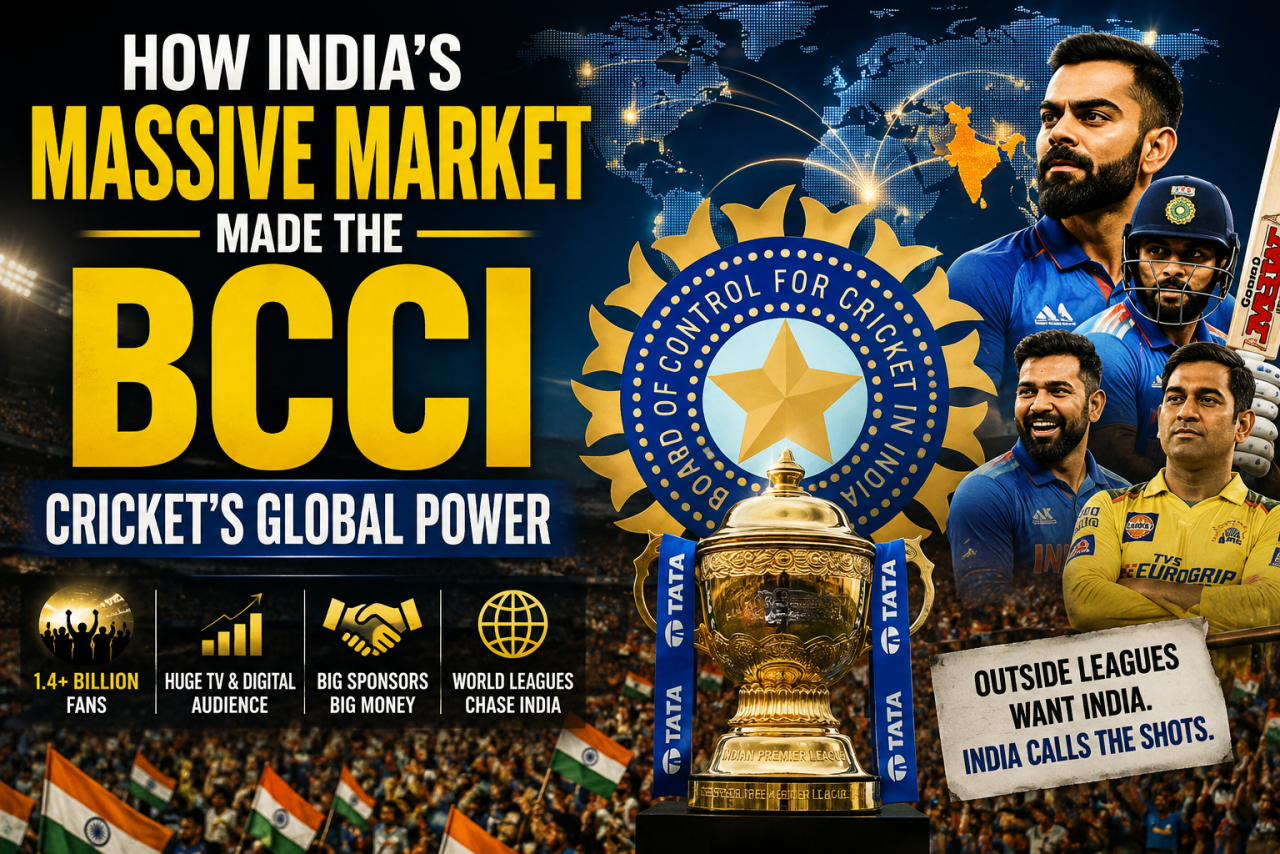
The BCCI's dominance isn't just about trophies. It's about India's unmatched cricket market, the IPL's commercial success, and why global leagues are chasing retired Indian stars.
India, home to more than 1.4 billion people, represents one of the world's most lucrative consumer markets. Any product that wins the confidence of Indian consumers gains access to an unparalleled scale of commercial opportunity. Cricket offers perhaps the clearest example of how market size can reshape the balance of power in an international sport.
The game in India is governed by the Board of Control for Cricket in India (BCCI), which has transformed India's enormous fan base into unmatched financial and strategic influence. The turning point came in 1987 when India and Pakistan jointly hosted the Reliance World Cup, the first Cricket World Cup ever staged outside England. The tournament demonstrated the commercial potential of the Indian subcontinent and marked the beginning of a new era in cricket administration.
Over the following decades, the BCCI steadily strengthened its financial position by attracting sponsors, broadcasters, advertisers, and millions of passionate fans. Today, it occupies the most influential position in world cricket and possesses the ability to shape major decisions affecting the global game. One example of this influence is its long-standing policy of not allowing active Indian men's cricketers to participate in overseas franchise leagues without its approval. As a result, the Indian Premier League (IPL) has retained its status as the world's premier T20 competition.
Indian cricketers command enormous fan followings, making them among the most valuable sporting personalities in the world. Their presence guarantees packed stadiums, soaring television ratings, and increased sponsorship revenue. The BCCI has successfully leveraged this commercial strength, ensuring that much of cricket's global financial ecosystem revolves around the Indian market.
Consequently, franchise leagues around the world are eager to tap into India's vast audience. Since active Indian players are generally unavailable, overseas leagues have increasingly turned to retired Indian cricketers as ambassadors, mentors, commentators, and franchise representatives to attract Indian viewers and sponsors.
South Africa's SA20 provides a notable example. The league appointed former Indian wicketkeeper-batter Dinesh Karthik as an ambassador after his retirement from international cricket and the IPL. His association with the Paarl Royals franchise is intended not only to enhance the league's global profile but also to strengthen its appeal among Indian audiences and the Indian diaspora in markets such as the United Kingdom.
Other leagues have followed a similar strategy. The Caribbean Premier League (CPL) explored opportunities with former India batter Ambati Rayudu, while the UAE's International League T20 (ILT20) brought in retired Indian stars such as Robin Uthappa and Yusuf Pathan for the Dubai Capitals. These appointments reflect a broader recognition that retired Indian cricketers remain commercially valuable because of their enduring popularity.
Cricket Australia also signalled this trend when former India Under-19 World Cup-winning captain Unmukt Chand joined the Big Bash League (BBL) after leaving Indian domestic cricket. At the time, the move surprised many observers. In hindsight, it illustrated the growing desire among overseas leagues to establish stronger connections with the Indian cricket audience.
The strategy extends beyond players. International leagues increasingly recruit renowned Indian commentators to enhance their broadcasts for Indian viewers. Ravi Shastri and Harsha Bhogle have featured in Big Bash League coverage, while legendary Indian opener Sunil Gavaskar has also worked on international broadcasts, including tournaments held in the United States. Their presence adds credibility and familiarity for audiences who closely follow Indian cricket.
The underlying message is clear. Modern cricket is influenced not only by sporting excellence but also by market economics. India's enormous audience has become the sport's greatest commercial asset, and the BCCI has mastered the art of converting that advantage into global influence.
There is also a broader lesson beyond cricket. Rather than viewing India's vast population solely as a developmental challenge, policymakers could increasingly regard it as a strategic economic asset. Just as the BCCI transformed a large fan base into global leadership, India's demographic scale, if supported by investment in education, skills, infrastructure, and innovation, could become one of the country's greatest strengths in achieving inclusive and sustainable economic growth.
India, home to more than 1.4 billion people, represents one of the world's most lucrative consumer markets. Any product that wins the confidence of Indian consumers gains access to an unparalleled scale of commercial opportunity. Cricket offers perhaps the clearest example of how market size can reshape the balance of power in an international sport.
The game in India is governed by the Board of Control for Cricket in India (BCCI), which has transformed India's enormous fan base into unmatched financial and strategic influence. The turning point came in 1987 when India and Pakistan jointly hosted the Reliance World Cup, the first Cricket World Cup ever staged outside England. The tournament demonstrated the commercial potential of the Indian subcontinent and marked the beginning of a new era in cricket administration.
Over the following decades, the BCCI steadily strengthened its financial position by attracting sponsors, broadcasters, advertisers, and millions of passionate fans. Today, it occupies the most influential position in world cricket and possesses the ability to shape major decisions affecting the global game. One example of this influence is its long-standing policy of not allowing active Indian men's cricketers to participate in overseas franchise leagues without its approval. As a result, the Indian Premier League (IPL) has retained its status as the world's premier T20 competition.
Indian cricketers command enormous fan followings, making them among the most valuable sporting personalities in the world. Their presence guarantees packed stadiums, soaring television ratings, and increased sponsorship revenue. The BCCI has successfully leveraged this commercial strength, ensuring that much of cricket's global financial ecosystem revolves around the Indian market.
Consequently, franchise leagues around the world are eager to tap into India's vast audience. Since active Indian players are generally unavailable, overseas leagues have increasingly turned to retired Indian cricketers as ambassadors, mentors, commentators, and franchise representatives to attract Indian viewers and sponsors.
South Africa's SA20 provides a notable example. The league appointed former Indian wicketkeeper-batter Dinesh Karthik as an ambassador after his retirement from international cricket and the IPL. His association with the Paarl Royals franchise is intended not only to enhance the league's global profile but also to strengthen its appeal among Indian audiences and the Indian diaspora in markets such as the United Kingdom.
Other leagues have followed a similar strategy. The Caribbean Premier League (CPL) explored opportunities with former India batter Ambati Rayudu, while the UAE's International League T20 (ILT20) brought in retired Indian stars such as Robin Uthappa and Yusuf Pathan for the Dubai Capitals. These appointments reflect a broader recognition that retired Indian cricketers remain commercially valuable because of their enduring popularity.
Cricket Australia also signalled this trend when former India Under-19 World Cup-winning captain Unmukt Chand joined the Big Bash League (BBL) after leaving Indian domestic cricket. At the time, the move surprised many observers. In hindsight, it illustrated the growing desire among overseas leagues to establish stronger connections with the Indian cricket audience.
The strategy extends beyond players. International leagues increasingly recruit renowned Indian commentators to enhance their broadcasts for Indian viewers. Ravi Shastri and Harsha Bhogle have featured in Big Bash League coverage, while legendary Indian opener Sunil Gavaskar has also worked on international broadcasts, including tournaments held in the United States. Their presence adds credibility and familiarity for audiences who closely follow Indian cricket.
The underlying message is clear. Modern cricket is influenced not only by sporting excellence but also by market economics. India's enormous audience has become the sport's greatest commercial asset, and the BCCI has mastered the art of converting that advantage into global influence.
There is also a broader lesson beyond cricket. Rather than viewing India's vast population solely as a developmental challenge, policymakers could increasingly regard it as a strategic economic asset. Just as the BCCI transformed a large fan base into global leadership, India's demographic scale, if supported by investment in education, skills, infrastructure, and innovation, could become one of the country's greatest strengths in achieving inclusive and sustainable economic growth.
























Leave a Comment