
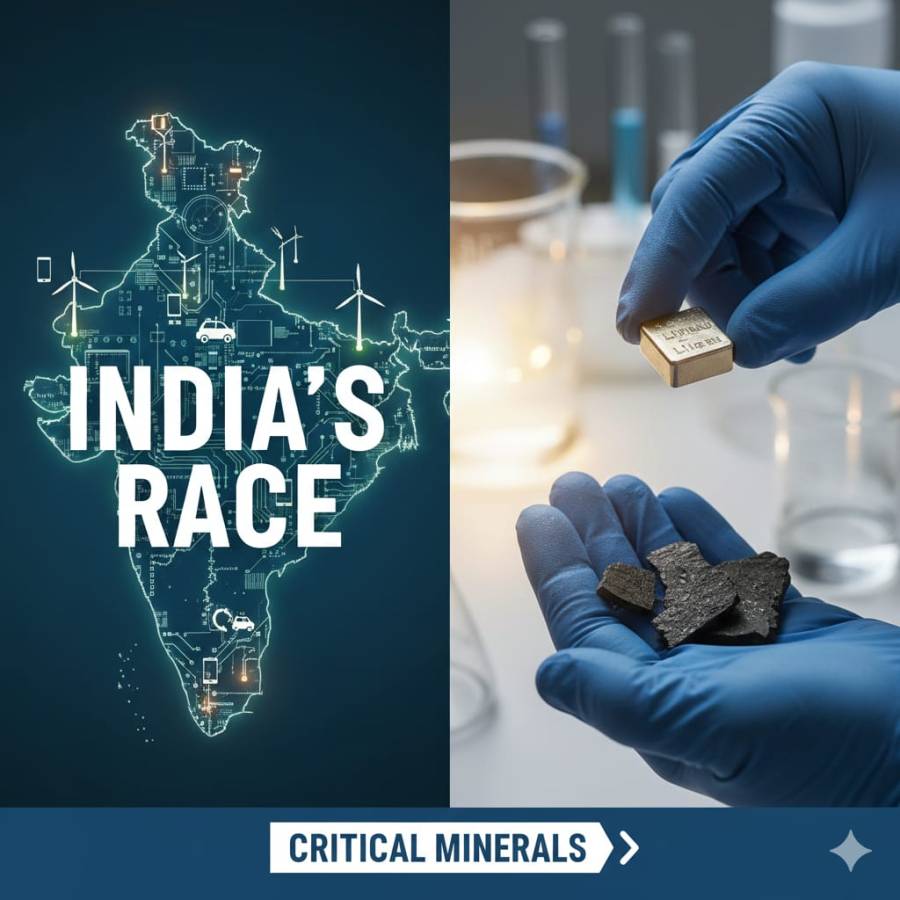
Critical minerals are quietly becoming the backbone of the modern economy. Lithium, cobalt, graphite, and rare earth elements are now as important as oil once was. They power electric vehicles, renewable energy systems, batteries, and advanced electronics. As India works toward its Viksit Bharat 2047 vision, ensuring steady and secure access to these minerals has become essential.
Global demand for critical minerals has surged as countries push for clean energy and lower emissions. Yet supply chains remain fragile and uneven. As of early 2026, China dominates the most sensitive part of the chain—the processing and refining stage, known as the midstream. China processes nearly 90 percent of the world’s rare earth elements and holds a strong grip over lithium and cobalt refining.
For India, this concentration is a concern. Even when minerals are sourced from friendly nations like Australia, Chile, or Argentina, they often need to be processed in China before reaching Indian factories. This dependence affects costs, delays production, and raises long-term strategic risks for India’s energy and manufacturing ambitions.
Why Processing Is India’s Biggest Challenge
Experts Amitabh Kant and Adil Rana Chhina have rightly pointed out that India’s weakness does not lie in exploration but in processing. India has increased mineral exploration in recent years, with over 230 projects launched in 2025–26. However, mining alone does not create value.
The real advantage lies in the midstream, where raw minerals are turned into high-quality materials used in batteries and electronics. India has traditionally imported finished materials instead of building refining capacity at home. As a result, it has remained a downstream consumer rather than a full participant in the global clean energy supply chain.
To address this gap, the government launched the National Critical Mineral Mission (NCMM) in 2025 with funding of more than ₹34,000 crore. The aim is not just to buy minerals but to gain ownership and control over processing assets, both in India and abroad. This marks a shift from dependence to participation.
India’s Path Forward: Partnerships, Processing, and Recycling
India is now taking a broader and more practical approach. Through Khanij Bidesh India Limited (KABIL), it is investing directly in overseas mineral assets, including lithium projects in Argentina and copper-cobalt discussions in Zambia. These moves give India equity access rather than simple trade links.
At home, the government plans to develop Critical Mineral Processing Parks, especially near ports. These hubs will offer faster approvals, reliable power, and water—key requirements for refining industries. The goal is to attract private investment and reduce long project delays.
Technology is another critical area. India is using international partnerships to close the knowledge gap. In early 2026, India and Germany agreed to set up a joint Centre of Excellence focused on rare earth processing and clean separation technologies. Similar cooperation with Australia and the US is helping India build technical capability.
Recycling is also becoming part of the solution. Since new mines take years to develop, India is investing ₹1,500 crore in urban mining to recover lithium and cobalt from used batteries and electronic waste. By 2031, India plans to build a recycling capacity of 270 kilotons, creating a steady secondary supply of critical minerals.
Recent policy steps, such as removing basic customs duties on 25 critical minerals, have already lowered costs for domestic manufacturers. Still, India remains fully dependent on imports for minerals like lithium and nickel. To move faster, private investment must be encouraged through clear regulations, assured demand, and long-term supply agreements.
In the end, India’s critical minerals push is about more than industry. It is about strategic autonomy. If India succeeds in building strong processing and refining capabilities, it will not only secure its clean energy future but also claim a meaningful place in the global green economy.
By Gautam Jha
Managing Editor










Leave a Comment