
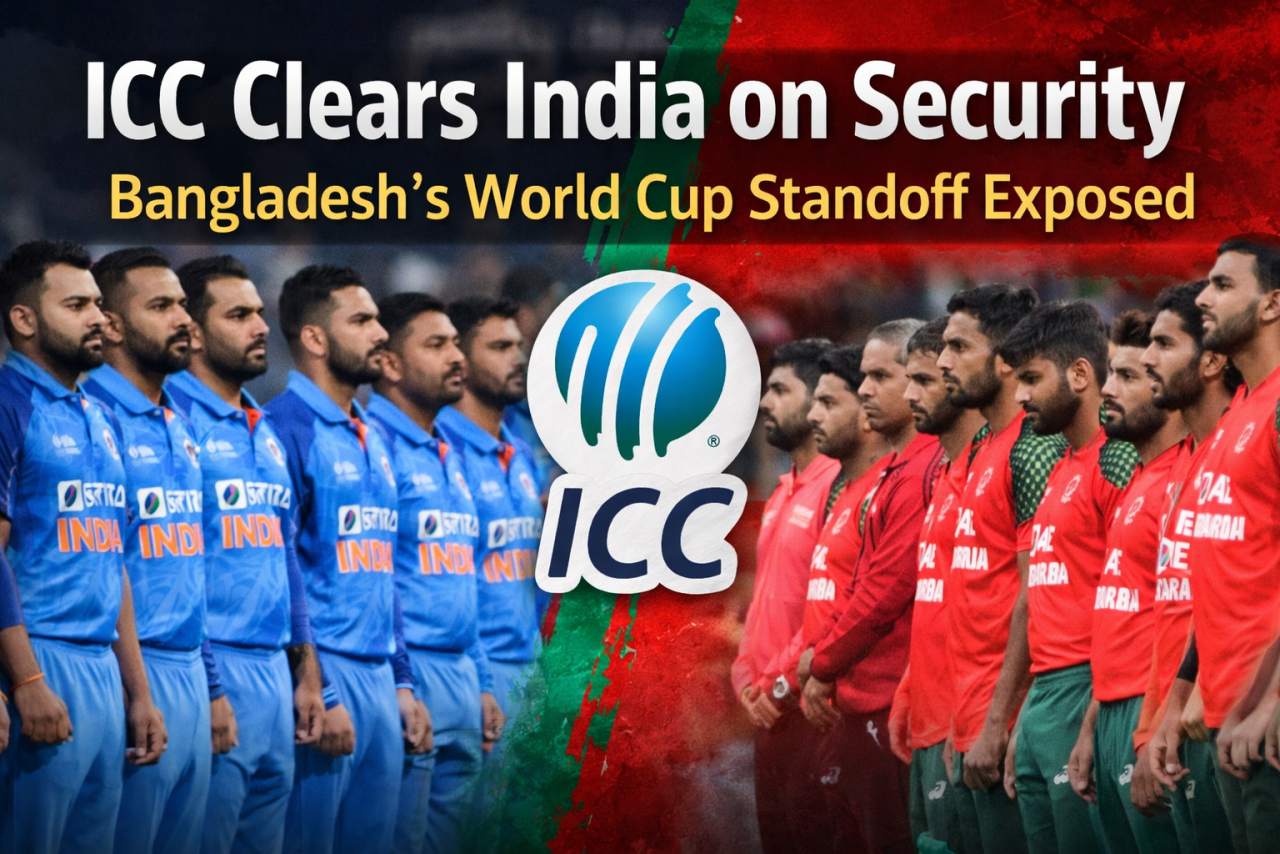
The long-simmering cricketing standoff between India and Bangladesh has entered a decisive phase. After weeks of speculation, political signalling, and administrative brinkmanship, the International Cricket Council’s latest independent security assessment has delivered a clear verdict: there is no specific or direct threat to the Bangladesh cricket team if it plays its scheduled matches in India during the 2026 ICC Men’s T20 World Cup.
The finding, reported in national dailies, fundamentally alters the narrative that has driven the Bangladesh Cricket Board’s (BCB) demand to relocate its World Cup fixtures from India. The ICC assessment, conducted through internationally recognised security agencies and shared with both boards, categorised the overall risk environment as low to moderate—a level consistent with other major sporting events hosted by India in recent years. Crucially, the report did not identify any intelligence-based or location-specific threat directed at Bangladesh’s players, officials, or supporters.
With this clarification, the burden of justification now rests firmly with Dhaka.
From Bilateral Tensions to a Global Cricket Issue
The current crisis did not erupt overnight. Relations between the two boards deteriorated sharply following the removal of Bangladeshi fast bowler Mustafizur Rahman from the 2026 Indian Premier League. Bought by Kolkata Knight Riders for ₹9.2 crore, Mustafizur’s contract was terminated after the Board of Control for Cricket in India intervened, citing unspecified “recent developments.” While no official explanation was offered, the decision was widely read as a response to the worsening political climate between the two countries and reports of unrest in Bangladesh.
Dhaka’s reaction was immediate and severe. The Bangladeshi government described the move as discriminatory and imposed a blanket ban on the broadcast of IPL matches within the country—an unprecedented step aimed squarely at Indian cricket’s commercial ecosystem. What began as a bilateral dispute soon escalated into a broader confrontation involving the ICC.
The Relocation Demand—and ICC’s Firm Response
Invoking safety concerns, the BCB formally requested that its T20 World Cup matches, scheduled for Kolkata and Mumbai, be shifted to Sri Lanka. The argument leaned heavily on precedent, drawing comparisons with Pakistan’s hybrid hosting arrangements in previous ICC tournaments.
The ICC, however, rejected the analogy. Unlike Pakistan’s case—shaped by decades of documented security incidents and sustained diplomatic hostility—the Bangladesh request was not supported by independent threat assessments. Today’s ICC report reinforces that position. Officials have indicated that granting a venue shift without substantiated risk would undermine the governing body’s credibility and invite similar demands driven by political considerations rather than security realities.
The message from the ICC has been unambiguous: Bangladesh must honour the tournament schedule or risk forfeiting points and facing disciplinary consequences.
The Sharfuddoula Question
Adding to the complexity is a contradiction that has not gone unnoticed. While the BCB insists India is unsafe for its national team, Bangladeshi elite umpire Sharfuddoula Ibne Shahid Saikat is currently officiating international matches in India, including the ongoing India–New Zealand ODI series in Vadodara.
His presence has raised uncomfortable questions. If India poses a genuine security risk, how does that threat selectively apply only to players? The BCB’s response has been procedural rather than persuasive. Umpires’ committee chairman Iftekhar Rahman has stated that Saikat operates under an ICC contract that mandates automatic release for international assignments, leaving the board with no discretion.
While technically accurate, the explanation reinforces perceptions of inconsistency—and weakens the moral force of the BCB’s broader argument.
A Test of Authority and Intent
The ICC’s security clearance has transformed the dispute from one of alleged safety to one of intent. Bangladesh’s continued resistance now appears rooted more in political signalling than in demonstrable risk. For the ICC, the episode represents a critical test of institutional authority. Yielding without evidence would set a destabilising precedent in an already politicised global sport.
For Bangladesh, the stakes are equally high. Persisting with a boycott could isolate the board within the ICC framework and damage its standing in future negotiations. For India, the episode underscores both its centrality in world cricket and the scrutiny that accompanies that position.
A Rivalry Redefined
Once defined by competitive imbalance and regional ambition, the India–Bangladesh cricket relationship has hardened into something colder and more transactional. As the 2026 T20 World Cup approaches, the ICC has drawn its line. The security question, at least on paper, has been settled.
The next move belongs to Dhaka and it may shape the future contours of South Asian cricket far beyond a single tournament.





















Leave a Comment