
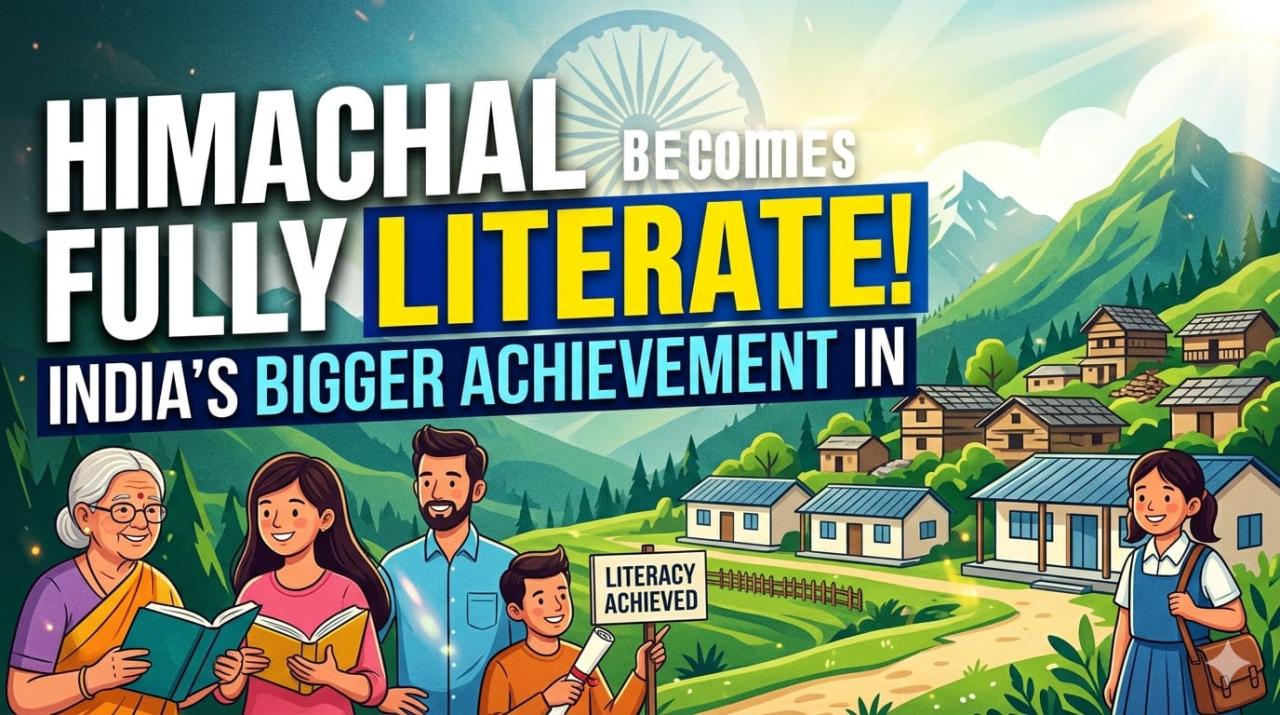
Himachal Pradesh has entered India’s elite “fully literate” club—but while states celebrate milestones, the bigger question is whether India is truly catching up with global education standards.
In a country where literacy has long been a battleground for progress, Himachal Pradesh has carved out a proud milestone. The Himalayan state has become the fourth fully literate state in India, after Tripura, Mizoram, and Goa, under the Union government’s Ullas (Understanding Lifelong Learning for All in Society) programme. This recognition places Himachal in a rare league, but it also throws light on the enormous gap India still faces when compared to most Western countries.
Defining Full Literacy
Under the Ullas scheme, a state is considered fully literate when at least 95% of its population above the age of 15 can read, write, and perform basic numeracy tasks essential for daily life. Himachal Pradesh has not only crossed this benchmark but has reached an impressive 99.30%, significantly higher than the national average of 95%. Chief Minister Sukhvinder Singh Sukhu also highlighted another achievement: Himachal now ranks first in the country in terms of student–teacher ratio, a critical factor in improving the quality of education.
A Nationwide Literacy Drive
Launched in 2022 with an outlay of over ₹1,037 crore, the Ullas scheme is more than just a classroom initiative. It aims to empower those above 15 years who missed formal schooling, integrating them into society and the economy. In its fourth year, the scheme has already touched 29.7 million learners with the help of 5.5 million volunteers. By combining hybrid learning, volunteer-led outreach, and digital platforms in 26 Indian languages, it attempts to bridge India’s literacy deficit.
The progress is undeniable. India’s literacy rate has risen from 74% in 2011 to 80.9% in 2023–24. Yet, the figures also reveal the task ahead. While Himachal and a handful of smaller states are setting examples, vast regions across the country remain far behind.
The Global Context
For India, the challenge is not just to celebrate these successes but to confront the international reality. Most Western countries boast literacy rates close to 99% for decades, often accompanied by far stronger education systems and universal access to learning. In comparison, India’s 80.9% literacy rate shows how much catching up is left to do, especially in states where poverty, gender inequality, and infrastructure gaps still obstruct educational progress.
Final Take
Union education minister Dharmendra Pradhan has emphasized that literacy should go beyond the ability to read and write—it must become a lived reality of empowerment, self-reliance, and civic awareness. The government has set its sights on at least 10 more states declaring themselves fully literate by the end of this year. If achieved, it could signal a turning point in India’s march toward universal literacy.
But the larger challenge remains: ensuring that literacy is not just statistical but transformational. That means linking education with skills, livelihoods, digital fluency, and financial literacy. For a country aspiring to compete with the developed world, nothing short of complete and meaningful literacy will do.
In a country where literacy has long been a battleground for progress, Himachal Pradesh has carved out a proud milestone. The Himalayan state has become the fourth fully literate state in India, after Tripura, Mizoram, and Goa, under the Union government’s Ullas (Understanding Lifelong Learning for All in Society) programme. This recognition places Himachal in a rare league, but it also throws light on the enormous gap India still faces when compared to most Western countries.
Defining Full Literacy
Under the Ullas scheme, a state is considered fully literate when at least 95% of its population above the age of 15 can read, write, and perform basic numeracy tasks essential for daily life. Himachal Pradesh has not only crossed this benchmark but has reached an impressive 99.30%, significantly higher than the national average of 95%. Chief Minister Sukhvinder Singh Sukhu also highlighted another achievement: Himachal now ranks first in the country in terms of student–teacher ratio, a critical factor in improving the quality of education.
A Nationwide Literacy Drive
Launched in 2022 with an outlay of over ₹1,037 crore, the Ullas scheme is more than just a classroom initiative. It aims to empower those above 15 years who missed formal schooling, integrating them into society and the economy. In its fourth year, the scheme has already touched 29.7 million learners with the help of 5.5 million volunteers. By combining hybrid learning, volunteer-led outreach, and digital platforms in 26 Indian languages, it attempts to bridge India’s literacy deficit.
The progress is undeniable. India’s literacy rate has risen from 74% in 2011 to 80.9% in 2023–24. Yet, the figures also reveal the task ahead. While Himachal and a handful of smaller states are setting examples, vast regions across the country remain far behind.
The Global Context
For India, the challenge is not just to celebrate these successes but to confront the international reality. Most Western countries boast literacy rates close to 99% for decades, often accompanied by far stronger education systems and universal access to learning. In comparison, India’s 80.9% literacy rate shows how much catching up is left to do, especially in states where poverty, gender inequality, and infrastructure gaps still obstruct educational progress.
Final Take
Union education minister Dharmendra Pradhan has emphasized that literacy should go beyond the ability to read and write—it must become a lived reality of empowerment, self-reliance, and civic awareness. The government has set its sights on at least 10 more states declaring themselves fully literate by the end of this year. If achieved, it could signal a turning point in India’s march toward universal literacy.
But the larger challenge remains: ensuring that literacy is not just statistical but transformational. That means linking education with skills, livelihoods, digital fluency, and financial literacy. For a country aspiring to compete with the developed world, nothing short of complete and meaningful literacy will do.















Leave a Comment