
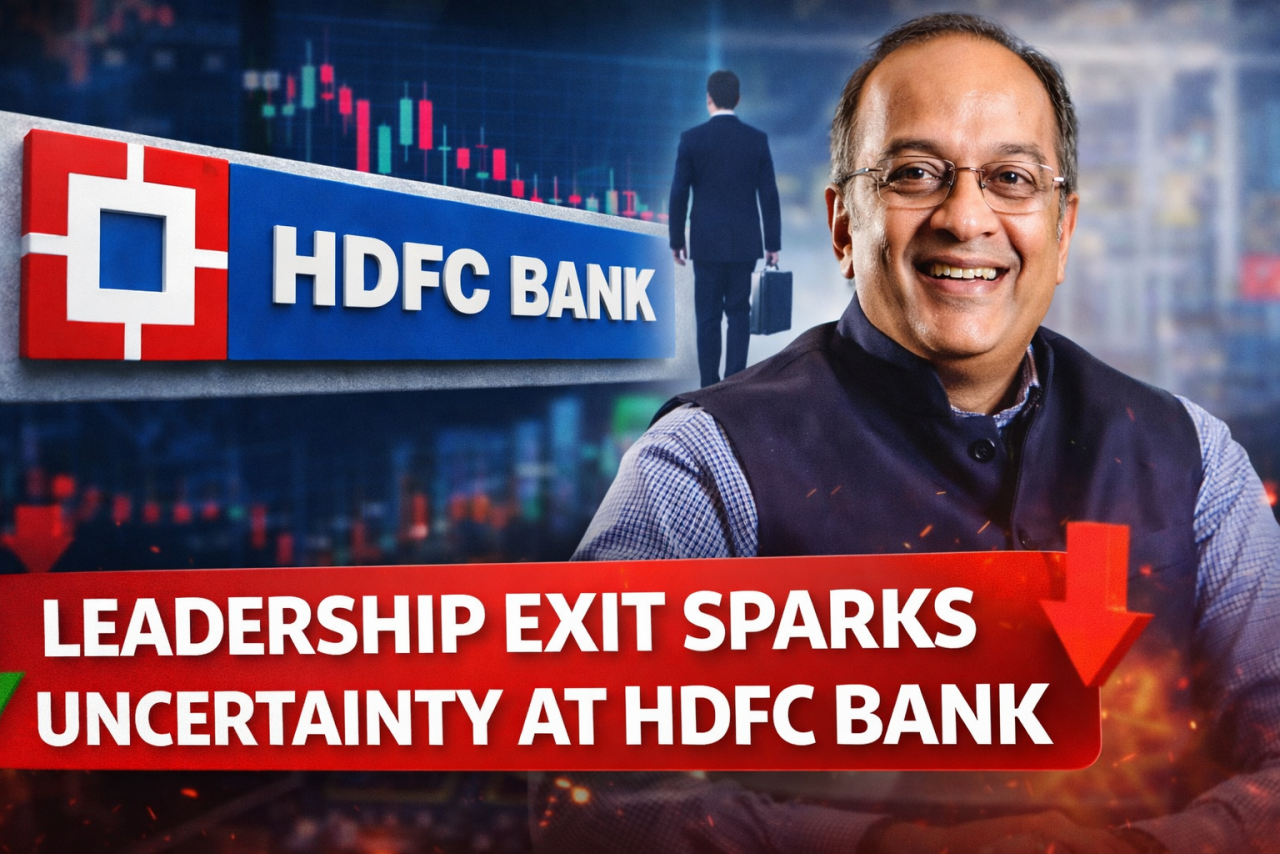
A sudden exit at the top, unanswered questions in the middle, and rising unease at the bottom—HDFC Bank now finds itself battling not just market volatility, but a growing trust deficit.
The sudden resignation of Atanu Chakraborty has cast a shadow over HDFC Bank, unsettling investors and raising fresh questions about governance transparency at India’s largest private sector lender. While the bank’s leadership has attempted to calm nerves, the lack of clarity surrounding the exit has left markets searching for answers.
In the immediate aftermath of the announcement, investor sentiment turned cautious. Shares came under pressure as stakeholders struggled to interpret what appeared to be a significant leadership change without a clearly articulated reason. In a market that thrives on clarity and forward guidance, ambiguity often translates into volatility—and that is precisely what has unfolded.
Chief Executive Officer Sashidhar Jagdishan acknowledged the uncertainty, stating that concerns arise when issues are hinted at but not fully explained. His remarks subtly pointed to the core of the problem: the resignation has been framed around “issues” without explicitly detailing their nature. This has created a vacuum where speculation thrives, something the bank now needs to actively manage.
Jagdishan emphasized that when an issue is clearly spelled out, it becomes easier for institutions to address it decisively. However, when concerns remain vague, they lead to multiple interpretations, making it harder for investors to assess risk. His comments reflect a broader truth in corporate governance—transparency is not just a regulatory requirement, but a cornerstone of market confidence.
The CEO indicated that the board is preparing to take a more proactive approach. Multiple meetings are expected as directors assess whether there are gaps that need tightening, whether operational or regulatory in nature. This signals that the bank is not dismissing the situation as routine, but instead treating it as a moment that requires introspection and possibly structural reinforcement.
Importantly, Jagdishan noted that the concerns could span a range of areas—from operational lapses to regulatory or conduct-related issues. However, he also made it clear that the absence of specifics from the former chairman has limited the board’s ability to respond swiftly and decisively. In essence, the bank is being asked to solve a problem that has not been fully defined.
This has naturally led to questions about whether these issues were raised earlier during the chairman’s tenure. Jagdishan suggested that as the head of the board, Chakraborty would have been aware of any significant concerns. Yet, the fact that they were not explicitly documented or communicated in detail has added another layer of complexity to the current situation.
For investors, the uncertainty extends beyond the immediate leadership gap. There are concerns about the future direction of the bank, especially at a time when leadership stability is critical for maintaining growth momentum and regulatory alignment. The appointment of an interim chairman has provided temporary continuity, but the market is keenly watching how the bank navigates the transition over the coming months.
Jagdishan confirmed his willingness to continue as CEO, subject to board and regulatory approvals, which offers a degree of stability. At the same time, the board has a defined window to evaluate long-term leadership options and ensure compliance with regulatory expectations. This period will be crucial not only for decision-making but also for rebuilding investor trust.
What emerges from this episode is a larger lesson for corporate India. In an era of heightened scrutiny and instant market reactions, communication gaps can have tangible financial consequences. Even a fundamentally strong institution like HDFC Bank is not immune to reputational risk when key developments are not accompanied by sufficient clarity.
The coming weeks will be decisive. If the board can quickly identify, articulate, and address the underlying concerns—whatever they may be—it could restore confidence and stabilize sentiment. However, prolonged ambiguity may continue to weigh on the bank’s perception in the market.
For now, the message from the leadership is one of patience and process. But in the world of finance, where confidence is currency, clarity remains the ultimate reassurance.
























Leave a Comment