
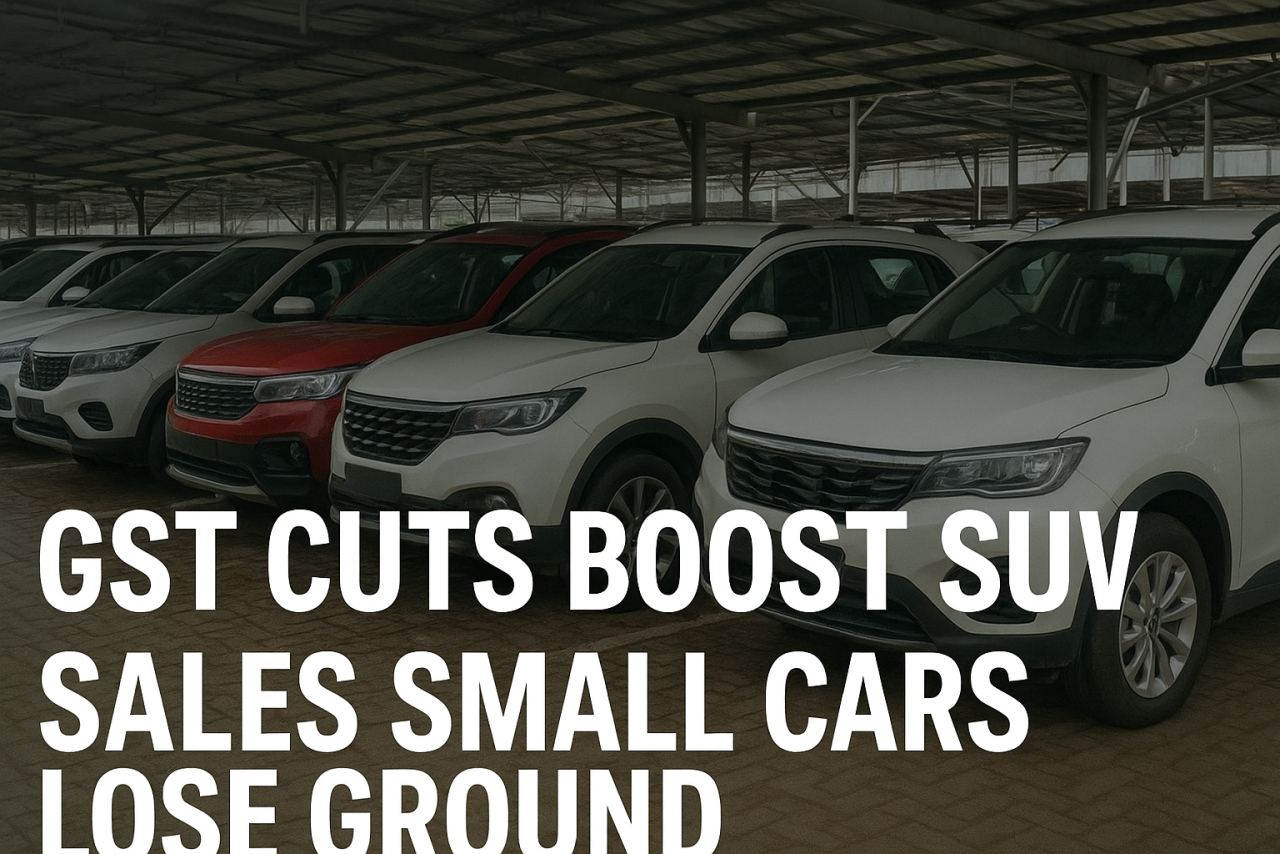
India’s automobile market is witnessing a clear shift in consumer preference. Recent data shows that while sales of compact SUVs have surged after a reduction in Goods and Services Tax (GST), small and mini cars are still finding it difficult to attract buyers. This trend highlights how tax policy, rising incomes, and changing aspirations are reshaping the country’s car market.
According to data released by the Society of Indian Automobile Manufacturers (SIAM) for October and November, sales of compact SUVs measuring less than four metres grew by a strong 17 percent year on year. Around 2.07 lakh units were sold during this period. In contrast, mini cars recorded a growth of only 3 percent, with sales reaching just over 22,000 units. These figures make it clear that buyers are increasingly choosing larger and more feature-rich vehicles even when they cost more.
The recent GST cut on cars played an important role in boosting demand. On September 3, the Union government reduced GST on vehicles from 28 percent to 18 percent for cars shorter than four metres. This tax cut applied not only to small cars but also to compact SUVs, which now dominate this size category. As a result, SUVs benefited more from the lower tax rates, making them more attractive to buyers.
Many had hoped that the GST reduction would give a much-needed boost to entry-level cars such as the Maruti Alto, Renault Kwid, and similar models. However, the sales numbers suggest otherwise. Buyers appear willing to spend more for vehicles that offer higher ground clearance, a stronger road presence, and more safety and comfort features. Compact SUVs fit this preference well, while small cars are increasingly seen as basic or outdated.
This shift comes at a time when carmakers are also dealing with tougher emission norms. The upcoming Corporate Average Fuel Efficiency Phase III (CAFE III) norms have intensified discussions around how small cars should be treated under regulations. These norms aim to reduce overall vehicle emissions and fuel consumption, but manufacturers argue that small cars need special consideration.
The draft norms released on September 25 provide some relief for cars weighing less than 909 kilograms by allowing additional benefits in fleet emission calculations. Since most small cars fall under this weight limit, the government has already included some flexibility for them. However, small car makers say this may not be enough.
Maruti Suzuki, India’s largest car manufacturer and a major player in the small car segment, has argued that further relief is required. The company believes special provisions are needed to protect the future of affordable cars in India. It has pitched for additional concessions, stating that small cars play a key role in providing mobility to first-time buyers.
On the other hand, manufacturers with a stronger SUV portfolio such as Tata Motors, Hyundai Motor India, and Mahindra and Mahindra have urged the government to maintain the current definition of small cars based on length rather than weight. They argue that introducing weight-based benefits could distort the market and create uneven advantages.
Industry executives also point out that the decline of small cars is not just due to policy or pricing. Rahul Bharti, senior executive officer at Maruti Suzuki, said that the idea that entry-level customers are abandoning small cars only because of SUVs is misleading. He noted that overall car ownership in India remains low, with only about 3 percent of the population owning a car. While this small group is buying more premium vehicles, the larger challenge is enabling the remaining population to afford any car at all.
Despite price cuts, festive offers, and discounts ranging from ₹1.4 lakh to ₹1.5 lakh, small cars have not seen the expected revival. This muted response suggests that consumer aspirations have changed. Buyers now want better safety ratings, modern interiors, advanced features, and vehicles that feel suitable for both city and highway driving.
The broader passenger vehicle market has shown signs of recovery compared to the first half of the financial year, when sales had fallen sharply. However, the recovery is uneven. Compact SUVs are clearly the winners, while mini and small cars continue to lose relevance.
In the coming months, how emission norms are finalized and whether further policy support is extended to small cars will be crucial. For now, the message from the market is clear. Indian consumers are moving up the value chain, and compact SUVs have become the new preferred choice, even if it means spending more.



.jpeg)



















Leave a Comment