
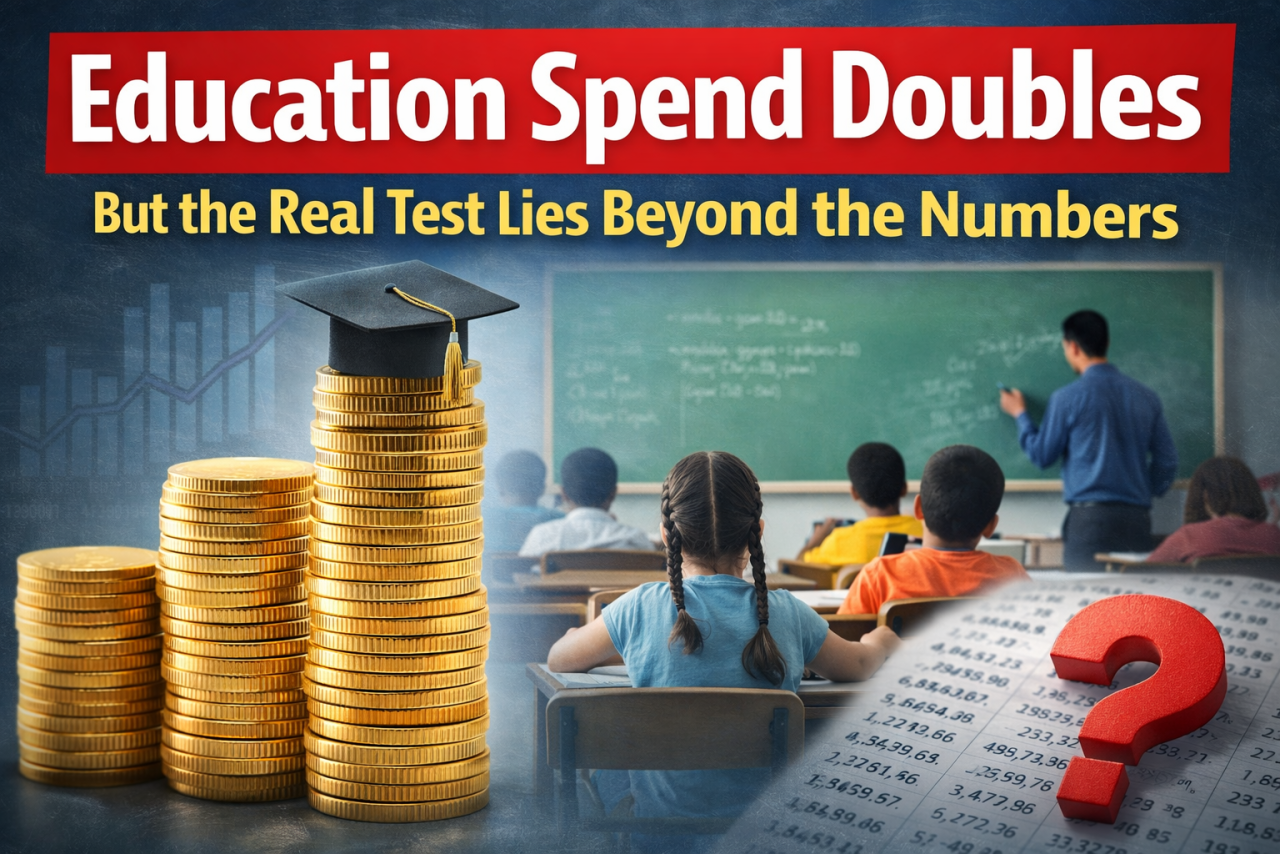
Money is flowing into education like never before—but inside classrooms, the real question remains unanswered: are students actually learning better, or are rising budgets hiding a deeper problem?
Delhi’s education budget has grown sharply over the past decade, more than doubling from around ₹9,000 crore in 2016–17 to nearly ₹19,000 crore in 2025–26. On paper, this looks like a strong commitment to strengthening public education. But a deeper look suggests a more complicated reality—one where rising funds do not necessarily translate into stronger outcomes.
While the total allocation has increased, education’s share in the overall budget has gradually declined. From over 23% a few years ago, it now stands at around 19%. This shift may not seem dramatic at first, but it reflects a subtle change in priorities. Education is still receiving more money, but it is no longer at the center of fiscal focus in the way it once was.
This raises an important question: is the system improving in proportion to the money being spent?
Delhi has often been seen as a model for education reforms. Investments in school infrastructure, teacher training, and curriculum changes have helped reshape public perception of government schools. The shift toward competency-based learning, which focuses on understanding and real-world application rather than rote memorisation, is a step in the right direction. It aligns with the needs of a modern economy where critical thinking and problem-solving are essential.
However, the gap between policy and practice remains a key concern. Reforms are only as effective as their implementation. Teachers need continuous training to adapt to new methods, and schools require consistent support to maintain quality. Without this, even well-designed policies risk losing impact over time.
Efforts to make education more inclusive have also gained attention. Financial support schemes, such as subsidies for uniforms and targeted benefits for economically weaker sections, aim to reduce barriers to access. These measures are crucial in a country where affordability often determines whether a child can stay in school. Yet, access alone is not enough. The real challenge lies in ensuring that students are actually learning and gaining skills that matter.
Another area of focus has been foundational learning, particularly language and communication skills. Initiatives like language labs are designed to improve reading, writing, and speaking abilities from an early stage. This is important because strong foundational skills shape a child’s entire academic journey. But once again, the success of such programmes depends on consistent use and monitoring. Without proper follow-through, they risk becoming underutilised investments.
What emerges from this trend is a shift in the nature of education policy. The focus is moving from expansion to efficiency—from building more schools to improving what happens inside classrooms. This is a necessary transition, but it also demands a more thoughtful approach to spending.
Instead of measuring success purely through budget increases, there is a growing need to evaluate outcomes. Are students performing better? Are dropout rates declining? Are teachers better equipped to handle changing educational needs? These are the indicators that truly matter.
The rise in education funding is undoubtedly a positive sign. It reflects intent and provides an opportunity to drive meaningful change. But the effectiveness of this spending will depend on how well it is translated into real improvements on the ground.
In the end, the question is not just about how much is being spent, but how wisely it is being used. Because when it comes to education, the cost of getting it wrong is far greater than the numbers in any budget.























Leave a Comment