
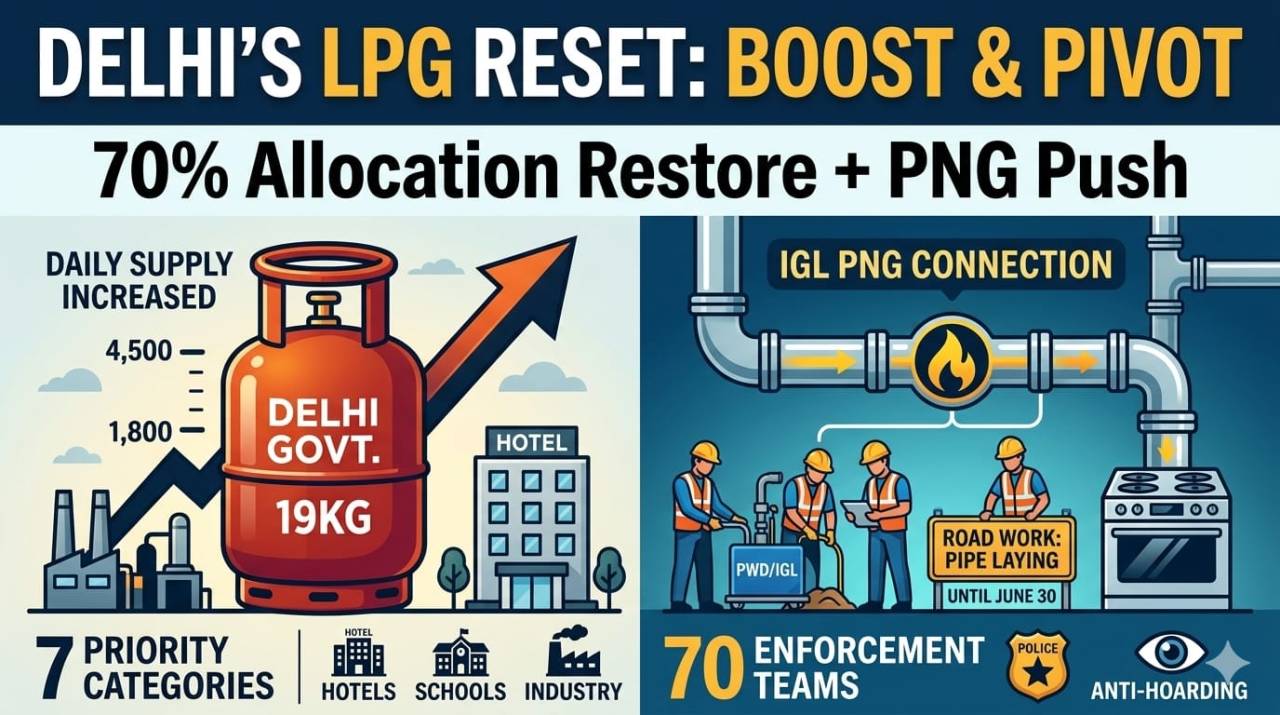
In a city where thousands of kitchens never sleep and factories run on tight margins, fuel is more than a utility—it’s survival. With the Delhi Government ramping up commercial LPG supply to 70%, this isn’t just a policy tweak—it’s a high-stakes reset that could determine how smoothly the capital’s economic engine keeps running.
In a move designed to provide immediate relief to the hospitality and industrial sectors, the Delhi Government has significantly scaled up the daily quota of commercial Liquefied Petroleum Gas (LPG). Under the direction of the Ministry of Petroleum and Natural Gas, the allocation for 19kg commercial cylinders was first hiked from a restricted 20% to 50%, and most recently, restored to 70% of pre-crisis levels.
This calibrated restoration is not merely a logistical update; it is a vital economic lifeline for a city where the "chulha" (stove) of the local dhaba and the boilers of pharmaceutical units are the silent engines of growth.
A Tiered Response to Energy Scarcity
The core of the government’s strategy lies in a seven-priority category framework. By dividing the total daily supply—which has risen from 1,800 to 4,500 and now approximately 6,300 cylinders—the Food and Supplies Department ensures that the most "vulnerable" and "essential" sectors are shielded from the vagaries of the open market.
- The Hospitality Backbone: Hotels, restaurants, and dairies receive the lion's share (75% of the 50% allocation phase). This recognizes the hospitality sector's role as a massive employer and a primary consumer.
- Essential Services: Educational institutions, healthcare facilities, and transport hubs (airports and railway stations) have been guaranteed their full requirement to ensure public services remain uninterrupted.
- The "Protected Social Allocation": In a notable display of social empathy, the government introduced a specific quota for migrant laborers. By supplying 5kg cylinders—totaling roughly 684 equivalent units—the policy protects the daily wage earners who often rely on smaller, portable cylinders for their survival.
Combatting the "Shadow Market"
A primary driver behind this structured allocation is the prevention of hoarding and black-marketing. Minister for Food and Supplies, Manjinder Singh Sirsa, has been vocal about the deployment of 70 joint enforcement teams. These teams are tasked with monitoring the supply chain in real-time to ensure that the increased quota actually reaches the end-user rather than being diverted to the black market at inflated prices.
Violators are being met with the full force of the law, specifically under the Essential Commodities Act and the newly implemented Bharatiya Nyaya Sanhita. This "carrot and stick" approach—providing more supply while tightening oversight—aims to debunk rumors of shortages that often trigger panic buying.
The PNG Pivot: A Condition for Growth
Perhaps the most strategic element of this policy is its link to Piped Natural Gas (PNG). To be eligible for the increased LPG quotas, many commercial entities must now demonstrate a "state of readiness" to transition to PNG.
The logic is twofold:
- Energy Security: Since India imports nearly 90% of its LPG (largely through the Strait of Hormuz), shifting to piped gas reduces the immediate pressure on cylinder logistics.
- Infrastructure Incentives: To expedite this, the Public Works Department (PWD) has waived road restoration charges for Indraprastha Gas Ltd (IGL) to lay pipelines until June 30, 2026. This coordination between departments shows a rare, unified push to modernize Delhi's energy grid.
Economic Resilience in a "Green" Budget Year
This LPG reset arrives on the heels of Delhi’s 2026–27 "Green Budget". With a total outlay of over ₹1 lakh crore, the city is attempting to balance rapid infrastructure growth with environmental sustainability. By prioritizing LPG for sectors like "process industries" (steel, textiles, and chemicals) where gas cannot easily be substituted, the government is protecting the manufacturing base while simultaneously nudging the hospitality sector toward cleaner, piped alternatives.
The recent hike to 70% allocation specifically targets these labor-intensive industries. As Minister Sirsa noted, ensuring that a textile mill or a pharmaceutical plant has the fuel it needs is paramount to preventing a slump in employment.
Final Take
The Delhi government’s intervention is a masterclass in crisis management. By transitioning from a blanket restriction to a nuanced, category-based allocation, they have managed to cool down a heating market. However, the long-term solution remains the successful rollout of PNG.
As long as geopolitical tensions persist in West Asia, the "cylinder economy" will remain fragile. For now, the increased allocation provides the breathing room Delhi's businesses desperately needed, but the message from the Secretariat is clear: the future of Delhi’s commercial energy is not in a bottle, but in a pipe.


.jpeg)





















Leave a Comment