

As India pushes for global sporting glory and a bid to host the 2036 Olympics, a troubling World Anti-Doping Agency report exposes a crisis that threatens to undermine its credibility on the world stage.
India is sprinting toward an ambitious future as a global sporting powerhouse. With an official bid for the 2036 Olympic Games and a steadily rising medal count across international competitions, the narrative has largely been one of progress and promise. Yet a recent report from the World Anti-Doping Agency (WADA) has cast a long and unsettling shadow over these aspirations.
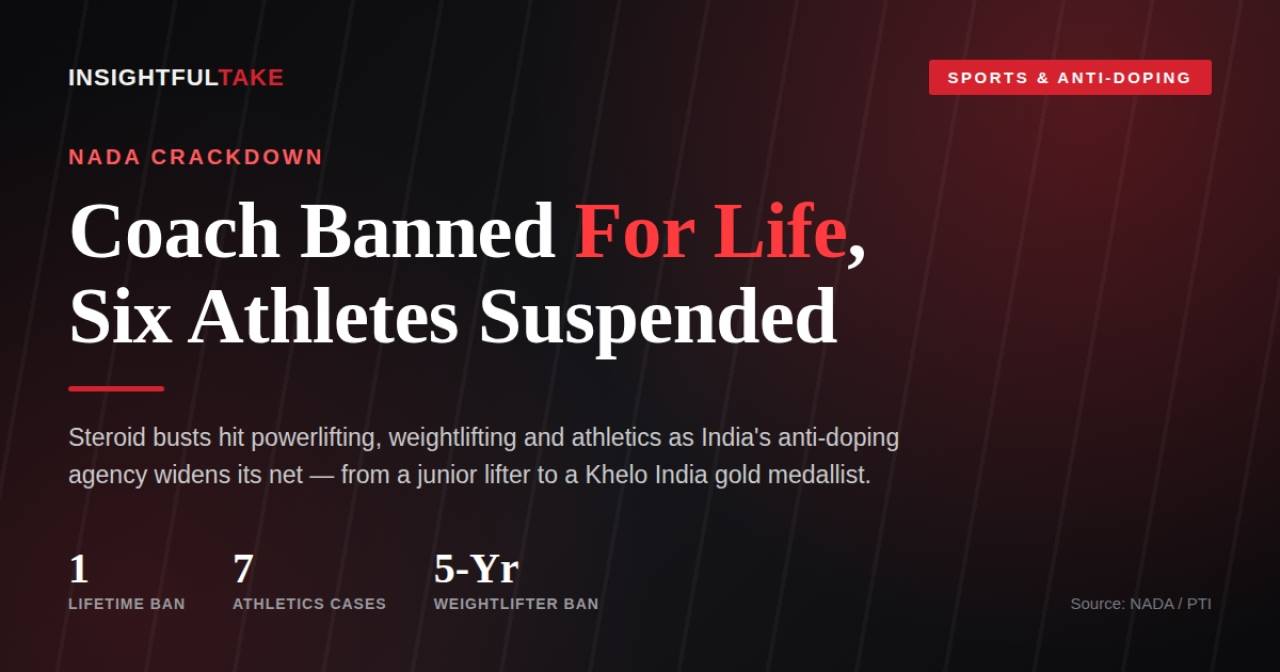
For the third consecutive year, India has topped the global list for doping violations, raising serious questions about the integrity of its sporting ecosystem. In 2024 alone, the National Anti-Doping Agency (NADA) tested 7,097 samples, of which 260 returned positive. The resulting positivity rate of 3.6 percent is not just high; it is alarmingly disproportionate when compared to countries like China, which recorded a positivity rate of just 0.18 percent despite conducting far more tests.
This is not a crisis evenly spread across sports. The data reveals a concentrated problem within India’s most medal-dependent disciplines. Athletics, weightlifting, and wrestling together account for nearly 60 percent of all positive cases. Wrestling, in particular, has emerged as the most vulnerable, with a positivity rate of around 7 percent. In practical terms, one out of every fourteen wrestlers tested was found using banned substances.
Experts point to deep-rooted structural pressures as a key driver of this trend. For many athletes, particularly those from rural and economically weaker backgrounds, sport represents a rare pathway to financial security. A medal at a national competition can translate into a government job, social mobility, and lifelong stability. In such a high-stakes environment, the temptation to seek chemical shortcuts becomes a dangerous gamble.
Compounding the issue is a lack of awareness. Young athletes often depend on unregulated supplements recommended by local trainers or gym operators, many of whom lack proper anti-doping education. What begins as ignorance can quickly spiral into career-ending violations.
NADA maintains that the high number of positive cases reflects more effective, intelligence-led testing rather than a worsening problem. The agency has expanded its outreach through education programs, verification apps, and grassroots workshops. Early indications from 2025 suggest the positivity rate may be declining, but reputational damage is harder to reverse.
For the International Olympic Committee, the principle of clean sport is non-negotiable. As India campaigns to host the 2036 Games, its image as the world’s leading doping offender offers ammunition to critics and rival bidders alike. Hosting the Olympics requires more than infrastructure and enthusiasm; it demands trust.
If India is serious about its Olympic dream, reform must go beyond athlete bans. Accountability must extend to coaches, medical professionals, and suppliers who sustain this underground ecosystem. The road to 2036 is not just about building stadiums and winning medals. It is about restoring faith in fair play.
Until that happens, India’s Olympic dream will remain precariously balanced between podiums and prohibited substances.



















Leave a Comment