
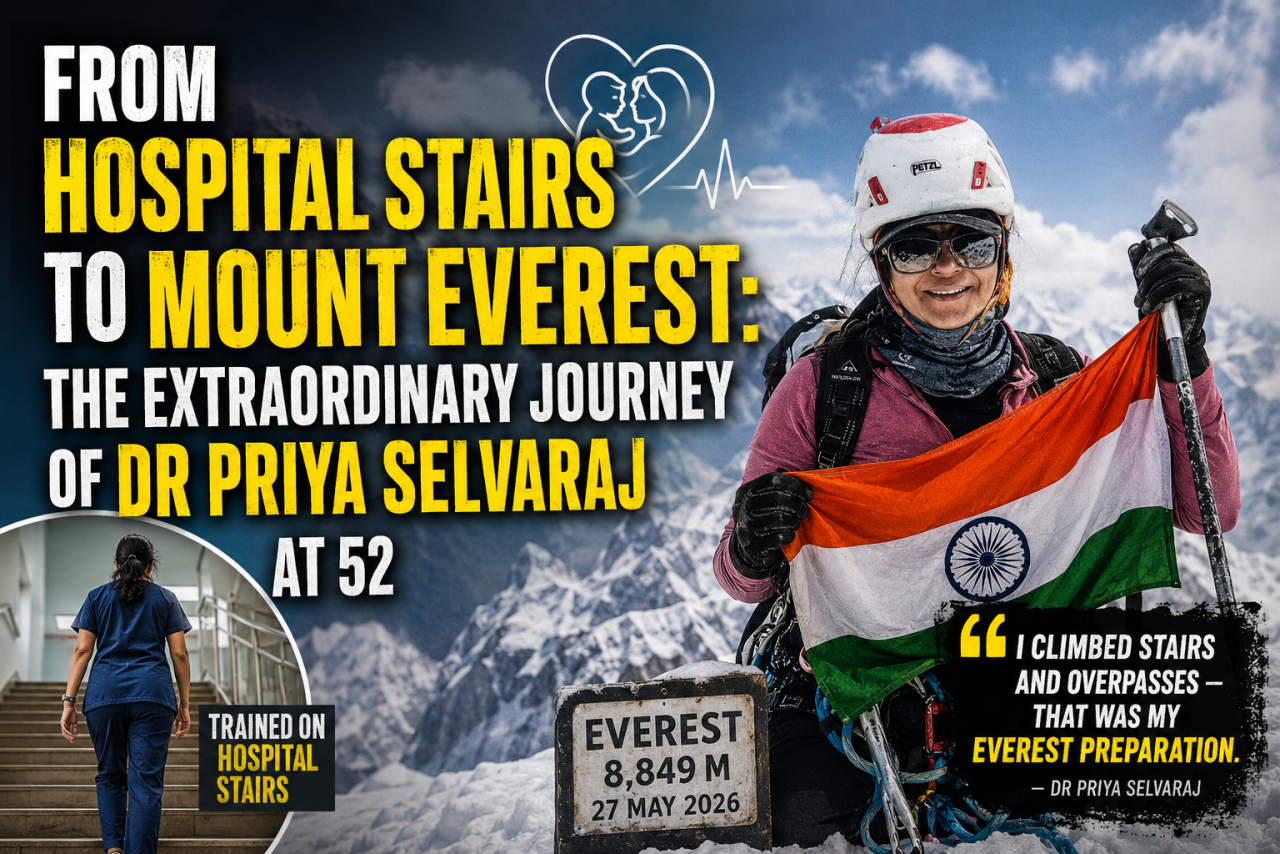
Most people know Dr Priya Selvaraj as the doctor who helped thousands of families welcome new life. Few expected that at 52, she would embark on a journey of her own—one that would take her from hospital corridors in Chennai to the summit of Mount Everest.
At 52, fertility specialist Dr Priya Selvaraj — granddaughter of Gemini Ganesan and daughter of pioneering reproductive medicine expert Dr Kamala Selvaraj — achieved what many spend a lifetime pursuing. On 27 May 2026, she stood atop Mount Everest, the highest point on Earth. Yet the true story lies not in the summit itself, but in the remarkable journey that led her there.
There is a particular kind of quiet that settles over a hospital corridor at midnight — the kind that a senior doctor learns to carry home without disturbing the household. Dr Priya Selvaraj has spent more than two decades living within that silence, helping women navigate the emotional and physical challenges of infertility. Through IVF cycles, embryo transfers, and the heartbreak of unsuccessful attempts, she has witnessed firsthand the power of perseverance.
That same perseverance would eventually take her to the roof of the world.
On the morning of 27 May 2026, Dr Selvaraj reached the summit of Mount Everest at an altitude of 8,849 metres, becoming the only Indian woman to achieve the feat during that climbing season. What makes the accomplishment extraordinary is not merely the height she reached, but the life she balanced while pursuing it: a demanding medical career, family responsibilities, and a training schedule squeezed into the margins of an already packed life.
Unlike most mountaineers, she did not have easy access to mountains.
"My training was limited to my home and hospital," she recalled after the climb. "I climbed stairs and overpasses — that was my Everest preparation."
It sounds improbable, but it is true. While many aspiring Everest climbers spend years training in high-altitude environments, Selvaraj transformed the staircases of her hospital into her personal mountain. The discipline she had cultivated through years in medicine — functioning under pressure, enduring long hours, and making critical decisions when exhausted — became the foundation of her mountaineering success.
Interestingly, mountaineering was not always part of her life plan.
The idea first emerged in 2021, when she decided to challenge herself in an entirely new way. Rather than treating it as a distant dream, she approached it with the same scientific rigour she brings to reproductive medicine. Under the guidance of Dr Sugapradeep, a dentist-turned-combat-fitness coach, she followed a structured programme focused on endurance, strength, altitude adaptation, and mental resilience.
The preparation was gradual but relentless.
She climbed Mount Kilimanjaro. She attempted Everest Base Camp and Lobuche East. She successfully scaled Manaslu, the world's eighth-highest mountain. Each expedition added another layer of experience, preparing her for the ultimate challenge.
When the Everest expedition finally began, Selvaraj joined Elite Exped, the company founded by renowned mountaineer Nirmal Purja. Accompanied by experienced high-altitude guide Anup Gurung, she entered an environment where even simple tasks become exhausting and every decision carries consequences.
The final ascent demanded twelve to thirteen hours of climbing each day. Selvaraj completed the expedition in just eight days — an achievement impressive even by Everest standards.
Yet the mountain was not finished testing her.
During the descent, she slipped and fell. Fortunately, her guide had insisted that she remain attached to a safety rope. That precaution proved lifesaving.
Looking back on the experience, Selvaraj reflected simply: "I feel like I've been reborn."
Her achievement also represents the continuation of a family legacy built on innovation and determination.
Her grandfather, Gemini Ganesan, remains one of the most celebrated figures in Tamil cinema. Her mother, Dr Kamala Selvaraj, transformed reproductive healthcare in India by helping deliver South India's first test-tube baby in 1990 and India's first surrogate baby in 1994. Together, they helped establish GG Hospital in Chennai, a name that honours the family's legacy while focusing on service and medical excellence.
Dr Priya Selvaraj has spent her own career expanding that legacy. Educated and trained through programmes in Singapore, Germany, and the United States, she has become a respected figure in reproductive medicine. The Everest summit does not represent a departure from that path; rather, it reflects the same qualities that shaped her medical career — discipline, resilience, and a refusal to accept conventional limitations.
Her message to younger generations is refreshingly direct.
Put down the phone. Move your body. Stop waiting for perfect conditions.
Dreams rarely arrive fully formed, and opportunities seldom appear at convenient moments. Progress belongs to those willing to begin with whatever resources they have.
Dr Priya Selvaraj did exactly that.
She climbed the stairs of her hospital for four years. Then she climbed the highest mountain on Earth. And when it was over, she returned to the work she loves — helping others create new life.
At 52, fertility specialist Dr Priya Selvaraj — granddaughter of Gemini Ganesan and daughter of pioneering reproductive medicine expert Dr Kamala Selvaraj — achieved what many spend a lifetime pursuing. On 27 May 2026, she stood atop Mount Everest, the highest point on Earth. Yet the true story lies not in the summit itself, but in the remarkable journey that led her there.
There is a particular kind of quiet that settles over a hospital corridor at midnight — the kind that a senior doctor learns to carry home without disturbing the household. Dr Priya Selvaraj has spent more than two decades living within that silence, helping women navigate the emotional and physical challenges of infertility. Through IVF cycles, embryo transfers, and the heartbreak of unsuccessful attempts, she has witnessed firsthand the power of perseverance.
That same perseverance would eventually take her to the roof of the world.
On the morning of 27 May 2026, Dr Selvaraj reached the summit of Mount Everest at an altitude of 8,849 metres, becoming the only Indian woman to achieve the feat during that climbing season. What makes the accomplishment extraordinary is not merely the height she reached, but the life she balanced while pursuing it: a demanding medical career, family responsibilities, and a training schedule squeezed into the margins of an already packed life.
Unlike most mountaineers, she did not have easy access to mountains.
"My training was limited to my home and hospital," she recalled after the climb. "I climbed stairs and overpasses — that was my Everest preparation."
It sounds improbable, but it is true. While many aspiring Everest climbers spend years training in high-altitude environments, Selvaraj transformed the staircases of her hospital into her personal mountain. The discipline she had cultivated through years in medicine — functioning under pressure, enduring long hours, and making critical decisions when exhausted — became the foundation of her mountaineering success.
Interestingly, mountaineering was not always part of her life plan.
The idea first emerged in 2021, when she decided to challenge herself in an entirely new way. Rather than treating it as a distant dream, she approached it with the same scientific rigour she brings to reproductive medicine. Under the guidance of Dr Sugapradeep, a dentist-turned-combat-fitness coach, she followed a structured programme focused on endurance, strength, altitude adaptation, and mental resilience.
The preparation was gradual but relentless.
She climbed Mount Kilimanjaro. She attempted Everest Base Camp and Lobuche East. She successfully scaled Manaslu, the world's eighth-highest mountain. Each expedition added another layer of experience, preparing her for the ultimate challenge.
When the Everest expedition finally began, Selvaraj joined Elite Exped, the company founded by renowned mountaineer Nirmal Purja. Accompanied by experienced high-altitude guide Anup Gurung, she entered an environment where even simple tasks become exhausting and every decision carries consequences.
The final ascent demanded twelve to thirteen hours of climbing each day. Selvaraj completed the expedition in just eight days — an achievement impressive even by Everest standards.
Yet the mountain was not finished testing her.
During the descent, she slipped and fell. Fortunately, her guide had insisted that she remain attached to a safety rope. That precaution proved lifesaving.
Looking back on the experience, Selvaraj reflected simply: "I feel like I've been reborn."
Her achievement also represents the continuation of a family legacy built on innovation and determination.
Her grandfather, Gemini Ganesan, remains one of the most celebrated figures in Tamil cinema. Her mother, Dr Kamala Selvaraj, transformed reproductive healthcare in India by helping deliver South India's first test-tube baby in 1990 and India's first surrogate baby in 1994. Together, they helped establish GG Hospital in Chennai, a name that honours the family's legacy while focusing on service and medical excellence.
Dr Priya Selvaraj has spent her own career expanding that legacy. Educated and trained through programmes in Singapore, Germany, and the United States, she has become a respected figure in reproductive medicine. The Everest summit does not represent a departure from that path; rather, it reflects the same qualities that shaped her medical career — discipline, resilience, and a refusal to accept conventional limitations.
Her message to younger generations is refreshingly direct.
Put down the phone. Move your body. Stop waiting for perfect conditions.
Dreams rarely arrive fully formed, and opportunities seldom appear at convenient moments. Progress belongs to those willing to begin with whatever resources they have.
Dr Priya Selvaraj did exactly that.
She climbed the stairs of her hospital for four years. Then she climbed the highest mountain on Earth. And when it was over, she returned to the work she loves — helping others create new life.






















Leave a Comment