
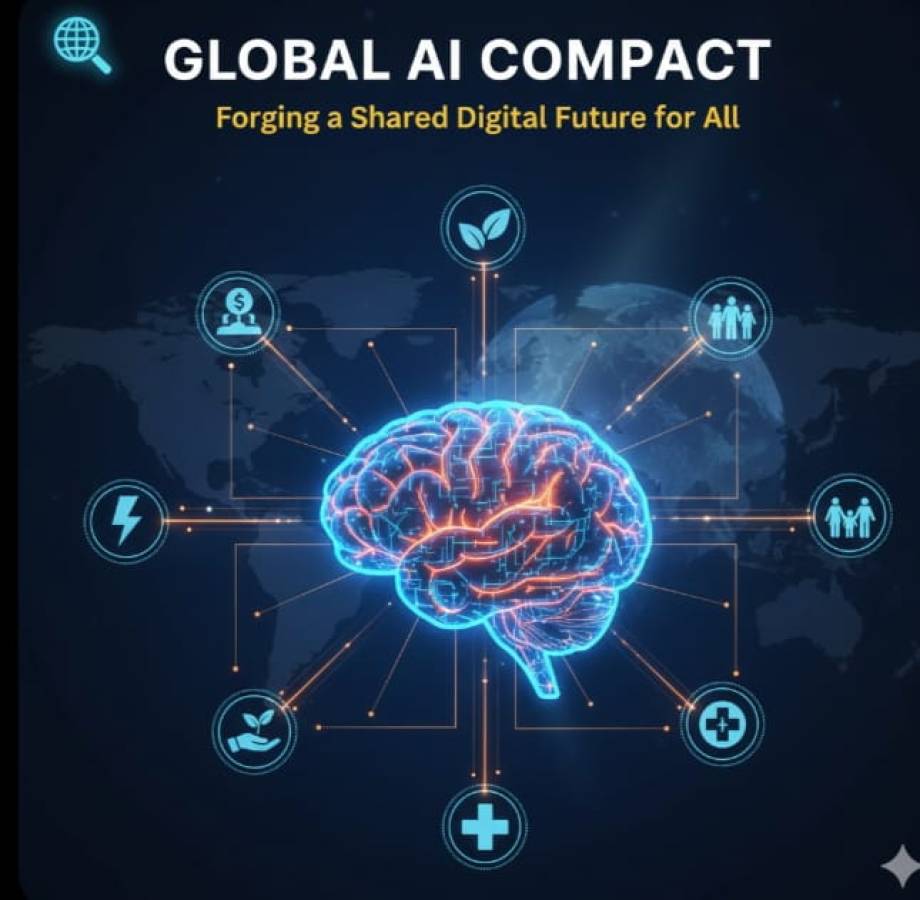
The global conversation around Artificial Intelligence has undergone a decisive shift. Once merely a marker of technological progress, AI is now a central issue of governance, equity, and international cooperation. This urgency was unmistakable at the recent G20 summit in South Africa, where leaders called for a “Global AI Compact” — a framework to ensure that AI development is human-centred, open-source, equitable, and safeguarded against misuse. Its fundamental goal: transform AI into a catalyst for sustainable global development rather than a driver of deeper inequality.
The argument is simple but crucial that AI is too consequential to be left unregulated or dominated by a handful of advanced economies. While the technology offers unprecedented potential to address challenges such as climate adaptation, efficient energy management, healthcare access, and fraud detection, its risks can be just as global. Without shared rules and interoperable standards, AI developed in one region could amplify vulnerabilities and inequalities in another.
The Transformative Potential for the Global South
For developing economies, collectively known as the Global South, the adoption of AI is not a luxury; it is an inflection point for transformation. Properly deployed, AI can offer solutions to critical and complex issues that legacy systems have failed to resolve.
1. The Revolution in Food Security and Agriculture
One of the most significant applications of the proposed AI compact lies in securing food production. For developing countries, farming faces unique challenges: small land holdings, fragmented markets, monsoon variability, and resource constraints. AI offers solutions for precision agriculture.
Prediction and Planning: AI-driven predictive analytics can offer real-time insights on crop and soil health, weather forecasting, and optimal planting dates, reducing dependence on guesswork and traditional, less resilient methods.
Resource Optimization: AI systems can manage irrigation and fertilization precisely, conserving water, reducing waste, and lowering the cost of production.
Risk Mitigation: The technology can provide early warning systems for pests, diseases, and climate risks, allowing farmers to take timely preventative action against crop losses.
2. Enhancing Public Services
Beyond agriculture, AI is a crucial tool for improving public good services. It can help in optimizing energy grids, water supply management, and automating data analysis for better governance and resource allocation, making services more accessible and affordable to citizens. In healthcare, AI can broaden the reach of health services, particularly in rural and remote areas, by assisting with diagnostics and patient monitoring.
Overcoming the Hurdles to Inclusive AI Deployment
Despite the promising potential, the deployment of AI in the Global South faces substantial structural barriers. The compact must address the foundational issues that currently concentrate AI benefits in developed economies.
Infrastructure Deficit: AI is computationally and energy-intensive. Many developing nations lack the stable energy grids, data center capacity, and broad connectivity required to host and build sophisticated AI models domestically.
Data and Bias: AI models rely on vast amounts of high-quality, relevant data. A lack of locally relevant data can lead to models that exhibit bias and are ill-suited to local languages, contexts, and needs.
Skills Gap: There is a persistent challenge in developing the local expertise and specialized talent needed to deploy, manage, and regulate AI systems, leading to dependence on external firms.
Principles for a Global Compact
The call for a Global AI Compact signals a recognition that the digital divide cannot be allowed to widen into an AI chasm. To succeed, the compact must center on principles of shared capacity and cooperation.
The path involves establishing shared AI governance frameworks, pooling resources for cloud infrastructure and compute services, and setting common, interoperable standards for ethics, transparency, and safety-by-design. The goal is not merely to regulate, but to empower—ensuring that AI becomes a force for equitable and sustainable transformation across the globe.

























Leave a Comment