
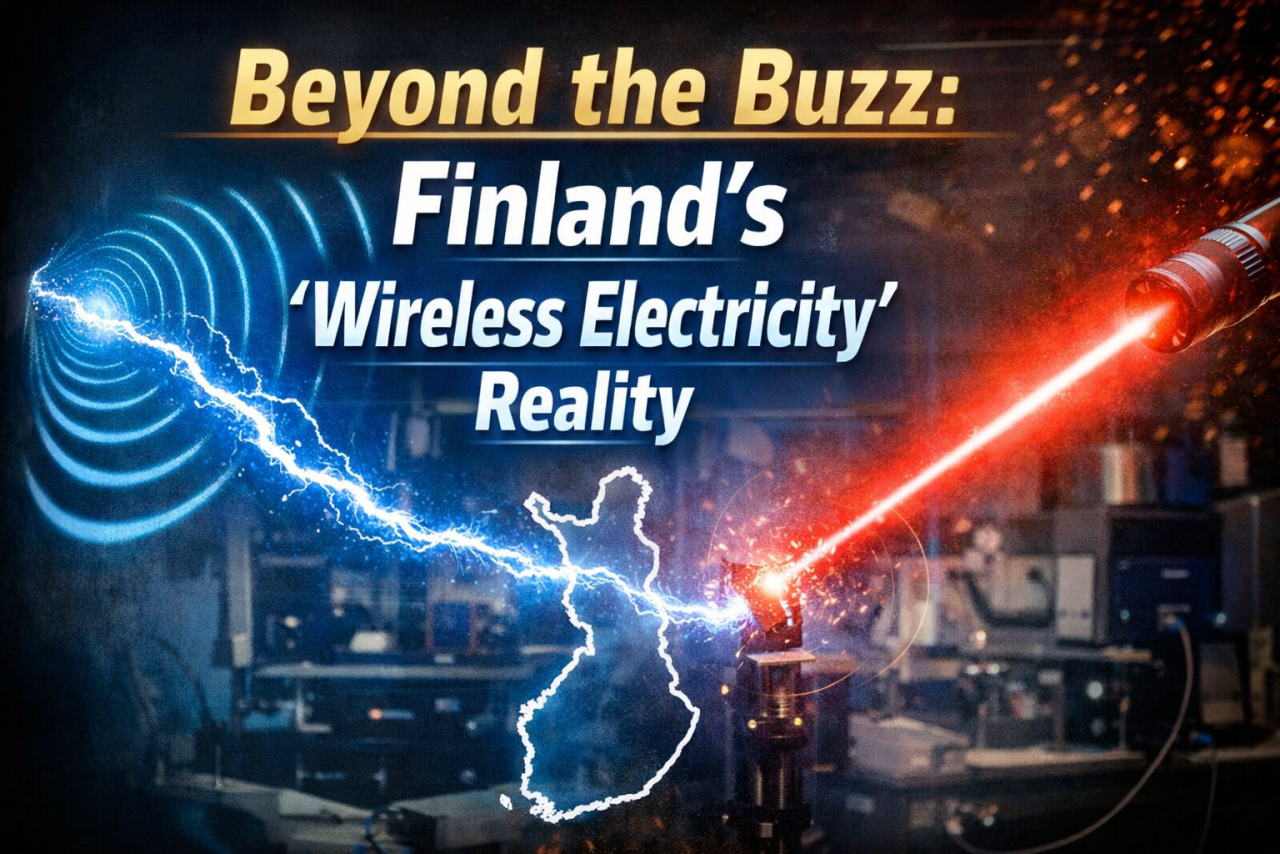
Recent claims of “wireless electricity” from Finland point not to a power revolution, but to a precise laboratory breakthrough in controlling how electrical sparks move through air.
The concept of transmitting electricity through open air has long captivated both scientists and the public imagination. Recent reports highlighting Finnish research claiming to send electricity without wires, using ultrasonic sound waves and laser beams, have sparked widespread interest. While these experiments are indeed scientifically significant, the reality of their applications is more nuanced than media coverage or social posts suggest.
At the core of this discussion is a recent experimental study conducted by researchers affiliated with the University of Helsinki and published in the peer-reviewed journal Science Advances. Contrary to some interpretations, the study does not demonstrate wireless power transmission in the conventional sense, such as delivering electricity to power devices or replace wiring, but instead explores a novel method of guiding electrical discharges through air.
Guiding Sparks, Not Power
Under normal conditions, electrical sparks traveling through air are unpredictable, branching randomly toward nearby conductive surfaces. The Finnish research team investigated whether it is possible to control the trajectory of these sparks. Their experiments showed that high-intensity ultrasonic sound waves can manipulate air density, creating channels that encourage sparks to follow predefined paths.
When a spark passes through air, it locally heats the surrounding region, reducing air density and making it easier for subsequent discharges to follow the same path. By carefully shaping ultrasonic waves, the researchers generated narrow channels of altered density. Sparks then naturally traveled along these channels, producing what has been described as an “invisible” or acoustic wire.
From a physics perspective, this represents a significant advance. It is the first demonstration of ultrasonic waves controlling plasma-like electrical discharges in open air with precision. However, the sparks involved are brief, short-range, and carry no meaningful electrical load. There is no continuous flow of usable power, and no system capable of charging a device, powering appliances, or replacing conventional electrical wiring.
Interpreting the Public Hype
The leap from “guiding sparks” to claims of “wireless electricity transmission” has led to significant misunderstanding. While the experiments successfully manipulate the path of electricity, they do not address fundamental challenges of practical power transmission: efficiency, stability, distance, safety, and scalability.
Researchers themselves emphasize that the work is fundamental research, not a ready-to-deploy technology. Any suggestion that it could soon replace power cables or revolutionize energy infrastructure exaggerates the current capabilities.
Laser and Radio-Frequency Power Transmission
Beyond acoustic guidance, other wireless energy methods are being explored in parallel, including laser-based power transmission and radio-frequency (RF) energy harvesting. Laser-based “power-by-light” systems use high-powered laser beams to deliver energy to photovoltaic receivers. Such approaches are particularly useful in hazardous or high-voltage environments, where physical connections pose safety risks, including industrial settings and space applications.
RF energy harvesting, often described as “Wi-Fi for power,” allows small sensors and ultra-low-power devices to draw energy from ambient electromagnetic signals. While promising for Internet-of-Things (IoT) applications, these methods deliver very limited power, sufficient only for small devices—not mainstream electronics or industrial machinery.
It is important to note that neither laser power beaming nor RF harvesting is directly related to the ultrasonic spark-guiding experiments. Combining them into a single “wireless electricity” narrative risks overstating technological maturity.
Scientific Significance and Future Implications
Rather than heralding a cable-free future, the Finnish experiments provide insight into controlling electricity using non-material fields such as sound and light. These principles could influence future research in plasma physics, contactless switching, high-voltage safety systems, and experimental electronics.
In the long term, such techniques might support the development of smarter interfaces, safer industrial controls, and improved ways to manage electrical discharges. Transitioning from controlled laboratory sparks to practical wireless power delivery, however, would require major breakthroughs in efficiency, regulation, and engineering.
Separating Science from Speculation
Scientific progress is typically incremental, not revolutionary. The ultrasonic spark-guiding experiments represent a genuine advancement in our understanding of electrical phenomena, but they do not yet constitute a technology that can deliver usable wireless electricity on any significant scale.
As research into wireless energy continues, from acoustic fields to lasers and radio waves, the central challenge remains: to transmit electricity safely, efficiently, and reliably. For now, Finland’s contributions belong firmly in the realm of promising laboratory science, offering intriguing possibilities without yet delivering practical plug-free power solutions.


.jpeg)






















Leave a Comment