
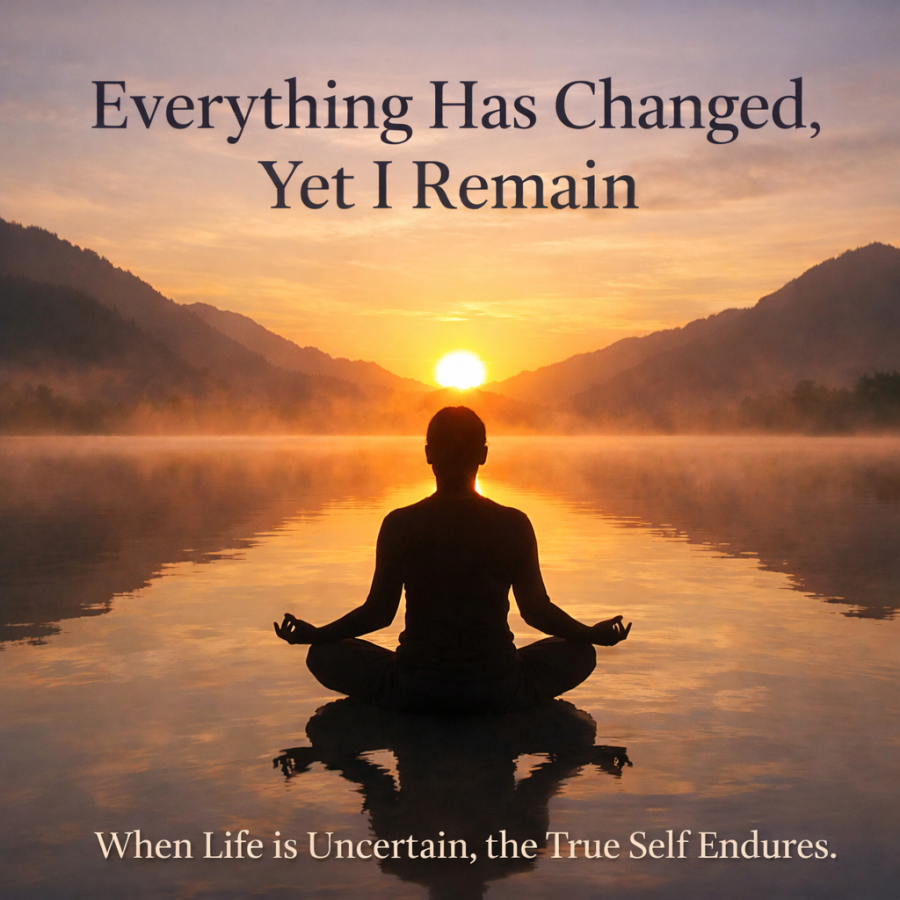
When life alters every visible landmark, the deepest transformations often reveal not loss, but a clearer sense of who we have always been.
“Everything has changed and yet, I am more me than I’ve ever been.”
There comes a point in life, often unnoticed at first, when change is no longer experienced as disruption but as background. The years rearrange familiar landmarks. Relationships alter their shape, beliefs soften or harden, ambitions either fulfil themselves or quietly withdraw. The world one inhabits no longer resembles the world one entered. And yet, amid this steady movement, there arises an unexpected recognition: a sense of being more firmly oneself than ever before.
This recognition does not announce itself with drama. It arrives without triumph and without regret. It is simply present, like a truth long suspected and finally confirmed.
We are taught, early and repeatedly, to associate identity with continuity of circumstance. We believe ourselves to be what we do, where we belong, what we are known for. When these markers change, as they inevitably must, we assume that the self itself has been unsettled. The unease that follows is often mistaken for loss, when it is more accurately a period of recalibration.
Time alters the visible structure of life, but it does not necessarily dissolve its core. In some cases, it refines it.
Modern life encourages us to think of identity as accumulation. More roles, more labels, more affiliations. We are praised for adaptability, for reinvention, for remaining relevant. Yet this constant emphasis on addition leaves little room for another, quieter process: subtraction. The gradual shedding of borrowed opinions, inherited anxieties, and performative versions of the self.
To become more oneself is not to resist change. It is to allow change to strip away what was never essential.
There is, inevitably, an element of suffering involved. Comfort rarely produces clarity. Loss, failure, and disillusionment perform the harsher work of simplification. They ask questions we would rather postpone: Who are you when approval recedes? What remains when belief systems fracture? What survives when life refuses to follow its early promises?
For some, these moments lead to bitterness or retreat. For others, they produce humility. And for a few, they offer something more enduring: a steadier relationship with oneself, no longer dependent on circumstance.
Faith and mysticism, at their most honest, do not deny change. They recognise it as inevitable. What they question instead is the assumption that change must imply erasure. Indian philosophical traditions speak of an inner witness that observes alteration without itself being altered. Christian mysticism speaks of a soul refined through trial, not replaced by it. Across traditions, the emphasis is not on preserving form, but on discovering essence.
The modern mind, impatient with stillness, often misunderstands this idea. It seeks transformation that is visible, measurable, shareable. But the change described in the quoted line is of a different order. It is not reinvention. It is recognition.
There is a certain freedom in no longer needing to explain oneself constantly. With time, the urgency to impress weakens. The fear of misinterpretation loses its sharpness. One does not become indifferent to the world, but one becomes less entangled in its judgments. What remains is not isolation, but proportion.
To say that one is “more me than I’ve ever been” is not a declaration of arrival. It is an acknowledgment of alignment. The self, once scattered across expectations and anxieties, has drawn inward. Not to withdraw from life, but to meet it with greater steadiness.
Everything has changed, yes. The body bears its marks, the world has shifted its tone, certainty has learned restraint. Yet beneath these alterations lies a continuity that is not rigid, but resilient. A self that has not survived change by resisting it, but by understanding it.
In a culture restless for novelty, this form of continuity is easily overlooked. But it may be the most reliable guide we possess. Not the promise that life will remain familiar, but the assurance that, as it changes, we may yet come closer to ourselves.












Leave a Comment