
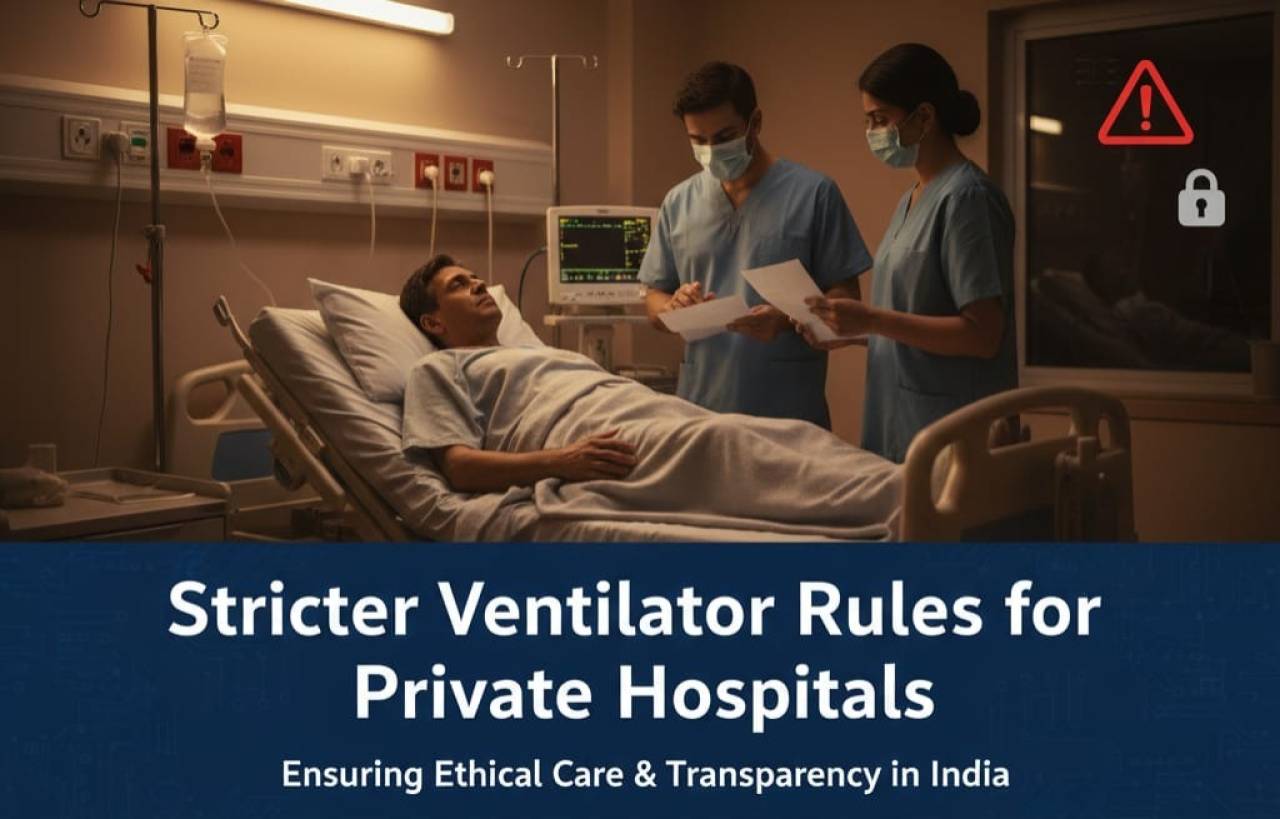
In order to protect patient rights and curb potential medical exploitation, the Indian government has introduced stricter guidelines for ventilator usage in private hospitals. Issued by the Directorate General of Health Services (DGHS), the new “Guidelines for Transparency in Ventilator Usage” mark a significant shift towards ethical healthcare practices and financial accountability.
At their core, these rules aim to ensure that ventilators—critical, life-saving medical devices—are used purely for patient welfare, not as instruments of unnecessary prolongation of treatment or commercial gain. The broader objective is to restore public trust in India’s private healthcare system.
Transparency Takes Centre Stage
One of the most impactful elements of the new guidelines is their strong emphasis on clear communication and transparent billing, an area that has long been a source of anxiety for patients’ families.
Under the new rules, private hospitals must:
- Publicly display ventilator charges, ensuring families are not confronted with hidden or unexpected costs.
- Adopt usage-based billing, meaning charges must reflect the actual duration and type of ventilator support provided.
- Justify prolonged ventilator use, especially when a patient remains on ventilation for more than 14 days. In such cases, hospitals must submit formal medical justifications backed by internal reviews and expert committees.
To enforce compliance, hospitals are required to maintain a clear documentation trail that can be audited by government authorities. Additionally, they must establish time-bound grievance redressal systems, giving families a formal and accessible channel to raise billing or treatment concerns.
Rooted in Bioethical Principles
Beyond financial transparency, the guidelines are firmly grounded in the four core principles of bioethics:
- Autonomy
- Beneficence
- Non-maleficence
- Justice
Informed Consent as a Legal Obligation
Hospitals must now obtain explicit informed consent from patients or their legal representatives before initiating mechanical ventilation. This consent must be meaningful, not symbolic.
Doctors are required to explain:
- The patient’s clinical condition
- The medical necessity of ventilation
- Expected outcomes and risks
- Whether ventilation is invasive or non-invasive
Beneficence and Non-Maleficence
Physicians are expected to act strictly in the patient’s best interest, ensuring that ventilator support is neither unnecessary nor prolonged without medical justification.
Justice in Access
The framework also seeks to promote fair and equitable access to ventilator support, discouraging discriminatory or profit-driven decision-making.
Tackling Information Asymmetry in Healthcare
The need for such regulation stems from a long-standing challenge in India’s healthcare system: information asymmetry. Patients and families often find themselves at a disadvantage, lacking the medical knowledge or negotiating power that hospitals and doctors possess.
As Indu Bhushan, former CEO of Ayushman Bharat, has highlighted, this imbalance frequently leaves families vulnerable during critical moments. The new guidelines aim to level the playing field by empowering patients with information, documentation, and legal safeguards.
A Rapidly Expanding Market Under Scrutiny
These reforms arrive at a crucial time. India’s ventilator market, valued at $207 million in 2024, is projected to grow to around $351 million by 2032. With rapid expansion comes the risk that commercial incentives could overshadow ethical medical judgment.
By enforcing transparency and accountability now, the government is attempting to ensure that technological growth does not come at the cost of patient dignity or financial ruin.
Why This Moment Matters
For families facing medical emergencies, decisions around ventilator use are often made under emotional distress and limited understanding. Unexpected bills or prolonged treatment without clarity can compound trauma.
By mandating transparency, ethical justification, and informed consent, the government is not merely regulating a medical device—it is safeguarding trust, dignity, and fairness at the most vulnerable moments of life.
Final Take
India’s new ventilator usage guidelines represent a turning point for private healthcare. By prioritising patient rights over profit motives, the policy signals a move toward a more humane, accountable, and ethical medical system.
Finally, these rules could lead to better healthcare outcomes, reduced financial exploitation, and a healthier relationship between patients and providers—where life-saving technology truly serves its intended purpose.
























Leave a Comment