
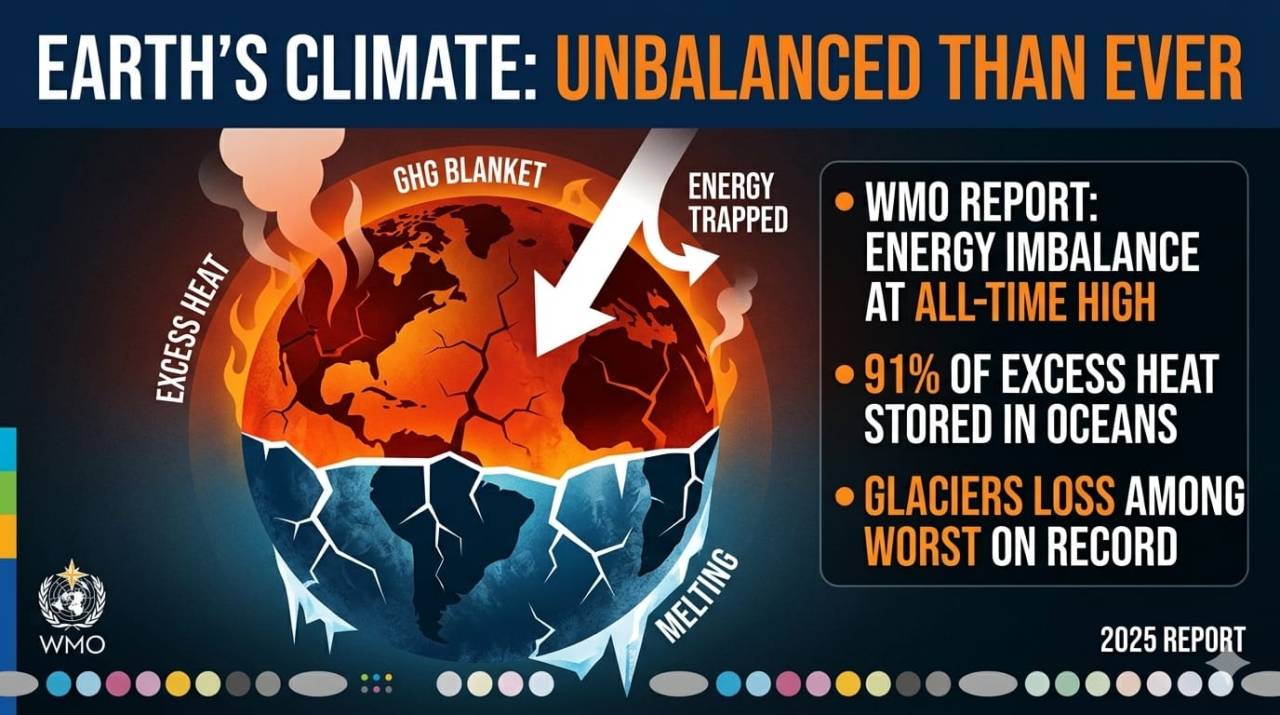
Earth is trapping more heat than ever, with oceans absorbing most of it. The 2025 climate report highlights rising risks and long-term global impact.
The air we breathe, the water in our vast oceans, and the ice at our poles are all sending a loud and clear message: the Earth is out of balance. According to the latest State of the Global Climate 2025 report by the World Meteorological Organization (WMO), our planet’s energy equilibrium has been disrupted more severely than at any point in recorded history. This isn’t just a number scientists track. It shows the Earth is starting to behave differently.
The Science of a Planet Tipping Over
In a healthy state, the Earth exists in a delicate balance. It receives energy from the sun and radiates a similar amount back into space. This keeps our temperatures stable and our weather patterns predictable. However, the rise of heat-trapping greenhouse gases has acted like a heavy thermal blanket. This blanket prevents heat from escaping, causing the planet to retain more energy than it releases.
For the first time, the WMO has highlighted this “energy imbalance” as a top-tier climate indicator. The data is startling. This imbalance has been growing since 1960, but the last 20 years have seen an alarming acceleration. By 2025, the gap between energy in and energy out hit an all-time high. We are essentially trapping heat at a rate that the Earth cannot shed.
Where Is the Heat Hiding?
One of the most common misconceptions is that climate change is only about the air temperature. In reality, the atmosphere is only holding a tiny fraction of this trapped energy—about 1%. The rest of that heat has to go somewhere, and it is largely being absorbed in the following ways:
- The Oceans: More than 91% of the excess energy is stored in our oceans. While this protects us from even more extreme air temperatures, it comes at a cost. Ocean heat reached a new record in 2025. The rate of warming has more than doubled since the mid-20th century.
- The Land and Ice: About 5% of the heat is absorbed by the land, while 3% is consumed by the melting of glaciers and polar ice sheets. This is why we see “zombie” glaciers that continue to disappear even in slightly cooler years.
A Year of Extremes: 2024 vs. 2025
When we look at the numbers, 2024 remains the hottest year on record, reaching approximately 1.55°C above pre-industrial levels. This was driven by a powerful El Niño. In contrast, 2025 was slightly cooler at 1.43°C above the baseline, ranking as the second or third warmest year.
This minor dip was not because the planet was “healing.” It was due to the natural cooling effect of La Niña. Even with this natural “air conditioner” running, 2025 was still dangerously hot. It proves that the underlying trend of human-caused warming is now strong enough to overwhelm natural cooling cycles.
The Invisible Culprits
The report traces this crisis back to three main greenhouse gases: carbon dioxide, methane, and nitrous oxide.
- Carbon dioxide levels in 2024 saw the largest annual increase since modern records began in 1957.
- Concentrations of these gases are now at their highest levels in 800,000 to 2 million years.
As we continue to burn fossil fuels, we are not just adding to the problem; we are weakening the Earth’s natural ability to restore balance. Forests and oceans, which usually absorb carbon, are becoming less effective as they grow over-saturated and stressed by rising temperatures.
Final Take
The consequences are no longer theoretical. They are visible in the 11-centimeter rise in sea levels since 1993 and the record-low sea ice in both the Arctic and Antarctic. UN Secretary-General Antonio Guterres has described this as a “state of emergency,” noting that every key indicator is “flashing red.”
The WMO’s findings show the planet is being pushed too far, too fast. These changes are happening within decades, but their effects will be felt for hundreds, if not thousands, of years. Restoring balance is the greatest challenge of our time, and the window to act is narrowing every day.




























Leave a Comment