
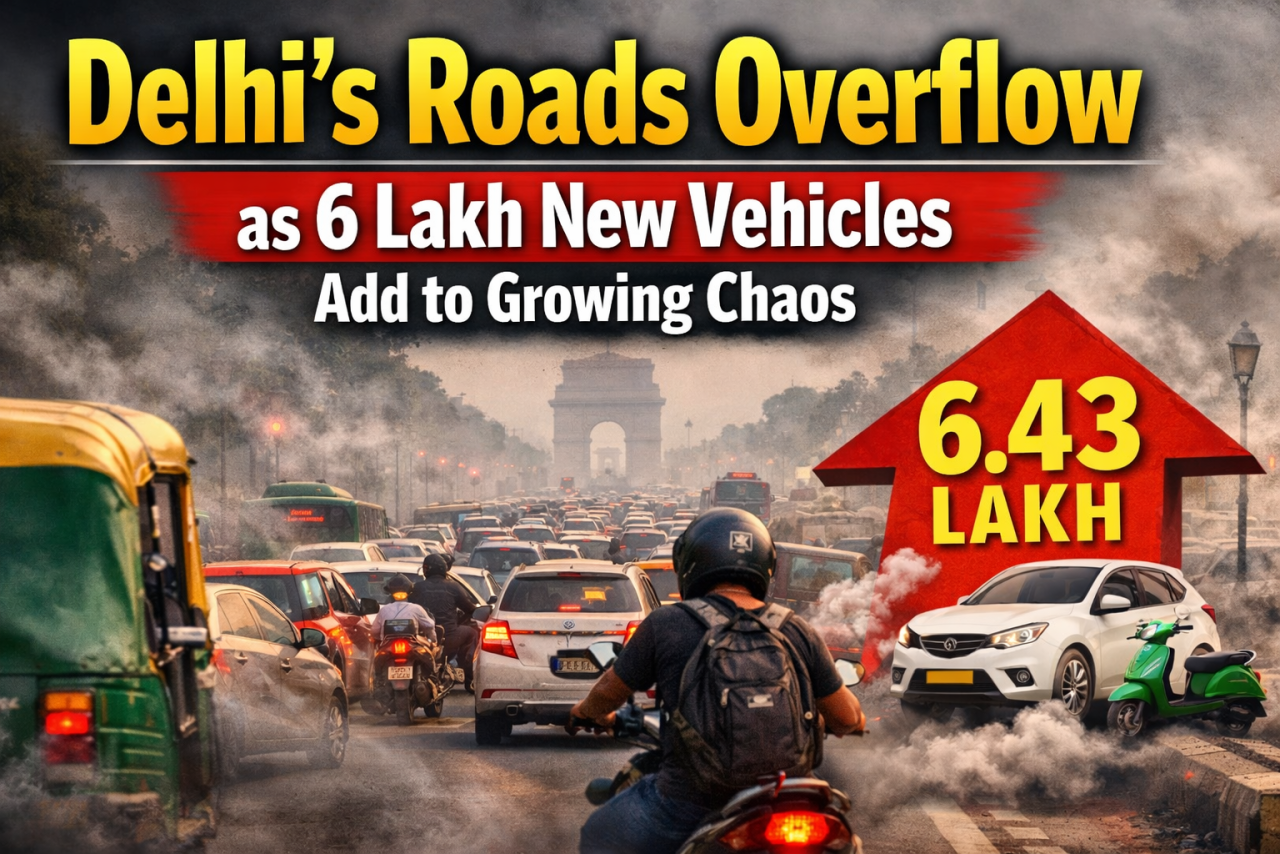
Delhi removed millions of old vehicles to clean its air, yet its roads are filling up faster than ever. With over 6 lakh new vehicles added in just one year, the city now faces a growing crisis of congestion, pollution, and pressure on its infrastructure.
Delhi is once again facing the pressure of a rapidly growing number of vehicles on its roads. After a brief slowdown in recent years due to strict pollution control measures, the capital has witnessed a sharp rise in registrations. According to the latest Economic Survey, more than 6.43 lakh new vehicles were added in 2025–26, pushing the total number of motorised vehicles in Delhi to 8.76 million as of March 19, 2026. This marks the highest annual increase recorded in the past nine years.
This surge is significant because it comes despite continued efforts to remove older, polluting vehicles from the roads. Authorities have already deregistered around 6.6 million vehicles, including diesel cars older than 10 years and petrol cars older than 15 years. These measures had earlier led to a sharp drop in total vehicle registrations by 4.3 million in 2021–22. However, the latest data shows that demand for personal transport is rising again at a fast pace, effectively reversing earlier gains.
A closer look at the numbers shows that two-wheelers continue to dominate Delhi’s roads. They account for more than two-thirds of all registered vehicles. Their numbers increased from 5.48 million to 5.92 million within a year, highlighting their popularity due to affordability and convenience. Four-wheelers, including cars and jeeps, make up about one-fourth of the total vehicle population. This segment also recorded steady growth, rising from 1.99 million to 2.12 million.
Electric vehicles are also gaining ground, though they still represent a smaller share of the total. Delhi now has over 470,000 registered electric vehicles. This growth has been supported by the expansion of charging infrastructure, with more than 3,100 charging stations and nearly 900 battery swapping stations now operational across the city. Government incentives have also played a role, with over 91,000 people benefiting from subsidy schemes aimed at encouraging a shift to cleaner mobility options.
At the policy level, the transport sector has received the highest allocation in the city’s budget for 2025–26. The government set aside ₹12,111 crore for transport-related initiatives, and more than 85 percent of this amount had already been used by March 2026. This indicates a strong focus on improving infrastructure and supporting mobility needs in the capital.
However, the rising number of vehicles raises serious concerns about congestion and pollution. Experts warn that simply replacing petrol and diesel vehicles with electric ones may not solve the larger problem. While electric vehicles reduce tailpipe emissions, they do not address the issue of overcrowded roads. The data clearly shows that both conventional and electric vehicle numbers are increasing at the same time.
This trend puts additional pressure on Delhi’s already strained road network. Traffic congestion is likely to worsen if the current growth continues unchecked. Long travel times, higher fuel consumption, and increased stress on urban infrastructure are some of the immediate consequences. At the same time, the environmental benefits of removing older vehicles could be offset by the sheer volume of new additions.
Urban transport experts suggest that the solution lies in strengthening public transport systems rather than allowing unchecked growth in private vehicle ownership. Expanding bus and metro networks, improving last-mile connectivity, and making public transport more reliable and affordable could help reduce dependence on personal vehicles. Without such measures, the city risks falling into a cycle where every improvement in income or convenience leads to more vehicles on the road.
Delhi’s current situation reflects a larger challenge faced by rapidly growing cities. People aspire for personal mobility, but infrastructure and environmental limits cannot keep pace with unlimited growth. The rise in electric vehicles is a positive step, but it needs to be part of a broader strategy that focuses on reducing the total number of vehicles, not just changing their fuel type.
As Delhi moves forward, the coming years will be crucial. The city must find a balance between mobility needs and sustainability goals. If the current trend continues without strong policy intervention, the gains made through deregistration drives and clean vehicle policies could be quickly undone. The real challenge is not just managing growth, but shaping it in a way that keeps the city livable, breathable, and functional for everyone.






















Leave a Comment