
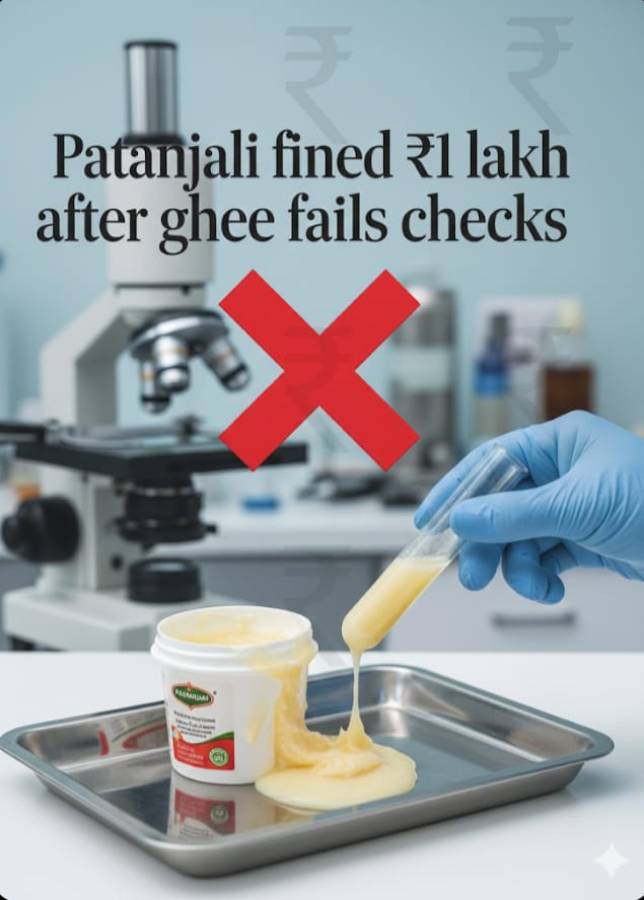
A consequential judicial order has been passed down in the Himalayan district of Pithoragarh, Uttarakhand, directly impacting one of India’s largest consumer goods manufacturers, Patanjali Ayurved Limited. The Additional District Magistrate ADM court has taken stringent action, imposing a substantial penalty of one lakh rupees on the company. This serious financial punishment follows the definitive failure of Patanjali’s manufactured cow ghee to meet essential quality benchmarks. The court's decision was based on conclusive evidence gathered from tests conducted at two separate government facilities—one state-level and one central-level—both of which confirmed the product was substandard. The ruling marks a significant regulatory intervention and includes a pointed directive to Patanjali, which has been strictly warned to guarantee continuous and rigorous compliance with all provisions outlined in the crucial Food Safety and Standards Act, 2006.
The judicial decree’s impact was not confined solely to the manufacturer. In a move that highlights the shared responsibility for consumer safety, the ADM court also extended financial penalties to parties further down the distribution network. The firm responsible for distributing the sub-par ghee was slapped with a fine of twenty-five thousand rupees. In addition, the individual retailer who sold the product received a penalty of fifteen thousand rupees. These fines serve as a clear legal signal regarding the enforcement of public health mandates, emphasizing that accountability for product quality rests on manufacturers, distributors, and retailers alike. The core legal breach cited in the case pertains to the company’s documented failure to operate in accordance with the quality and safety specifications detailed within the Food Safety and Standards Act, 2006. This act constitutes the principal framework for maintaining standards within the country’s food industry.
The lengthy legal process that culminated in the recent fine began years earlier, with the initial action dating back to 2020. It was in that year that the then senior food safety officer, Dilip Jain, initiated a crucial inspection. The officer's action was prompted by official suspicion that the product being sold was not adhering to mandatory quality and safety standards. The investigation focused on M/S Karan General Store, a retail outlet situated in Kasani, within the Pithoragarh district. During the inspection, Officer Jain methodically collected a sample of Patanjali cow ghee that was openly displayed for sale. This sample was subsequently sent to a certified laboratory for comprehensive testing to definitively ascertain its compliance with regulatory mandates.
The results of the initial laboratory analysis soon confirmed the concerns of the regulatory body. The ghee sample was forwarded to the state analysis laboratory located in Rudrapur. By June 2021, the findings were returned, formally declaring the Patanjali cow ghee sample to be "substandard." In response to this initial failure, the company, Patanjali, sought recourse by requesting a mandatory retest. The sample was then redirected to the National Food Laboratory in Ghaziabad, a facility operating under central authority. The anticipation for a conflicting result was dashed, however, when the National Food Laboratory released its findings in October 2021. The central lab’s report corroborated the earlier state analysis, concluding that the sample was indeed substandard. The fact that the product failed quality checks at two distinct governmental testing facilities—one state and one central—is a significant point in the prosecution's case.
Patanjali Ayurved Limited, however, is refusing to concede to the court's verdict and has already outlined its legal plan to challenge the order. According to company spokesperson SK Tijariwala, an official appeal is currently being prepared for submission before the Food Safety Tribunal. Tijariwala provided the rationale behind the appeal, citing two core legal technicalities intended to invalidate the testing process itself and, by extension, the fine. Firstly, the spokesperson alleged a fundamental flaw in the retesting procedure, stating, "The referral laboratory was not accredited by NABL for testing cow ghee, therefore the test is not legally valid." This argument targets the legal permissibility of the evidence. Secondly, Patanjali is contesting the timing of the reanalysis. Tijariwala pointed out that "The retest was conducted after the expiry date of sample, which is invalid under the law." Both procedural arguments aim to establish that the testing itself was fundamentally flawed and inconsistent with legal stipulations.
The decision by Patanjali to file an appeal before the Food Safety Tribunal ensures that this high-profile legal conflict over food quality will continue. The tribunal must now deliberate upon the merits of the company's technical arguments—the issues concerning NABL accreditation and the sample’s expiry date—pitting them directly against the documented findings of substandard quality from two reputable government laboratories. The final outcome of this legal proceeding will be closely watched by regulators and the wider food industry, as it promises to set a significant precedent regarding procedural standards for quality testing and the level of accountability required from major food manufacturers operating under the extensive framework of the Food Safety and Standards Act of 2006.
























Leave a Comment