
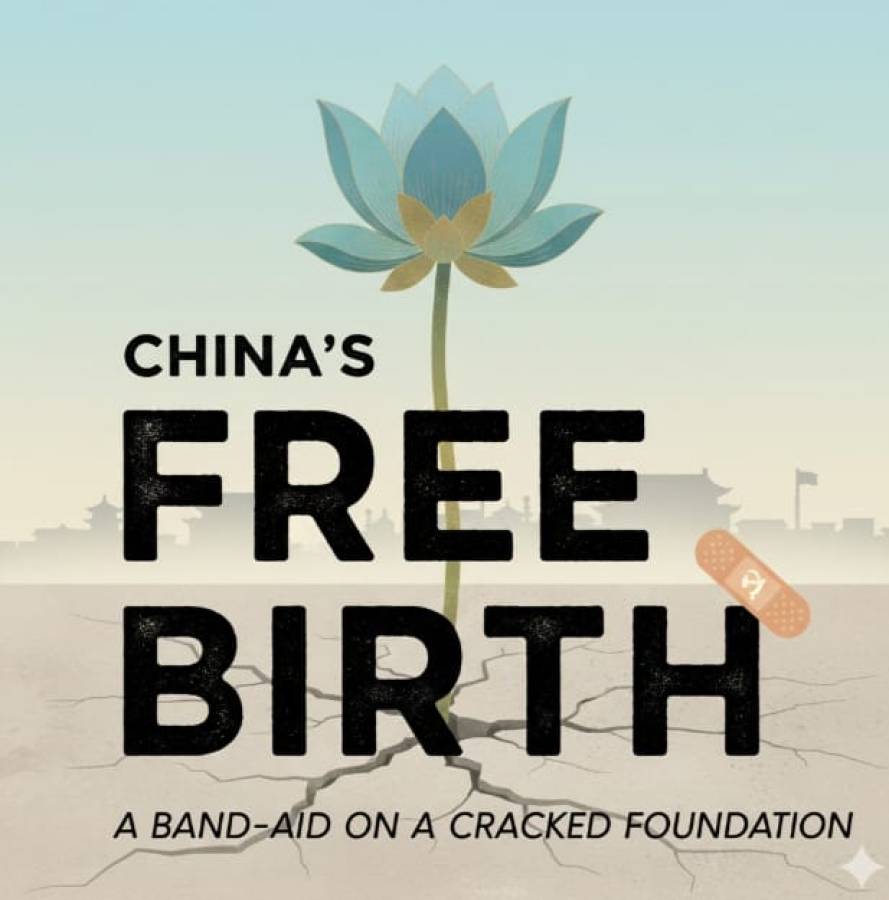
Beijing’s decision to make childbirth free by 2026 is being hailed as a bold demographic fix. But for a generation shaped by the one-child policy, rising costs, and work pressure, the real barriers to parenthood lie far beyond the delivery room.
This week, Beijing put a startling number on the cost of birth: zero. By 2026, the Chinese government says it will cover all out-of-pocket expenses for childbirth, from prenatal checkups to the delivery room, in an effort to slow the country’s accelerating population decline.
On the surface, it looks like a masterstroke of social welfare. Yet a closer look reveals a deeper, more human paradox. In a country where the state once enforced the one-child limit with ironclad resolve, it is now trying to buy births back. The question is simple but uncomfortable: can a structural crisis be solved with a checkbook?
The Long Shadow of the One-Child Policy
For decades, the one-child policy was not merely a regulation; it reshaped how Chinese families thought about life, success, and security. It produced the now-famous “4-2-1” family structure—four grandparents and two parents investing all their hopes, resources, and anxieties into a single child.
That child became both precious and pressured. Education was not just a path to opportunity but a competitive race with little room for failure. Parenting, over time, came to be seen less as a source of joy and more as an all-consuming responsibility with lifelong financial consequences.
Making childbirth free may lower the entry fee, but it does little to reduce the cost of membership.
The Real Bill Comes After Birth
In modern China, the hospital bill for delivery is often the smallest expense in raising a child. The real costs accumulate quickly and relentlessly.
Education remains fiercely competitive, driving families toward expensive tutoring, test preparation, and extracurricular activities simply to keep pace. A child, in this environment, is not just a loved family member but a high-stakes investment.
Marriage itself has begun to lose its appeal. Many young people increasingly view it as a restrictive contract rather than a personal milestone, one that comes bundled with expectations about children, caregiving, and financial sacrifice.
For women, the calculation is even more severe. The cost of motherhood is frequently paid in stalled careers, reduced income, and an unequal share of domestic labour—penalties that no free hospital stay can erase.
Why “Free” May Not Be Enough
Think of it this way: offering free childbirth is like offering a free car in a city where fuel is unaffordable, parking is scarce, and insurance is mandatory but out of reach. The gift, however generous, does not change the larger reality.
China’s population declined in both 2022 and 2023, and demographers expect the trend to continue. The challenge is no longer purely financial. It is psychological and cultural. When a generation grows up associating parenthood with exhaustion, anxiety, and sacrifice, removing one upfront cost does little to change the narrative.
The so-called fertility trap lies not in hospital fees but in lived experience.
Moving Beyond Demographic Math
For too long, population policy has treated children as demographic units—future workers, taxpayers, or supports for an ageing society. That framing misses the point.
A genuinely birth-friendly society does not ask citizens to reproduce for economic reasons. It makes life easier for people who want to become parents in the first place. That means offering more than symbolic incentives.
Parents need time—real work-life balance that does not punish mothers or sideline fathers. They need space—housing that is affordable for families, not priced like luxury assets. Above all, they need trust: confidence that the future their children inherit will be less stressful and more secure than the present.
Demographers and sociologists have long warned that once fertility decline becomes socially embedded, financial incentives alone rarely reverse it.
Final Take
Free childbirth is a meaningful gesture. It signals that the state is finally willing to share some responsibility for child-rearing rather than leaving families to bear the burden alone. But goodwill, however sincere, is not the same as reform.
When the deeper pressures of housing, work, education, and gender inequality remain unresolved, a free hospital stay risks becoming a band-aid applied to a cracked foundation. It may ease the pain of one moment, but it does little to heal the underlying fracture shaping how an entire generation views parenthood.
Until the cost of living comes down to meet the promise of a birth-friendly society, policies like free childbirth may grab attention—but they are unlikely to bring lasting change.
























Leave a Comment