
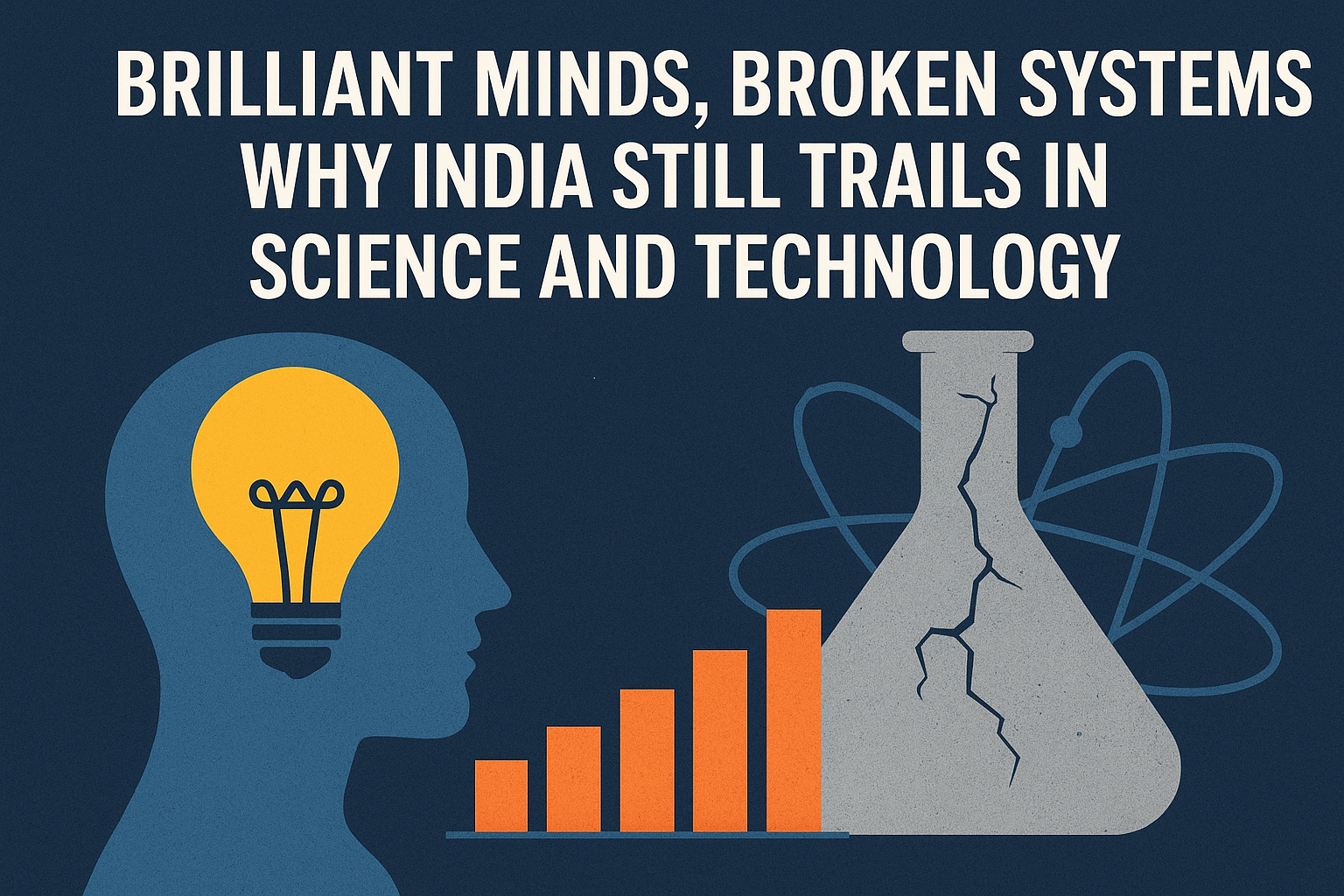
India often celebrates its scientific milestones with justified pride. From Chandrayaan-3’s soft landing on the Moon to breakthroughs in vaccine manufacturing, the nation has proved its intellectual might. Yet, behind these shining moments lies a less glamorous truth — India’s scientific ecosystem still struggles to match the infrastructure, investment, and innovation culture seen in developed countries. The problem is not lack of talent but lack of structure, funding, and long-term vision.
The Innovation Deficit
India produces some of the world’s finest scientists and engineers, but most of them thrive abroad. The “brain drain” continues because research environments in countries like the US, Germany, and Japan offer better funding, mentorship, and interdisciplinary collaboration. According to UNESCO data, India spends just about 0.7% of its GDP on research and development (R&D), far behind the United States (3.4%), South Korea (4.9%), and Israel (5.4%). This funding gap creates a shortage of modern laboratories, research infrastructure, and stable career opportunities for scientists.
In developed countries, young researchers can focus on innovation because their institutions provide both financial and intellectual support. In India, however, the limited research funding often goes to a few premier institutes, leaving state universities and smaller labs under-equipped. As a result, much of the nation’s scientific potential remains untapped.
Bureaucracy and the Missing Freedom to Innovate
One of the silent killers of scientific progress in India is bureaucracy. Researchers often spend more time filling forms, justifying budgets, and waiting for approvals than conducting actual experiments. The rigid administrative setup discourages risk-taking and slows down projects. In contrast, developed countries have more flexible grant systems that encourage curiosity-driven research rather than only “safe” or “government-prioritized” topics.
For instance, the United States’ National Science Foundation (NSF) and Europe’s Horizon programs allow scientists to explore emerging fields like quantum computing and synthetic biology with fewer bureaucratic hurdles. India’s system, on the other hand, still operates with outdated norms that favor hierarchical control over creative freedom.
Industry-Academia Disconnect
Innovation flourishes where academia and industry collaborate. In developed economies, companies fund university research, leading to real-world applications and technological startups. In India, this connection is weak. Most industries prefer importing technology rather than investing in indigenous research.
While India has begun promoting initiatives like “Startup India” and “Make in India,” these programs often focus more on entrepreneurship than on foundational scientific research. For true progress, industries need to see universities not just as degree factories but as idea hubs. Encouraging collaborative research, patent development, and joint innovation labs can bridge this gap and drive industrial growth.
Outdated Curriculum and Weak Research Culture
India’s education system still emphasizes rote learning over creative problem-solving. Even in top technical institutions, students spend more time memorizing formulas than experimenting with ideas. Science education in schools rarely encourages curiosity or independent thinking, which are the roots of innovation.
Developed countries nurture these qualities from an early age. Students are exposed to lab-based learning, coding, robotics, and interdisciplinary thinking. This foundation leads to a research-driven mindset. In India, however, research is often treated as an optional luxury rather than a national priority.
Shortage of Modern Infrastructure and Skilled Technicians
A major obstacle to cutting-edge research in India is the lack of advanced equipment and technical expertise to run them. Many university labs operate with outdated tools, and researchers face long delays in importing necessary instruments. Even when advanced equipment is available, trained technicians are often missing.
Developed nations maintain centralized research facilities where scientists can access world-class equipment and expertise. India’s Council of Scientific and Industrial Research (CSIR) has attempted to replicate this model, but the scale and accessibility remain limited.
Need for Better Management and Vision
Science thrives not just on ideas but on systems that nurture them. India’s scientific institutions often suffer from short-term planning and political interference. There is little focus on long-term continuity, especially when government priorities change.
Developed countries maintain independent scientific advisory boards and long-term funding mechanisms that protect research from political cycles. India needs similar autonomy for its scientific institutions. Stronger project management, transparent funding, and measurable outcomes can make a significant difference.
Final Take
India’s path to becoming a scientific superpower does not depend solely on producing more engineers or scientists. It depends on creating an ecosystem where knowledge is valued, funded, and applied. Increasing R&D spending to at least 2% of GDP, establishing regional centers of excellence, and encouraging collaboration with global institutions can transform the research landscape.
Moreover, India must invest in its people — from school students to senior scientists — by promoting curiosity, rewarding innovation, and removing bureaucratic roadblocks. Science must be seen not just as a national achievement but as a public good that powers growth, equity, and global leadership.
The country has no shortage of ideas or ambition. What it needs is courage to reform its systems, trust its scientists, and commit resources to the long game of discovery. If India can fix its structure as boldly as it dreams, its science will not just catch up with the world — it might lead it.



























Leave a Comment