
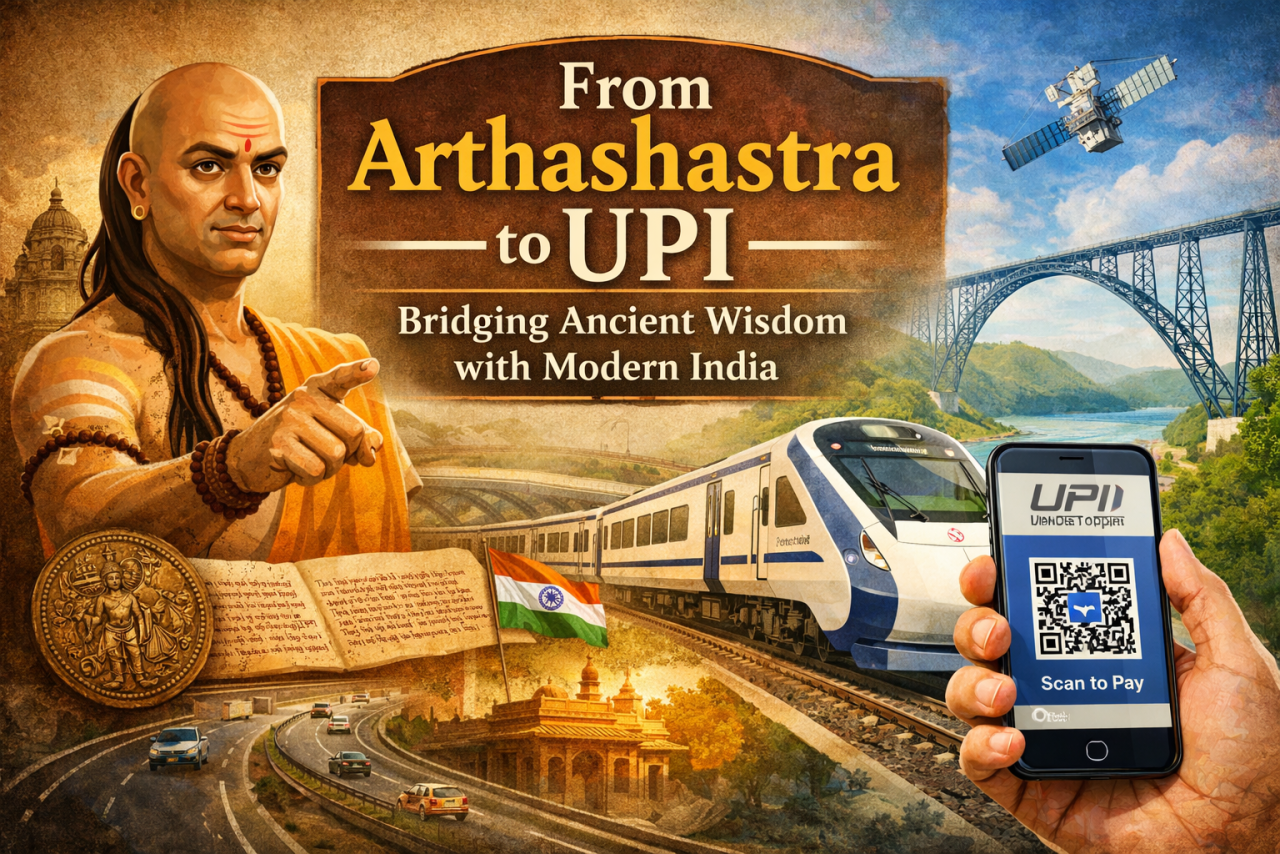
The evolution of a nation’s economic identity is rarely a journey of abrupt starts and stops; rather, it is a continuous tapestry where the threads of the past are woven into the innovations of the present. The new NCERT Social Science curriculum for Class 7, specifically in its exploration of "Exploring Society: India and Beyond," takes a bold step in highlighting this continuity. By linking the ancient wisdom of Kautilya’s Arthashastra with modern marvels like the Unified Payments Interface (UPI) and the Vande Bharat Express, the textbook invites students to see India not just as a "developing" economy, but as a civilization reclaiming its long-standing tradition of sophisticated fiscal and structural governance.
The Ancient Blueprint of Infrastructure
Central to this pedagogical shift is the recognition that India’s current infrastructural push is deeply rooted in ancient Indian thought. The Arthashastra, attributed to Kautilya in the 4th century BCE, was more than just a political treatise; it was a manual for comprehensive state-building. Kautilya emphasized that the prosperity of a kingdom—the Janapada—rested on the efficiency of its roads and waterways.
The textbook draws a direct parallel between these ancient concepts and modern "state-of-the-art physical infrastructure." When students read about the Atal Tunnel, the Chenab Railway Bridge, or the Atal Setu, they are encouraged to see these not merely as feats of engineering, but as modern manifestations of the ancient duty of the state to ensure connectivity. In ancient times, roads were built in varying widths depending on the traffic they carried, and strict penalties were imposed for damaging public works. Today, the Delhi-Meerut Expressway and the proliferation of electric vehicles represent a contemporary pursuit of that same efficiency and order.
The "Magic" of Finance: From Temples to UPI
Perhaps the most intriguing leap the new curriculum makes is in the realm of financial literacy. By titling a chapter "Banks and the Magic of Finance," the NCERT moves away from dry definitions of currency to a narrative of trust and inclusion.
The book introduces students to a 13th-century Tamil Nadu inscription from Kodumbalur. This historical record documents community borrowing and interest payments linked to a temple agreement. This serves as a vital lesson: the concept of organized finance, credit, and community interest is not a Western import but a lived reality of Indian history.
Fast forward to the 21st century, and this “magic” becomes visible through initiatives such as the Pradhan Mantri Jan Dhan Yojana, which has brought more than 500 million people into the formal banking system, reshaping how millions interact with money and institutions. This movement toward financial inclusion finds its digital peak in the Unified Payments Interface (UPI). Described as "India’s gift to the world," UPI represents a transformative moment where ancient concepts of community-wide financial access meet cutting-edge digital innovation. The fact that countries like France, Singapore, and Mauritius are adopting this system reinforces the idea that India is once again a global leader in economic thought.
A Human-Centric Economy
Beyond the bridges and the apps, the new curriculum emphasizes the "human angle" of economic development. It posits that infrastructure is the "backbone of our nation" because it makes life easier for people and communities. The textbook explicitly states that "safe and sustainable" growth must consider the most vulnerable—children, the elderly, and the disabled.
This perspective shifts the focus from GDP numbers to the quality of life. It teaches young learners that while the government can impose penalties and build bridges, the "role of citizens is equally important" in maintaining this progress. This creates a sense of shared ownership and civic duty.
Reclaiming the Indian Knowledge System
The integration of these topics is a deliberate move aligned with the National Education Policy (NEP) 2020. By connecting India’s modern prosperity with the Indian Knowledge System (IKS), the NCERT is fostering a generation that understands its heritage not as a museum piece, but as a functional toolkit for the future.
As students turn the pages of "Exploring Society," they are not just memorizing dates or names; they are discovering that the spirit of innovation that designed the Janapadas is the same spirit driving the digital and physical revolution of modern India. It is a journey from the palm-leaf manuscripts of the Arthashastra to the seamless scan of a QR code—a journey of a civilization in motion.
















Leave a Comment