
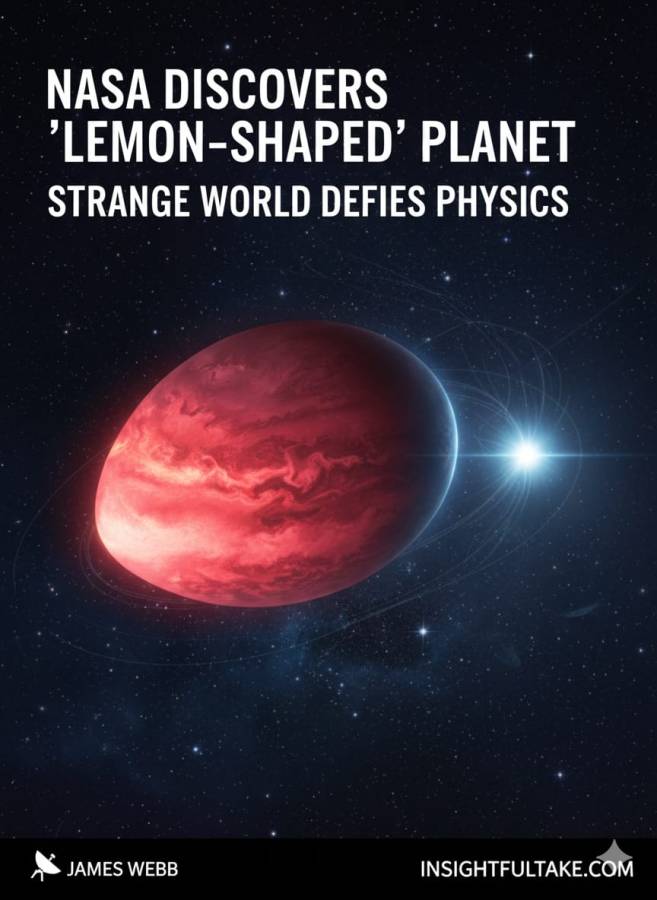
The universe has a way of defying our expectations. While we are used to thinking of planets as near-perfect spheres—much like our own Earth or the marbles we played with as children—space continues to reveal objects that challenge the very laws of celestial geometry.
In a groundbreaking discovery that has sent ripples through the astronomical community, NASA’s James Webb Space Telescope (JWST) has identified an exoplanet so physically distorted that it resembles a lemon more than a ball. Located over 2,000 light-years away, the planet, officially designated as PSR J2322-2650b, is being hailed as the "most stretched" planet ever observed.
A Shape Defying Gravity
The discovery, recently detailed in The Astrophysical Journal Letters, highlights the extreme environmental forces at play in deep space. According to the data, the planet’s equatorial diameter is 38% wider than its polar diameter.
To put that into perspective, Earth is slightly wider at the equator due to its rotation, but the difference is negligible to the naked eye. In the case of PSR J2322-2650b, the "stretch" is so violent and pronounced that its silhouette is distinctly oval.
Why the odd shape?
The answer lies in its proximity to its host star. The planet is locked in a punishingly tight orbit around a pulsar—a dense, rapidly rotating remnant of a massive star. It completes a full "year" (one orbit) in just eight hours. At such a close distance, the pulsar’s intense gravitational pull exerts massive tidal forces on the planet, physically stretching its mass outward in a process astronomers often compare to "spherical pulling."
An Atmosphere Unlike Anything Seen Before
The shape of PSR J2322-2650b isn’t the only thing baffling scientists. Its chemical composition is equally alien. Most gas giants, like Jupiter, are primarily composed of hydrogen and helium. However, JWST’s spectroscopic analysis reveals that this lemon-shaped world is entirely devoid of hydrogen and oxygen.
Instead, its atmosphere is dominated by:
- Helium
- Molecular Carbon
- Nitrogen
"It is a helium- and carbon-dominated world," says Peter Gao, a planetary scientist and co-author of the study. "We’ve never seen something like this before." This strange chemistry suggests the planet didn't form like a traditional world, but rather through a more "cannibalistic" cosmic process.
Planet or Cosmic Remnant?
The unique nature of PSR J2322-2650b has led some researchers to question if it can even be classified as a "planet" in the traditional sense. The scientific team, led by Michael Zhang of the University of Chicago, has proposed two intriguing theories:
The Stripped Core: It may be the surviving core of a dead star. In this scenario, the pulsar it orbits likely siphoned off the outer layers of a companion star, leaving behind a carbon-rich "husk" that now orbits as a planet.
An Entirely New Class: It could represent a "new kind of object" altogether—one that sits on the evolutionary line between a star and a planet, shaped by extreme radiation and gravity.
Final Take
For those of us on Earth, discoveries like PSR J2322-2650b serve as a reminder of how diverse the galaxy truly is. As the James Webb Space Telescope continues to peer into the dark corners of the Milky Way, it is proving that the "standard model" of planetary formation is just one page in a much larger book.
This lemon-shaped world isn't just a cosmic curiosity; it is a laboratory for extreme physics. By studying how gravity and radiation warp this planet, scientists can better understand the life cycles of stars and the fate of planetary systems in the far reaches of the universe.
As we look up at the night sky, it’s fascinating to realize that 2,000 light-years away, a giant, carbon-filled "lemon" is racing around a dead star every eight hours—a testament to the chaotic beauty of the cosmos.





















Leave a Comment