
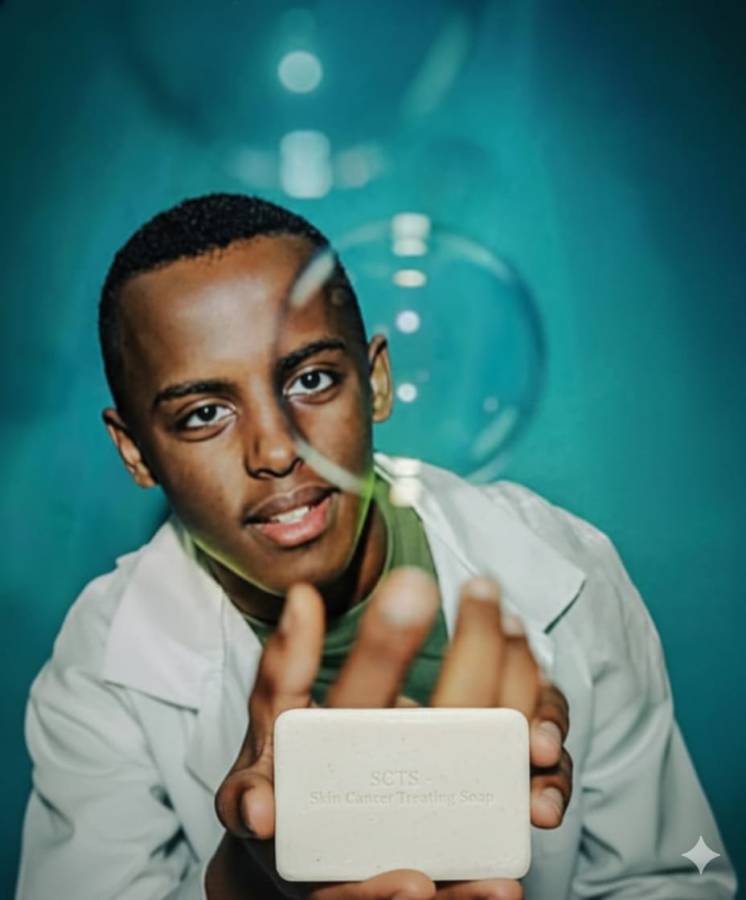
Big medical breakthroughs usually come with complex machines, years of research, and budgets running into millions of dollars. That is why the story of Heman Bekele stands out. His idea is not about advanced equipment or futuristic technology. It begins with something almost everyone uses every day — a bar of soap.
Heman Bekele is a teenager, but his thinking has drawn the attention of scientists, educators, and global media alike. In 2023, he won the prestigious 3M Young Scientist Challenge, and a year later, he was named TIME’s 2024 Kid of the Year. The reason was simple but powerful: he imagined a low-cost way to help fight skin cancer, one of the most common cancers in the world.
An idea shaped by early memories
Bekele was born in Addis Ababa, Ethiopia, and moved to the United States when he was four years old. Even after settling into a new country, memories from his early childhood stayed with him. He remembers seeing people working outdoors for long hours under intense sunlight, often without sunscreen or protective clothing. Many of them had no idea that constant sun exposure could damage their skin or increase cancer risk.
As he grew older and began learning science, Bekele discovered another uncomfortable truth. Skin cancer treatment can be extremely expensive, especially in countries with limited access to healthcare. For many people, early treatment is either delayed or never happens at all. That gap between medical knowledge and real-world access pushed him to think differently.
Instead of asking how to create a new drug, he asked a simpler question: What if treatment could fit into a daily habit?
How a soap fits into cancer care
Bekele’s concept is based on existing medical science. His proposed “skin cancer–treating soap” uses imiquimod, a drug already approved and used in cream form to treat certain non-melanoma skin cancers and precancerous skin conditions. The drug works by stimulating the body’s immune system, helping it recognize and attack abnormal skin cells.
The challenge lies in delivery. Creams can be costly, inconvenient, and inconsistently applied. Bekele’s idea focuses on using lipid-based nanoparticles — extremely small fat-like carriers — to hold the drug inside a soap formulation. When the soap is used, these particles are designed to stay on the skin instead of being completely washed away.
In theory, regular use could help activate immune cells in the skin and support early intervention, especially in high-risk populations.
It is important to be clear: this soap is not a cure, and it is not yet approved for medical use. The idea is still in early research stages, involving lab studies and simulations under expert supervision. No human clinical trials have taken place so far.
Curiosity that turned into recognition
Bekele’s interest in chemistry began at a young age. Like many curious children, he experimented with household materials, mixing substances just to see how they reacted. Over time, that curiosity became more focused and disciplined.
His project impressed judges at the 3M Young Scientist Challenge not because it promised miracles, but because it addressed a real-world problem with empathy and logic. The judges saw a young thinker trying to reduce barriers to healthcare, not chase headlines.
TIME later echoed that sentiment, recognizing Bekele for combining scientific thinking with social responsibility.
A long journey ahead
Bekele openly acknowledges that turning an idea into an approved medical product takes time. The path includes years of testing, safety evaluations, and regulatory review. Even in the best-case scenario, it could take a decade or more before such a product reaches the public.
Yet his vision remains steady. He has spoken about forming a non-profit organization in the future to ensure that, if the soap is ever approved, it could be sold at a very low cost — possibly under one dollar per bar.
Why the idea matters
Heman Bekele’s story is not really about soap. It is about rethinking access. Instead of designing solutions only for wealthy healthcare systems, he imagined one that could reach people who are often overlooked.
The idea may evolve, improve, or even fail — as many scientific ideas do. But the mindset behind it already carries weight. It shows that meaningful innovation can start with compassion, curiosity, and a willingness to ask simple questions.
Sometimes, the most powerful ideas are not the most complicated ones. Sometimes, they fit right in the palm of your hand.




















Leave a Comment