
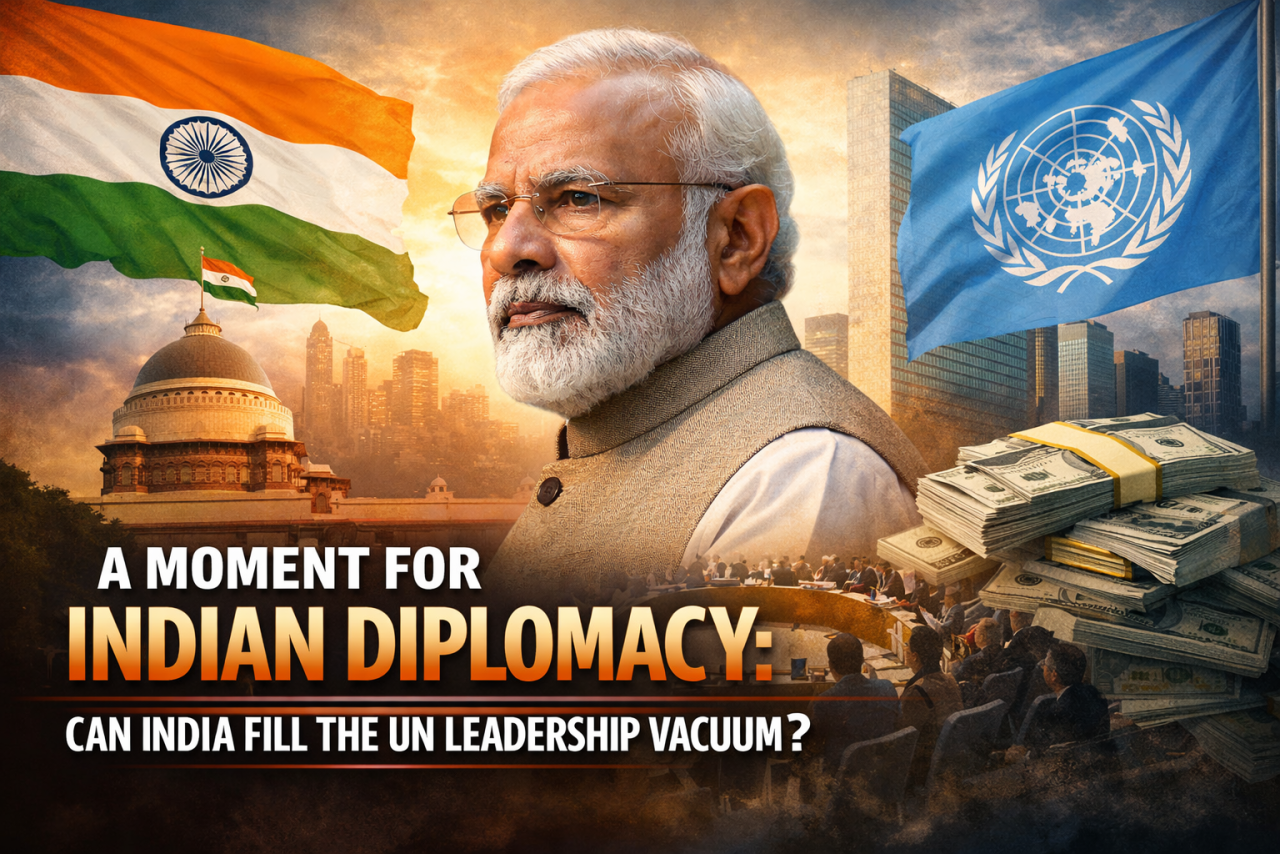
The decision by the United States to significantly cut its financial contributions to the United Nations has triggered anxiety across the global humanitarian system. Yet, every geopolitical disruption creates a parallel opportunity. For India—now positioning itself as the world’s fourth-largest economy and a rising global power—this moment offers a rare chance to translate economic strength into diplomatic influence.
For decades, the UN’s financial architecture has been heavily dependent on Western donors, particularly the United States. Washington’s pullback, driven by domestic politics and a growing skepticism toward multilateral institutions, has exposed a structural vulnerability in global governance. But it has also opened space for emerging powers to redefine the balance of influence within the UN system. India, with its growing economic weight, demographic strength, and expanding diplomatic footprint, is uniquely placed to respond.
India’s claim to global leadership is no longer aspirational rhetoric. With a GDP crossing $4.18 trillion and projected to overtake Germany in the coming years, New Delhi increasingly presents itself as a voice of the Global South. Its presidency of the G20, emphasis on development-focused diplomacy, and advocacy for reform of global institutions reflect this ambition. However, leadership at the UN requires more than speeches—it demands tangible commitments.
Historically, India has contributed actively to UN peacekeeping missions, often supplying the largest number of troops among member states. This has earned India moral credibility, but financial leadership has remained limited. As US funding declines, New Delhi now has an opportunity to recalibrate its role by stepping up contributions to key UN agencies, particularly those working in development, health, food security, and climate adaptation. Doing so would not only stabilize vital humanitarian programs but also strengthen India’s leverage within multilateral decision-making.
Critics may argue that India, despite its growth, still faces pressing domestic challenges—poverty, infrastructure gaps, and employment pressures. This concern is valid. Yet global leadership does not require reckless spending; it requires strategic investment. Targeted funding, issue-based leadership, and coalition-building with other emerging economies can allow India to expand influence without overextending resources.
More importantly, India’s involvement could reshape the philosophical orientation of global aid. Unlike traditional Western donors, India brings a development model rooted in capacity-building rather than dependency. Its emphasis on digital public infrastructure, low-cost healthcare solutions, and south-south cooperation aligns with the needs of developing nations. If India channels these approaches through the UN system, it could push humanitarian governance toward more sustainable, locally driven outcomes.
Geopolitically, a stronger Indian role would also alter international power dynamics. At present, reduced US funding risks making UN agencies increasingly dependent on a narrow set of donors, which could politicize aid and undermine neutrality. India’s entry as a major contributor would help diversify funding sources and preserve multilateral balance. It would also reinforce India’s long-standing demand for reforms in global institutions, including its bid for a permanent seat on the UN Security Council.
This moment is also about narrative power. As India positions itself as a civilizational state with global responsibilities, stepping into the UN funding gap would signal maturity on the world stage. It would demonstrate that India is not merely benefiting from the international order but is prepared to sustain it.
Of course, success is not guaranteed. Any increased role must be backed by institutional capacity, diplomatic coordination, and domestic political consensus. But global leadership is rarely comfortable. It is claimed, not granted.
As the UN grapples with shrinking budgets and an uncertain future, the question is no longer whether India can afford to play a larger role. The real question is whether India can afford not to. If New Delhi rises to the occasion, the contours of international politics may indeed shift—marking the beginning of a more multipolar, representative global order with India firmly at its center.
By Gautam Jha
Managing Editor













Leave a Comment