
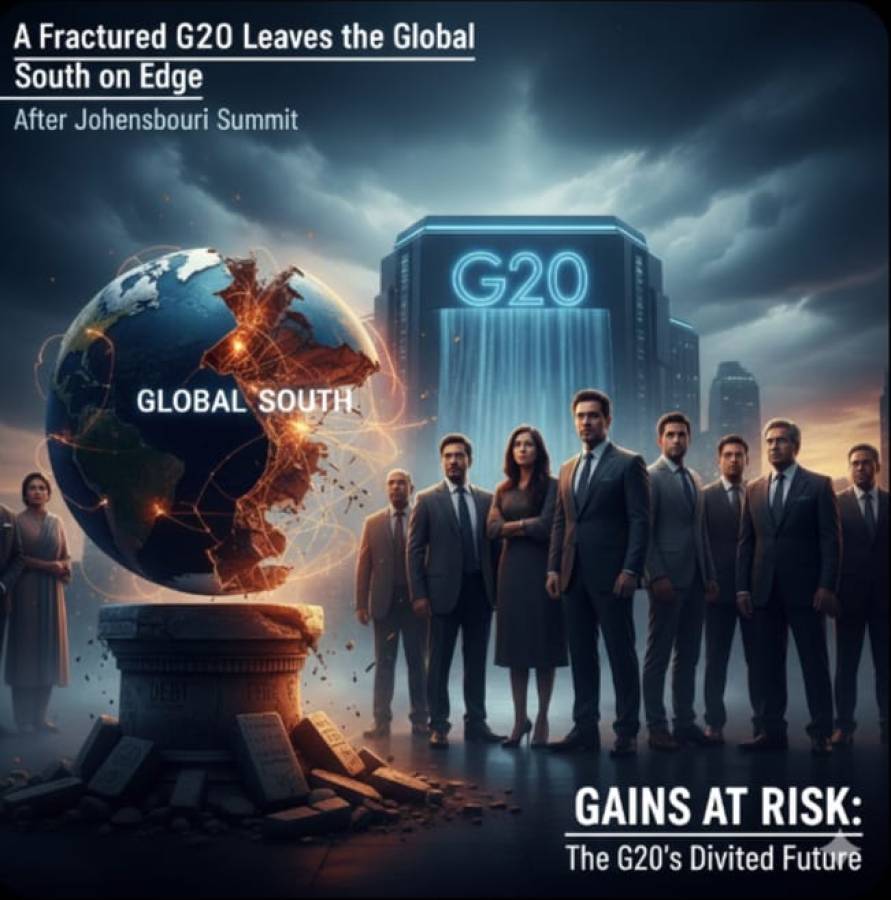
The Group of Twenty (G20) Summit, held in Johannesburg, South Africa, on November 22-23, unfolded under the ominous shadow of escalating global geopolitical tensions. While hailed by the host as a success for adopting a declaration despite the US boycott, the event brought to the fore deep-seated divisions and raised profound questions about the future comity of the G20, particularly regarding the gains secured by the Global South.
The Johannesburg Summit marked the culmination of a four-year cycle of G20 presidencies held by developing countries—Indonesia, India, Brazil, and South Africa. This continuity provided a unique platform to bring the concerns of the Global South to the forefront, addressing critical issues like debt sustainability, climate change finance, disaster resilience, and the use of critical minerals for African growth. India’s presidency, in particular, helped bridge a long-standing gap in inclusivity by successfully inducting the African Union into the G20, thus amplifying the collective voice of developing nations.
The Boycott and the Shifting Centre of Gravity
Despite this momentum, the South African summit was marred by the boycott of the US and the absence of several key leaders, including the presidents of Russia, China, Argentina, and Mexico. The US, scheduled to host the G20 in 2026, expressed strong objections to South Africa’s thematic focus on “Solidarity, Equality, and Sustainability,” controversially labelling it "anti-Americanism."
The most critical political maneuver came when the US skipped the summit and attempted to discredit South Africa by raising historical issues. Nevertheless, the majority of the G20 members proceeded, eventually adopting a declaration. T.S. Tirumurti, former Ambassador/Permanent Representative of India to the UN, notes that the summit’s outcome affirms that the announcements of the death of multilateralism are premature. However, the lack of an explicit condemnation of Russia in the final text—mirroring similar diplomatic compromises in previous summits—underscored the difficulty of achieving true consensus when major geopolitical fissures exist. The challenge of balancing Western demands with the sensitivities of the Global South, many of whom maintain neutral or non-aligned positions, remains a constant obstacle to a fully unified G20.
The Looming Threat of the 2026 US Presidency
The main concern now gripping the Global South is the potential erosion of their hard-won gains under the upcoming US presidency in 2026. The incoming administration has reportedly pledged to radically reduce the scope of the G20, explicitly threatening to curtail crucial developmental and humanitarian issues that have been central to the agendas of Indonesia, India, Brazil, and South Africa. The US objective appears to be shifting the G20’s focus back to its original mandate of purely economic and financial issues, potentially sidelining topics like energy transition, food security, and technology-sharing for the developing world.
This planned contraction of the G20’s mandate would be viewed as a significant setback for developing countries, effectively renewed marginalization after years of striving for greater inclusivity. The prospect of the G20 meeting in Miami in 2026 becoming an event where the development concerns of the South are marginalized is a genuine threat to the institution’s credibility as a forum for global governance.
Protecting the Sanctity of Global Institutions
In this volatile and disruptive global environment, the responsibility to protect the sanctity and inclusivity of global institutions falls increasingly on middle powers like India and Brazil. These nations must take the lead in ensuring that the G20 does not revert to being a forum solely dictated by the interests of a select few. The current geopolitical, geo-technological, and geo-economic disruption necessitates robust multilateral mechanisms that are representative and sensitive to the needs of the majority of the world's population.
The future health and relevance of the G20 depend on its ability to maintain a focus on humanism, viewing the individual, society, and nature as a single integrated ecosystem—a guiding principle essential for sustainable growth. If the modest gains of the Global South are allowed to be lost in 2026, the G20 risks becoming a political instrument rather than a genuine platform for collective global problem-solving. It is up to the current and future presidencies to safeguard the G20's potential as a truly transformative force.
The future of the G20 is intertwined with the future of the Global South.














Leave a Comment