
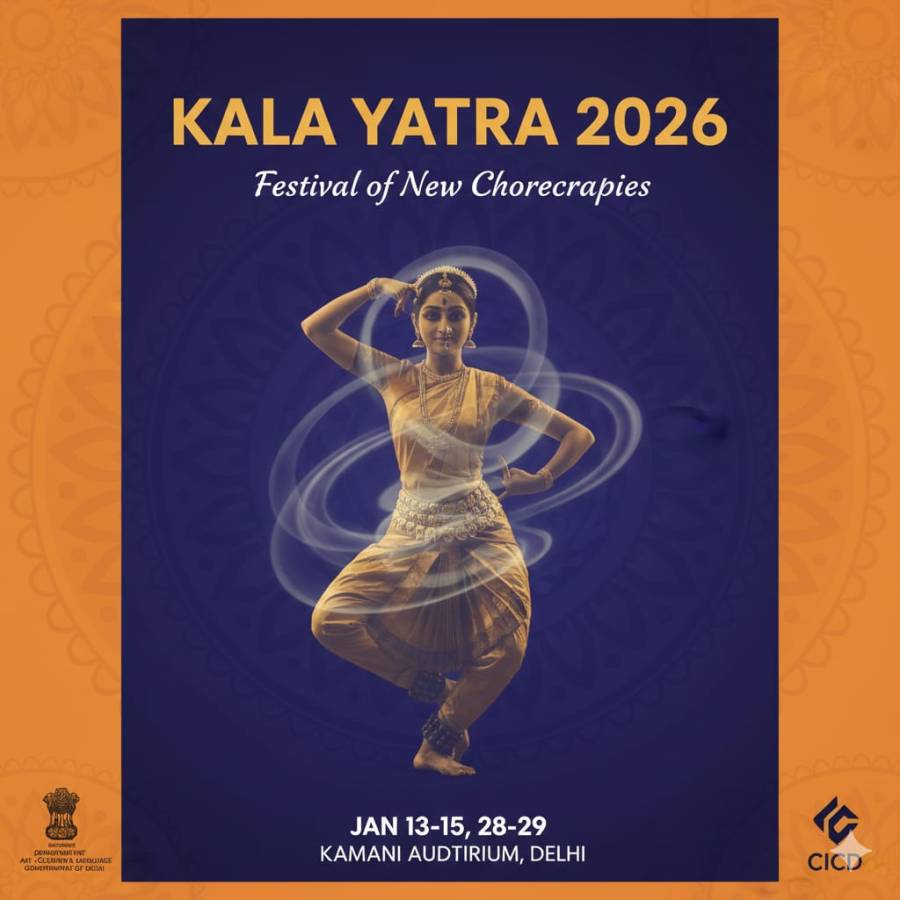
As winter settles into Delhi and the evenings grow sharper, Kamani Auditorium is getting ready for a different kind of warmth—one created by movement, memory, and creative risk. The Festival of New Choreographies – Kala Yatra 2026, curated by Padma Vibhushan awardee Dr. Sonal Mansingh, is not merely another cultural event in the city’s crowded calendar. It marks an important moment in how Indian classical dance continues to rethink itself.
Presented by the Department of Art, Culture & Language, Government of Delhi, in collaboration with the Centre for Indian Classical Dances (CICD), the festival unfolds across five evenings—January 13, 14, 15, 28, and 29. Together, they promise something rare: not just performances, but ideas in motion.
Tradition as a Living River
At a time when “modernisation” is often mistaken for abandoning the past, Dr. Sonal Mansingh offers a quieter, deeper perspective. “This festival is not merely a cultural event; it is a civilisational dialogue,” she says. For her, tradition is not frozen in time. It is something that must move, respond, and adapt if it is to remain alive.
Kala Yatra 2026 brings together ten original choreographies that use classical vocabulary to speak about contemporary concerns. Mythology, ecology, identity, and social responsibility run through the festival’s themes. The opening production, Amrut-Manthan, directed by Mansingh herself, revisits the ancient image of the churning of the ocean—not as spectacle, but as a metaphor for the conflicts and contradictions of the present moment.
Highlights: From Myth to Social Reality
What sets Kala Yatra apart is its willingness to ask uncomfortable and timely questions without losing artistic discipline. The festival moves easily between the sacred and the everyday.
One of the most closely watched performances will be Matrika by the Rainbow Dance Troupe from Barasat. As a professional LGBTQ+ ensemble, their presence on a classical stage is significant. By interpreting the power of Shakti and the symbolism of the nine devis, the group quietly but firmly expands who gets to claim space within classical traditions.
Environmental concerns also find a strong voice. Athijeevanam, choreographed by Guru T.B. Jagadeesan, uses the intense physical language of Kathakali to address ecological survival. In an era marked by climate anxiety, the piece shows how classical forms can confront modern crises without diluting their grammar.
Another recurring theme is complexity—especially in how epics are read. Works such as Ratikant Mohapatra’s Duryodhana and Shriram Bharatiya Kala Kendra’s Chakravyuha resist easy moral binaries. Instead of heroes and villains, these productions explore flawed, conflicted human beings shaped by circumstance, ambition, and fate.
A Legacy in Frames
Beyond the performances, Kala Yatra 2026 also pauses to reflect on history. In the foyer of Kamani Auditorium, a pictorial exhibition traces the 49-year journey of the Centre for Indian Classical Dances. Founded in 1977, CICD’s story is one of sustained research, training, and commitment to keeping classical dance relevant without stripping it of depth.
The exhibition adds context to the festival, reminding visitors that innovation does not appear overnight. It grows out of decades of discipline, debate, and experimentation.
Why This Festival Matters
Kala Yatra 2026 is not only for seasoned rasikas. It also speaks to first-time viewers curious about how classical arts engage with contemporary life. Across generations—senior gurus and emerging performers alike—the festival circles a shared question: how does an ancient art form speak honestly to the present?
The answers are not uniform, and that is precisely the point. Kala Yatra creates space for disagreement, reinterpretation, and renewal.
Catch It Live: Essential Details
If you are anywhere near Mandi House this January, Kala Yatra 2026 is worth experiencing in person. It is less about spectacle and more about conversation—between past and present, discipline and experimentation, tradition and change.
Festival Details
- What: Festival of New Choreographies – Kala Yatra 2026
- Where: Kamani Auditorium, 1 Copernicus Marg, Mandi House
- When: January 13, 14, 15, 28, and 29
- Time: 6:30 PM onwards
- Nearest Metro: Mandi House (Blue & Violet Lines)
- Entry: Open to all (non-ticketed; seating subject to availability)






















Leave a Comment