
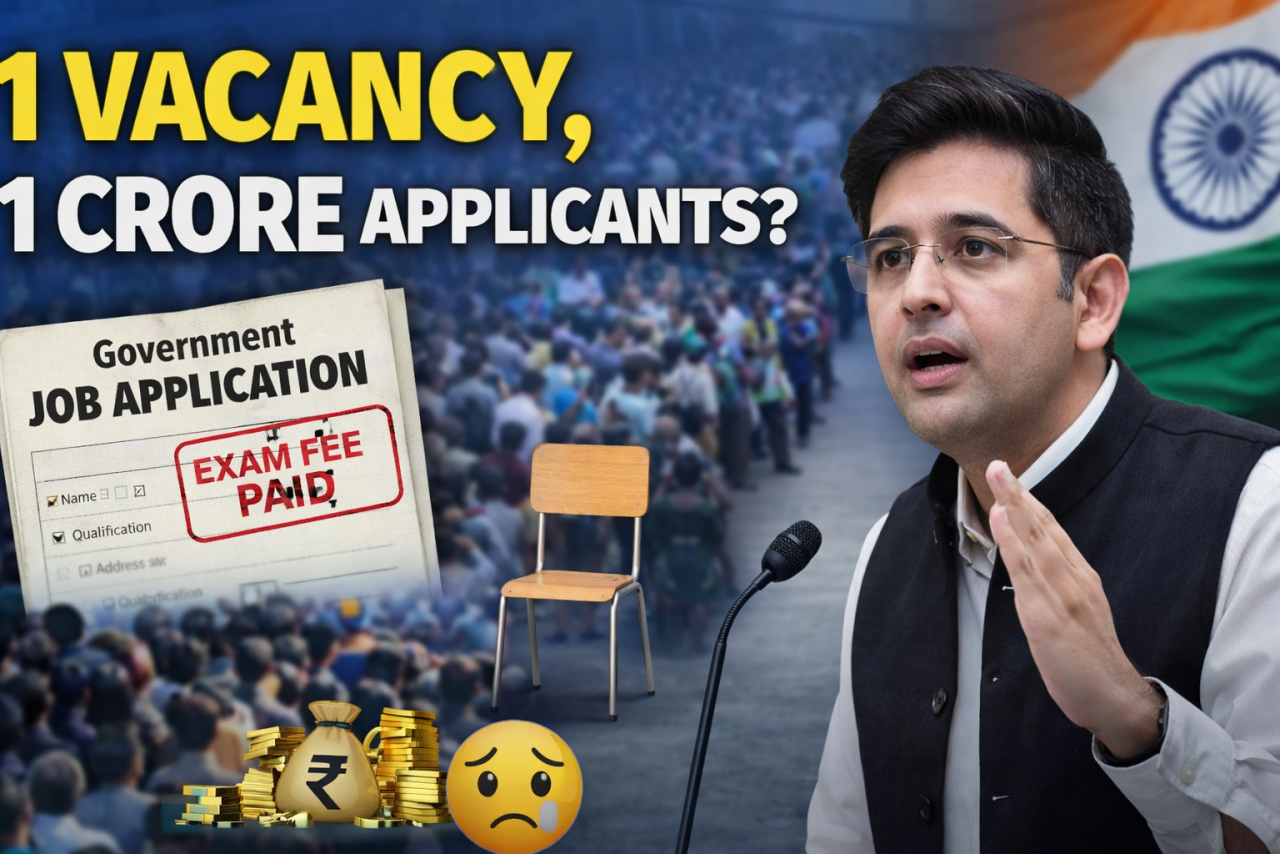
When a single job draws a crore applicants, the real question isn’t who gets selected—it’s who is paying the price for a system stretched beyond its limits.
When Raghav Chadha questioned why governments should earn from the desperation of the unemployed, it struck a nerve across India. His remark—framed around the stark reality of “1 vacancy, 1 crore applicants, and 0 refunds”—has reignited a long-standing debate on the fairness, efficiency, and financial burden of India’s recruitment ecosystem.
India’s employment challenge is not new, but the scale has become increasingly alarming. According to data from the Centre for Monitoring Indian Economy (CMIE), India’s unemployment rate has fluctuated between 7–9% in recent years, with youth unemployment often exceeding 20%. Each year, millions of graduates and school-leavers enter the job market, but the number of secure, formal-sector jobs—particularly government jobs—remains limited.
This imbalance is most visible in government recruitment exams. A widely cited example is the Railway Recruitment Board (RRB) exams, where over 1.25 crore candidates applied for around 35,000 posts in 2019. Similarly, state-level exams frequently see application numbers running into lakhs or crores for just a few thousand vacancies. The Staff Selection Commission (SSC) and various state public service commissions report similar trends, highlighting a systemic mismatch between supply and demand.
At the heart of the controversy lies the application fee. Typically ranging from ₹100 to ₹500 per exam, the fee may appear modest in isolation. However, for candidates applying to multiple exams across different agencies, the cumulative cost becomes significant. For aspirants from economically weaker backgrounds, this repeated expenditure—often without any guarantee of timely exams or results—can be financially draining.
The issue becomes more contentious when exams are delayed, canceled, or marred by irregularities. Over the past decade, multiple recruitment processes across states have faced allegations of paper leaks, administrative lapses, or prolonged delays. In such cases, candidates rarely receive refunds, effectively turning application fees into sunk costs. Critics argue that this creates a system where the financial risk is entirely borne by applicants, while institutions face limited accountability.
Data from parliamentary discussions and audit reports suggest that examination bodies generate substantial revenue from application fees. While exact figures vary, large-scale exams with millions of applicants can generate tens to hundreds of crores in revenue. Governments and agencies defend these fees by citing the high cost of conducting examinations—logistics, infrastructure, invigilation, security, and digital systems all require significant investment.
Indeed, organizing a nationwide exam is a massive operational exercise. For example, computer-based tests require setting up secure test centers, ensuring data integrity, and deploying monitoring mechanisms to prevent malpractice. In recent years, authorities have also invested in biometric verification and AI-based surveillance systems to enhance transparency. These measures, while necessary, increase the overall cost of recruitment.
However, the core question remains: should these costs be disproportionately transferred to applicants, especially in a country where job scarcity is acute? Many experts argue that the current model effectively monetizes demand for jobs without guaranteeing efficiency or fairness.
There are, however, emerging ideas to address these concerns. One proposal is a “one-time registration” system, where candidates pay a single fee to apply for multiple exams over a defined period. Another suggestion is income-based fee waivers or subsidies for economically weaker sections, ensuring that financial constraints do not limit access to opportunities.
Technology could also play a transformative role. A unified national recruitment platform—similar to the National Recruitment Agency’s Common Eligibility Test (CET) proposal—aims to streamline the process, reduce duplication, and lower costs for both candidates and authorities. If implemented effectively, such systems could reduce the frequency of exams and, consequently, the financial burden on aspirants.
Transparency is equally critical. Timely communication, strict timelines for exams and results, and accountability in cases of cancellation or irregularities can restore trust in the system. Refund policies, or at least partial compensation in cases of administrative failure, could also be considered as a fairness measure.
Ultimately, the “1 vacancy, 1 crore applicants” phenomenon is not just about numbers—it reflects deeper structural issues in India’s economy. The overwhelming demand for government jobs points to a lack of sufficient private-sector opportunities, concerns over job security, and the enduring appeal of stable public employment.
As the debate sparked by Raghav Chadha continues, it serves as a reminder that recruitment is not merely an administrative process—it is a gateway to economic mobility for millions. Striking the right balance between cost recovery and fairness will be essential in ensuring that this gateway remains accessible, transparent, and just.


























Leave a Comment