
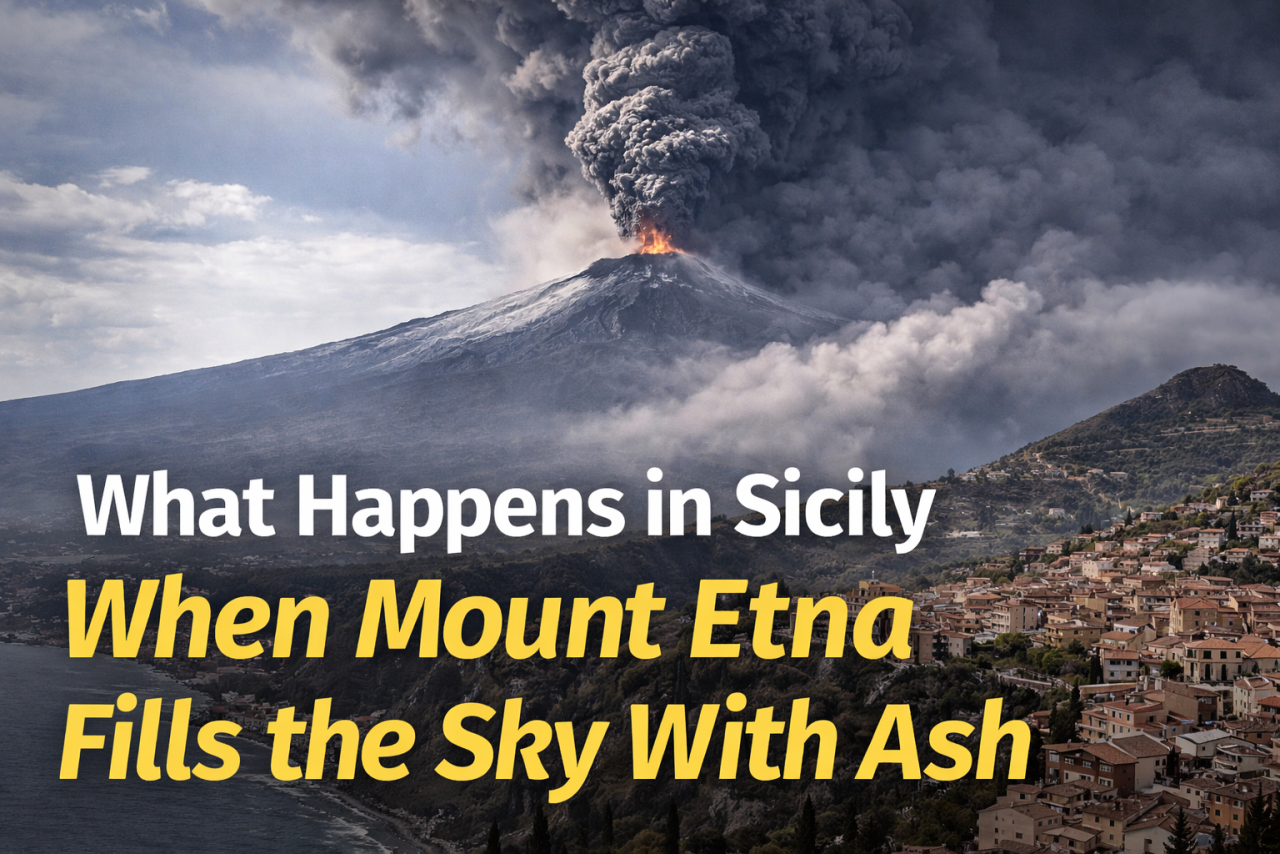
There is a certain familiarity in Sicily when Mount Etna sends ash and smoke into the sky. For the people living on Europe’s most active volcano, an eruption is not just a breaking news event but a reminder of a long-standing relationship with the land beneath their feet. Etna is watched closely, respected deeply, and adjusted regularly. The latest activity has once again shown how life on this island bends, but rarely breaks, when the mountain stirs.
The recent episode began with underground tremors detected by monitoring stations positioned around Etna. These small but persistent vibrations are often the first sign that magma is moving below the surface. Soon after, ash clouds and incandescent material rose from the volcano’s north-eastern crater, marking another phase in Etna’s ongoing cycle of eruptions. Thick grey plumes climbed into the air, visible from towns along the coast and from planes approaching eastern Sicily.
Ashfall followed quickly, carried by the wind toward the northeast. Areas such as Taormina and the slopes near Piano Provenzana experienced a light but steady settling of volcanic dust. Streets, cars, balconies, and fields were coated in a fine grey layer. In tourist centres, the usually clear views of the sea were replaced by a hazy skyline. For residents, this meant sweeping doorsteps, protecting water tanks, and limiting outdoor activities for a day or two.
Italy’s National Institute of Geophysics and Volcanology (INGV) confirmed that the activity was centred on the Bocca Nuova crater. Their observations recorded intermittent explosions that threw molten rock several metres into the air. These bursts, while visually striking, are a routine part of Etna’s behaviour. Scientists continue to monitor gas emissions, seismic activity, and ground deformation to assess whether the eruption is likely to intensify or slowly subside.
As ash spread across parts of eastern Sicily, local authorities moved into a familiar mode of preparedness. Alert levels were raised to ensure coordination between civil protection agencies, emergency services, and local administrations. This step does not automatically signal danger, but it ensures that responses can be scaled up quickly if conditions change. Flights may be delayed, roads monitored, and public advisories issued, depending on wind direction and ash density.
For people who live near Etna, ashfall is inconvenient but not shocking. Many Sicilians have grown up with eruptions as part of their environment. Schools sometimes close temporarily, and people are advised to wear masks or avoid driving when ash thickens on roads. Older residents often describe these moments as interruptions rather than disasters, unless lava flows threaten homes directly.
Culturally, Mount Etna occupies a unique place in Sicilian life. Locals often call it “A Muntagna,” simply “The Mountain,” a name that reflects both familiarity and respect. Etna’s eruptions have shaped the island’s geography for thousands of years, building land while also destroying it. Villages, farms, and vineyards exist because of the volcano’s fertile soil, enriched by layers of mineral-rich ash.
Farmers in particular understand the double-edged nature of Etna’s activity. Fresh ash can damage crops in the short term, especially when it is heavy, but over time it replenishes the soil. Vineyards around Etna are among the most productive and distinctive in Italy, producing wines that owe much of their character to the volcanic terrain. This long-term benefit shapes how many locals perceive ashfall—not as a curse, but as part of a cycle.
Mount Etna stands at roughly 3,400 metres, though its height changes frequently due to eruptions and collapses at the summit. Each episode subtly reshapes the mountain, reminding residents that the landscape itself is never fixed. Living here means accepting uncertainty as a constant.
As the ash cloud gradually disperses over the Mediterranean and seismic activity stabilises, daily life in Sicily begins to return to normal. Streets are cleaned, flights resume, and the volcano slips back into the background. But it is never forgotten. Etna remains a watchful presence, quiet for now, yet always capable of filling the sky with ash again—and Sicily remains prepared to respond when it does.























Leave a Comment