
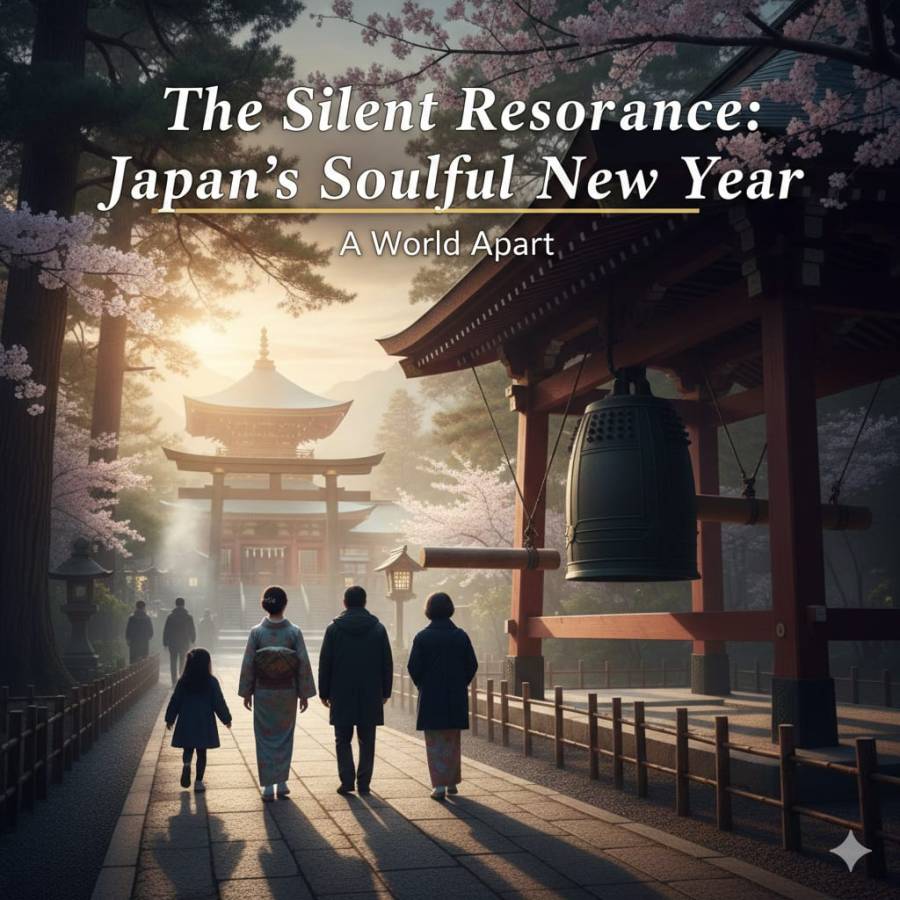
Across much of the world, the New Year arrives loudly. Fireworks explode in the sky, music fills public squares, and people count down the final seconds with raised glasses and shouted hopes. The night is about release, noise, and spectacle. In Japan, the moment feels very different. As the calendar turns, the country steps into the New Year quietly, with intention and calm. Instead of celebrating the end of something, Japan focuses on the careful beginning of what comes next.
In Japan, New Year, or Shogatsu, is not treated as a single night of excitement. It is seen as a spiritual reset, a time to pause, clear away what no longer belongs, and make space for renewal. The idea of purity runs through everything, shaped by centuries of Shinto and Buddhist thought. It is not about doing more, shouting louder, or consuming endlessly. It is about simplicity, order, and reflection.
Around the world, New Year traditions often lean toward dramatic gestures. In Denmark, people throw old plates against the doors of friends and family, believing broken porcelain brings good luck. In parts of Italy, old furniture was once thrown out of windows to symbolically remove the past. Elsewhere, people jump into freezing water, dance through the streets, or stay up all night drinking and singing. These customs are powerful in their own way, but they rely on action and noise.
Japan chooses a different path. In the weeks leading up to New Year’s Day, homes, offices, schools, and temples take part in Osouji, or the big cleaning. This is not rushed or casual. Every corner is addressed. Dust is removed, clutter is sorted, and broken items are repaired or respectfully discarded. The cleaning is physical, but it is also emotional. It represents letting go of the weight carried from the previous year. The belief is simple: you cannot welcome something new into a space that is already full.
This act of cleaning is closely tied to the idea of welcoming Toshigami, the New Year deity believed to bring good fortune. A clean space shows respect, not just for tradition, but for life itself. Instead of destruction, Japan practices restoration. Instead of chaos, it seeks balance. The aim is to step into the New Year with clarity, not excess.
When the New Year finally arrives, millions of people take part in Hatsumode, the first visit to a shrine or temple. Despite the huge crowds, the atmosphere remains calm. People wait patiently in long lines, often in the cold of early morning. There is no pushing, shouting, or urgency. Each person approaches the shrine quietly, offers a coin, bows, claps, and makes a silent wish or prayer.
Compared to New Year rituals elsewhere, the contrast is striking. In Brazil, crowds gather by the ocean dressed in white, jumping over waves and offering flowers to the sea. In colder countries, people leap into icy lakes to shock their bodies into a sense of rebirth. These acts are full of energy and movement. In Japan, the energy turns inward. The power comes from stillness.
At midnight, the difference becomes even clearer. While cities around the world explode with fireworks and countdowns, Japan listens to bells. This ritual, known as Joya no Kane, involves temple bells being struck exactly 108 times. In Buddhist belief, humans are burdened by 108 earthly desires and distractions. Each bell ring symbolizes releasing one of these attachments.
The sound is deep and slow, carrying across neighborhoods. It does not excite the senses; it grounds them. People listen rather than cheer. The bell does not mark victory or celebration. It marks release. As the sound fades, there is a feeling of emptiness, but not loss. It is the kind of emptiness that makes room for peace.
Even food during the New Year reflects this mindset. While many cultures celebrate with large feasts and constant cooking, Japan prepares Osechi-ryori in advance. These dishes are carefully arranged in lacquered boxes and eaten over the first few days of the year so that cooking can be avoided. This reduces noise, effort, and distraction, allowing families to rest and reflect together.
Each dish carries meaning. Black soybeans represent health and hard work. Herring roe symbolizes family growth and continuity. Dried sardines stand for a good harvest. Nothing is random. Eating becomes an act of quiet gratitude rather than indulgence. Meals are shared slowly, often without conversation dominating the room.
Another powerful moment of the Japanese New Year is watching the first sunrise, known as Hatsuhinode. People wake early, travel to the coast, climb hills, or gather on rooftops just to stand silently as the sun rises. There is no countdown, no cheering. The rising light itself is enough. It marks the true beginning of the year, reminding people that every cycle starts gently, not suddenly.
What makes Japan’s New Year so striking is not what is added, but what is removed. Noise, clutter, pressure, and excess are intentionally set aside. In a world that is constantly connected, constantly demanding attention, this approach feels rare. Japan shows that renewal does not need to be dramatic. It can be quiet. It can be thoughtful.
The Japanese New Year teaches a simple lesson. To move forward, we do not always need to make a scene or prove our joy. Sometimes, the most meaningful way to begin again is to clean our surroundings, calm our minds, and listen. In silence, Japan finds its strongest form of celebration.
And perhaps that is why, long after the bells fade, the feeling of the Japanese New Year stays with you. It does not overwhelm. It settles.





























Leave a Comment